

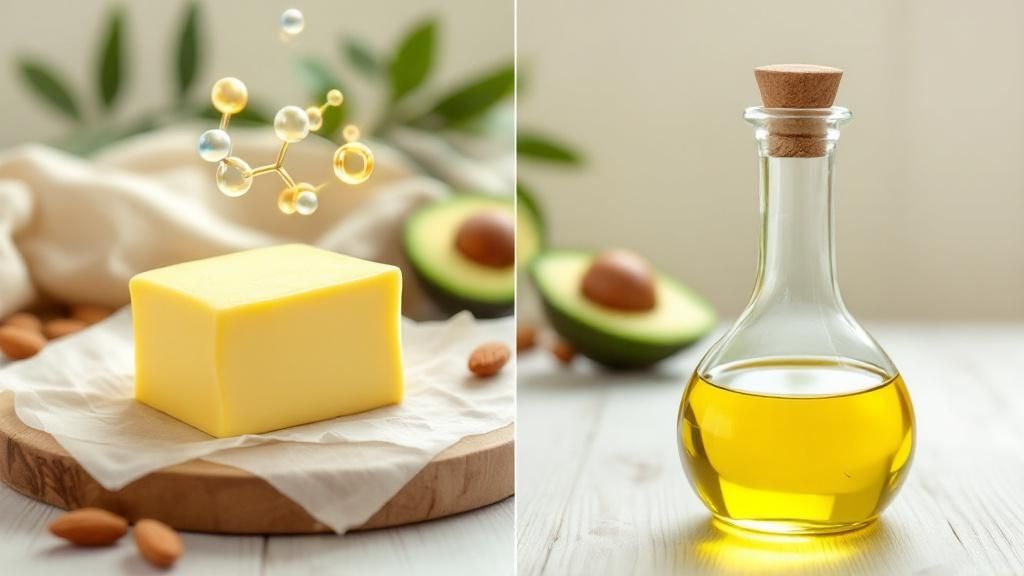
The essential difference between saturated and unsaturated fatty acids lies in their chemical structure: Saturated fats have no double bonds, while unsaturated fats have at least one. While this might sound like pure chemistry, it has very practical implications for your everyday life – for example, why butter is solid at room temperature but olive oil remains liquid.
What truly separates saturated and unsaturated fatty acids
When you stand in the supermarket aisle, wondering which oil or spread to put in your basket, you often make a small decision for your health. But what do these terms on the packaging actually mean? The key lies in the molecular structure.
Just imagine a chain of carbon atoms. In saturated fatty acids, every link in the chain is fully occupied by hydrogen atoms – the chain is said to be "saturated." This straight, rigid structure allows the molecules to pack tightly together. The result? They are solid at room temperature, as you know from butter or coconut fat.
In unsaturated fatty acids, there is at least one double bond, which acts like a small kink in the chain. This kink introduces disorder into the system and prevents the molecules from packing densely. That's why they remain liquid – typical for olive or rapeseed oil.
This infographic shows you the crucial differences at a glance, from the number of double bonds to the melting point.

Here you can clearly see how a small chemical deviation leads to large physical differences. These differences are also crucial for the role fats play in your body.
Fatty acids in direct comparison
To make your daily choices easier, we have summarized the most important points in a table.
Fatty Acids in Direct Comparison A quick overview of the key differences between saturated and unsaturated fatty acids.
| Characteristic | Saturated Fatty Acids | Unsaturated Fatty Acids |
|---|---|---|
| Chemical Bond | No double bonds | At least one double bond |
| State at 20 °C | Mostly solid | Mostly liquid |
| Main Sources | Animal products, coconut fat | Vegetable oils, nuts, fish |
| Health Focus | Consume in moderation | Prefer to consume |
This fundamental difference in structure significantly influences how your body processes fats. For this very reason, the German Nutrition Society (DGE) recommends limiting the proportion of saturated fatty acids to a maximum of 10% of your daily energy intake. This can noticeably reduce the risk of cardiovascular diseases.
A simple rule of thumb for everyday life: Use solid fats more consciously and sparingly than liquid oils.
With this knowledge, you can make healthier choices much more easily in your daily life. If you want to delve deeper into the topic, check out our article on healthy and unhealthy fats.
How fats influence your health and weight

When it comes to fat, there's one crucial rule: not all fat is created equal. This is especially true when we look at how it affects your health and weight. The real difference between saturated and unsaturated fatty acids lies in how your body utilizes them and what signals they send to it.
Eating many saturated fats can elevate levels of "bad" LDL cholesterol in the blood. This cholesterol tends to accumulate on the walls of your arteries, which can increase the risk of cardiovascular problems in the long run.
The situation is quite different with unsaturated fatty acids. They are the true stars for your health and an important ally if you want to keep your weight under control.
The power of unsaturated fatty acids
Unsaturated fats, especially polyunsaturated omega-3 and omega-6 fatty acids, are essential for your body – they are also called essential. Your body cannot produce them itself and relies on you to get them through your diet.
Their positive effects are truly impressive and well-researched. They tackle health on several fronts at once:
- They fight inflammation: Omega-3 fatty acids help to alleviate silent inflammation in the body. Such inflammation can slow down your metabolism and make losing weight unnecessarily difficult.
- They are good for the heart: They help maintain normal cholesterol levels and ensure that your blood vessels remain elastic.
- They nourish your brain: Your brain is largely made up of fat. Omega-3 fatty acids are therefore super important for your concentration and cognitive performance.
- They help with weight management: Healthy fats are very satisfying and keep you full for a long time. This helps you control cravings and better manage your calorie intake.
A simple swap from saturated to unsaturated fats is one of the most effective steps for your health. Even small changes in your daily life, such as using olive oil instead of butter, can make a huge difference.
Fats as allies in weight loss
Many people who want to lose weight make the mistake of completely eliminating fats from their diet. But this backfires. Your body needs healthy fats to absorb fat-soluble vitamins A, D, E, and K, which are absolutely crucial for countless metabolic processes.
A balanced diet with a high proportion of unsaturated fatty acids is therefore a central building block for your long-term success. Ultimately, it's about the right balance of nutrients. If you're looking for inspiration for delicious and figure-friendly dishes, check out our article on the best healthy diets and recipes for losing weight. There you'll find great tips on how to easily incorporate the right fats into your daily routine and optimally support your body on its journey to your desired weight.
The best sources for healthy unsaturated fats
Okay, enough theory – where can you actually find these "good" unsaturated fats in everyday life? The good news is that a fat-conscious diet doesn't have to be complicated or boring. On the contrary, it's often incredibly delicious. It's not about giving up everything, but simply making smarter choices.
Plant-based foods, in particular, are often true powerhouses when it comes to healthy fats. Those who deliberately integrate them into their diet do their bodies good and provide them with important nutrients that promote well-being and health.
Plant power for your body
The selection of foods rich in monounsaturated and polyunsaturated fats is huge. Here are a few favorites that you can easily incorporate into your daily routine:
- High-quality vegetable oils: Olive, rapeseed, and flaxseed oil are fantastic all-rounders in the kitchen. My tip: A spoonful of flaxseed oil in your morning muesli or smoothie is a super easy way to increase your intake of omega-3 fatty acids.
- Nuts and seeds: Walnuts, almonds, chia, or flax seeds are not only a perfect snack for in between meals. They also enhance any salad, yogurt, or homemade bread and provide valuable fiber.
- Avocados: This creamy fruit is a star among providers of monounsaturated fatty acids. Whether as a spread, in a salad, or as the base for a quick dip – avocado always works.
Even small examples show how big a difference the right choice makes. A handful of walnuts (approx. 20 g) provides an impressive 10.4 g of polyunsaturated fatty acids. A comparable amount of chocolate contains only 0.2 g. This clearly shows how much control you have over your fat intake.
A small swap with a big impact: Try replacing the butter on your bread with mashed avocado or a high-quality nut butter. This way, you'll start your day much healthier.
Utilize animal sources strategically
Of course, there are also animal products that provide us with valuable fats – especially omega-3 fatty acids. Cold-water fish such as salmon, mackerel, or herring play an important role here. Ideally, they should be on your plate once or twice a week.
Such small, conscious decisions are a crucial step towards greater well-being. You can find more tips on this in our article on five healthy habits for weight loss.
And if everyday life is too hectic to always pay attention to the perfect diet, our Omega-3 capsules from bodysperfect.com can be a really practical supplement to ensure your body still gets what it needs.
Where unhealthy fats hide in everyday life
Saturated fats are not inherently bad, but in our modern diet, we often eat far too much of them. The real problem? They hide in places you wouldn't necessarily expect. This is where knowing the difference between saturated and unsaturated fatty acids helps to spot these little traps.
Heavily processed foods, in particular, are masters of disguise. The quick frozen pizza, the ready-meal for lunch, or the chocolate bar for a snack – they all often contain enormous amounts of saturated fats. These not only make the products tastier but also give them a longer shelf life. A quick glance at the nutrition label reveals the truth.
Typical fat traps in focus
Pay special attention to foods that don't look particularly fatty at first glance. It's usually the everyday little things that add up at the end of the day.
- Baked goods & sweets: Croissants, cookies, or cakes from the bakery are often full of butter, lard, or palm oil. All of them are rich in saturated fatty acids.
- Sausage & meat products: Salami, liver sausage, and generally fatty cuts of meat are classic sources. Lean poultry or even a plant-based spread are smart alternatives here.
- Dairy products: Full-fat cheese, cream, and of course butter also bring a good portion. Lower-fat versions can be a good choice if you don't want to give them up entirely.
- Ready-made sauces & dressings: Creamy sauces and ready-made salad dressings, in particular, are often packed with hidden fats and sugar, just to boost the flavor.
A common fallacy is supposedly healthy snacks. Many a muesli bar turns out, on closer inspection, to be a pure calorie bomb that, due to added fats and sugar, provides more saturated fatty acids than a handful of nuts.
Sugar and fat: A dangerous duo
It becomes really problematic when a lot of saturated fat meets a large amount of sugar – a combination found in countless processed products. This mix can trigger cravings and makes it significantly harder to control your weight. We show you how harmful sugar can really be in our article on the effects of sugar on the body.
The key to everything is making conscious choices. If you learn to read labels correctly and opt for fresh, unprocessed foods more often, you regain control and cleverly navigate around the fat traps of everyday life.
Finding the right balance for your diet plan
Now you know the theory – the differences between saturated and unsaturated fatty acids. But what really matters is practice. It's not about completely banning fats, but about making conscious and clever decisions for your health and your goals in everyday life.
The good news: even small adjustments can make a huge difference. You don't have to completely change your diet overnight. Instead, focus on a few simple swaps that can be easily integrated into your daily routine.
Your roadmap for smart fat choices
A balanced plate is the best compass here. Just imagine building your meals according to a few simple basic rules. This way, you'll intuitively find the right balance of fats and at the same time secure all important nutrients.
- The base: vegetables. Half of your plate should always be filled with colorful vegetables or salad. This provides valuable fiber, vitamins, and is very filling.
- Important proteins: A quarter of the plate is reserved for a high-quality protein source – think lean meat, fish, legumes, or tofu.
- Complex carbohydrates: The last quarter belongs to energy providers like whole grains, potatoes, or quinoa.
- And the fat? This is where you make a conscious decision. A tablespoon of good vegetable oil (like olive or rapeseed oil) for salad or cooking, a small handful of nuts as a topping, or a few slices of avocado perfectly rounds off your meal.
A simple but crucial thought: Don't see fat as an enemy. Understand it as an important flavor carrier and nutrient that you use specifically – quality over quantity.
How our eating habits have changed
This conscious fat selection is more important today than ever before. A look back shows how much the diet in Germany has changed. In the 1960s and 1970s, saturated fats from butter and lard often dominated the diet.
Only later did the health benefits of unsaturated fatty acids increasingly come to the fore. This shift has led to the increased popularity of vegetable oils and margarine and underscores the importance of informed food choices. If you are interested in the official recommendations, you can find more information in the DGE's fat guideline.
If you learn to enjoy saturated fats in moderation and use unsaturated fats strategically, you take control of your diet. This lays the foundation for achieving your health and weight loss goals successfully and, most importantly, long-term.
Frequently Asked Questions about Fatty Acids
Here we clarify the questions that arise most frequently in everyday life. This way, we eliminate any remaining ambiguities and give you quick, clear answers so that you can optimally use the differences between saturated and unsaturated fatty acids for yourself.
Is coconut oil really a superfood?
Coconut oil is often touted as a healthy miracle cure, but the reality is a bit more complex. It consists of over 90% saturated fatty acids, which chemically makes it more similar to animal fats than most vegetable oils. While it contains medium-chain triglycerides (MCTs) that the body metabolizes differently, the main component is lauric acid, which behaves more like a long-chain fatty acid.
In moderation, coconut oil is perfectly fine in the kitchen, especially if you want to fry at high temperatures. However, it should not be your primary fat source. Oils like rapeseed or olive oil offer a significantly better fatty acid profile for your heart health.
Coconut oil is not a miracle cure, but it's not a pure villain either. Consider it a delicacy for certain dishes, not as the basis of your daily fat intake.
Does low-fat automatically mean healthier?
No, this myth persists. Many "low-fat" or "light" products often compensate for the loss of flavor with added sugar or artificial flavors. This can actually be unhealthier in the end and promote cravings. Your body needs healthy, unsaturated fats to absorb fat-soluble vitamins and to create a long-lasting feeling of fullness.
How much fat is ideal per day?
There is no one-size-fits-all answer here, as your needs depend on your age, weight, and activity level. A good rule of thumb from the German Nutrition Society (DGE) states that about 30% of your daily calories should come from fat.
However, the quality is much more important than the exact amount:
- Saturated fats: should not make up more than 10% of your total energy.
- Unsaturated fats: should form the majority of your fat intake, ideally from sources such as vegetable oils, nuts, and fish.
So focus less on avoiding fat and more on choosing the right fats. If you want to lose weight specifically and healthily, you will find further valuable strategies that are easy to implement in our guide on natural weight loss.
Do you want to specifically support your metabolism and achieve your weight loss goals more effectively? BODY'S PERFECT products have been developed with natural ingredients to support you on your journey. Discover our specially tailored solutions for your feel-good weight at https://bodysperfect.com.


































Share:
Fat Burner Test Stiftung Warentest: Results & Recommendations
L-Arginine: How it really boosts your fitness & health