


If you want to lose weight, you need to consume slightly fewer calories than your body expends throughout the day. The trick is to first determine your total calorie needs and then subtract a reasonable deficit of 300 to 500 calories. This is precisely what ensures healthy and, above all, sustainable weight loss.
The Science Behind Weight Loss – Simply Explained

Before we dive into the numbers, let's briefly understand the principle behind it. Weight loss isn't magic; it's simple physics. Imagine your body as an account: calories are the currency. You deposit them through eating and drinking, and you withdraw them through your bodily functions and every movement.
To lose weight, your account must be in the red at the end of the day. This means you need to spend more calories than you deposit. This forces your body to tap into its savings – stored body fat – to cover the deficit. This state is called a calorie deficit. It is the only scientifically proven method that truly works.
Why a Gentle Deficit is the Best Way
Have you ever wondered why radical crash diets almost always fail? They put the body into an actual state of alarm. The result is often cravings, nutrient deficiencies, and, even worse, the breakdown of valuable muscle mass. And less muscle means a slower metabolism.
The key is to be patient and consistent. A moderate deficit signals to your body that it should primarily use fat as an energy source while protecting muscles.
That's why finding the right balance is so important. Nutritionists recommend a daily deficit of 200 to a maximum of 500 kilocalories. This way, you avoid unpleasant side effects like constant fatigue or the dreaded muscle loss.
A well-thought-out calorie deficit is therefore the basis. If you combine this with a few good routines, nothing stands in the way of your success. Incorporating 5 healthy weight loss habits can additionally help you not only achieve your goals but also maintain them long-term. With this knowledge, you can better understand the following calculations and make conscious decisions for yourself and your health.
Find out what your body really needs
Okay, now we're getting down to business. To lose weight successfully, we need to know a very personal number: your total daily calorie expenditure, often called TDEE (Total Daily Energy Expenditure). This isn't rocket science, but simple logic that we will now go through step by step together. Think of this number as your personal starting point – from here, we will determine the appropriate calorie deficit.
Your total requirement consists of two parts: your Basal Metabolic Rate (BMR) and your Activity Energy Expenditure. The BMR is the energy your body uses at absolute rest – simply for breathing, heartbeat, and metabolic processes. The Activity Energy Expenditure is everything on top of that: from a walk to the bakery, to working at a desk, to an intense workout.
How to easily calculate your Basal Metabolic Rate (BMR)
Let's start with the foundation: your BMR. For this, we'll use one of the most proven formulas available – the Mifflin-St Jeor formula. It is considered quite accurate because it takes into account gender, weight, height, and age.
- For men: (10 × weight in kg) + (6.25 × height in cm) – (5 × age in years) + 5
- For women: (10 × weight in kg) + (6.25 × height in cm) – (5 × age in years) – 161
Let's illustrate with an example. Let's take Anna: She is 35 years old, 168 cm tall, and weighs 70 kg.
Her calculation would look like this: (10 × 70) + (6.25 × 168) – (5 × 35) – 161 = 700 + 1050 – 175 – 161 = 1414 kcal.
This is the amount of energy Anna's body would consume if she were to lie in bed all day.
The following graphic clearly shows how simple the path from basal metabolic rate to actual daily requirement is.
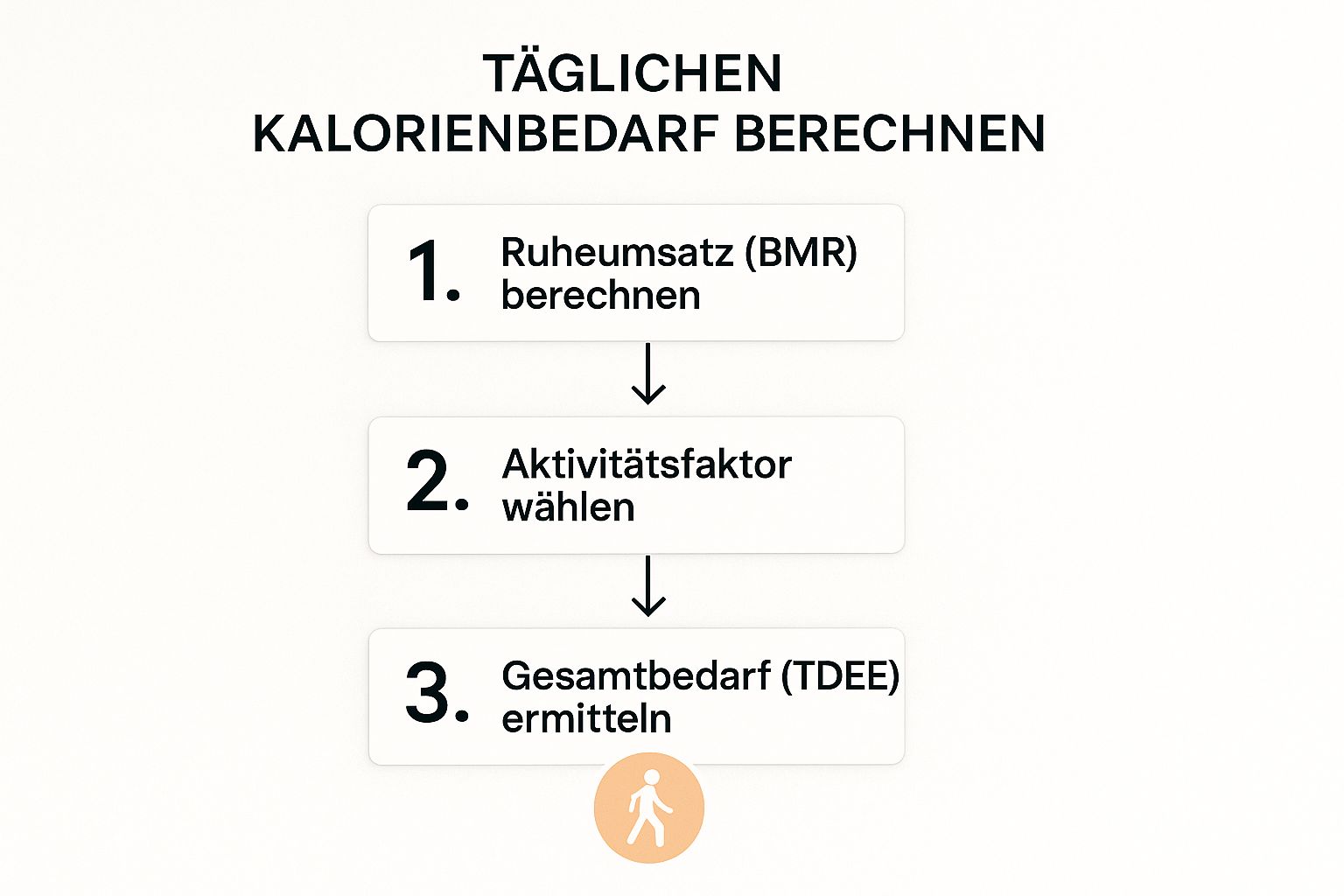
As the graphic illustrates, the next step – an honest assessment of your daily activity – is crucial to determining your total needs.
Your daily routine makes the difference: From BMR to total calorie needs
We've got the BMR now. What's still missing is your personal activity level. For this, there's the so-called PAL factor (Physical Activity Level), which we multiply by the BMR.
My tip from experience: Be absolutely honest with yourself here. Many people overestimate their daily activity. Setting the factor too high leads to an overly high calorie target and unnecessarily slows down your progress.
To make the assessment easier for you, I have compiled a table.
PAL Factors for Assessing Activity Level Find your personal PAL factor (Physical Activity Level) to correctly determine your activity energy expenditure.
| Activity Level | Description | PAL Factor |
|---|---|---|
| Sedentary | Office job, hardly any additional physical activity. | 1.2 |
| Lightly active | Sedentary job, but with walks and 1–2 light workouts per week. | 1.4–1.5 |
| Active | Mainly standing/walking job or office job with 3–4 sports sessions per week. | 1.6–1.7 |
| Very active | Physically demanding job (e.g., construction) or daily, intense training. | 1.8–1.9 |
With this table, it's easy to find the right value for yourself.
Back to our example: Anna works in an office but goes to the gym three times a week. Her PAL factor is therefore approximately 1.6. The final calculation is simple:
1414 kcal (BMR) × 1.6 (PAL) = 2262 kcal (TDEE)
This is the amount of calories Anna would need to maintain her weight. This number is the golden baseline for now calculating the perfect calorie deficit for weight loss. If you want to go deeper and get more practical tips on how to lose weight fast and healthily, I recommend our in-depth article.
How to find your perfect calorie deficit

Okay, you now know your Total Daily Energy Expenditure (TDEE). That was the most important part of the preparation. Now comes the step where it's all about implementation: we set your calorie deficit.
A little intuition is required here, because too radical an approach can quickly backfire. We want to sustainably reduce fat and not put our body into an unnecessary state of alarm.
The golden rule from my experience? A daily deficit of between 300 and 500 calories. This range is ideal. It's large enough to make noticeable progress, but moderate enough that you don't have to constantly starve or feel completely drained.
Why more is not always better
Sure, a deficit of over 500 calories sounds tempting at first – faster results, right? But in practice, it's often a boomerang. With such a drastic calorie reduction, your body starts to break down not only fat but also valuable muscle mass. And that's exactly what we absolutely want to avoid. Muscles are the best calorie burners we have, after all. So, less muscle means a lower basal metabolic rate.
Furthermore, you risk nutrient deficiencies and the dreaded yo-yo effect is almost knocking at the door. If you want to know how to cleverly avoid this, read our guide on losing weight without the yo-yo effect.
My practical tip: Slower but steady progress always beats fast but short-lived diet successes. Patience is truly your most important partner on the way to your feel-good weight.
A real-life example
Let's calculate this for our example person, Anna. Her Total Daily Energy Expenditure (TDEE) is 2,262 kcal. We want a moderate deficit that she can easily integrate into her daily life. Let's decide on 400 calories.
- Anna's Total Daily Energy Expenditure (TDEE): 2,262 kcal
- Our chosen deficit: - 400 kcal
- Anna's daily calorie target: 1,862 kcal
What does this mean in concrete terms? One kilo of body fat has approximately 7,000 calories. With a daily deficit of 400 calories, Anna saves 2,800 calories per week (i.e., 400 kcal x 7 days). This results in a weekly weight loss of about 0.4 kg – an absolutely healthy and motivating pace!
Health experts also recommend precisely this moderate approach. They advise keeping the daily calorie deficit to a maximum of 500 calories, with many considering a value around 300 calories as particularly practical for everyday life. Also remember that your needs change as you lose weight. It's smart to recalculate the numbers every few weeks. You can find more on scientific recommendations at Augsburger Allgemeine.
How to lose weight in everyday life
The theory is solid, the numbers are clear – now it's time to get down to business. You know how to calculate your calorie deficit, but the real test awaits in everyday life. The goal isn't to be constantly hungry or to only sip water at every get-together with friends.
The key to success is simple: satiety. Focus on foods that keep you full and satisfied for a long time. Here, proteins and fiber are your absolute superheroes. A meal with chicken breast, a mountain of vegetables, and a handful of quinoa will keep you much fuller than the same amount of calories from two slices of toast with jam. This isn't magic; it's simply smart nutrition.
Eating smarter instead of strictly dieting
Forget rigid diet plans that dictate what you should eat and when. Hardly anyone can stick to something like that. A flexible approach that adapts to your life and allows you to make conscious decisions works much better.
- Focus on protein power: Every one of your meals should contain a decent portion of protein. Think of low-fat quark for breakfast, lentils in your salad at lunch, or a nice piece of fish in the evening. Proteins are incredibly satiating and help you protect your muscles.
- Incorporate fiber: Whole grains, legumes, vegetables, and fruits are your friends. They fill you up, keep blood sugar stable, and effectively curb cravings.
- Don't forget healthy fats: Fats are vital and also make you feel full. But beware, a tricky calorie trap lurks here! One tablespoon of oil in the pan quickly has over 100 calories. So it's super important to develop a feel for the right fats and the right amounts. You can find more about this in our article on healthy and unhealthy fats.
A practical tip that truly changes everything: Prepare your meals in advance! If you have healthy, delicious food already ready in the fridge, you won't even be tempted to grab a quick, unhealthy snack in stressful moments.
As a rule of thumb for healthy weight loss in Germany, a calorie deficit of about 500 calories per day is often recommended. This allows you to lose approximately half a kilo per week. This may sound slow, but precisely this moderate pace protects you from the dreaded yo-yo effect, which is almost guaranteed with crash diets.
Also, watch out for liquid calories. Juices, sodas, or sugar in coffee can wipe out your entire deficit without you even noticing. Water and unsweetened tea are always the best choices to drink enough without burdening your calorie count.
Answers to frequently asked questions about calorie management

When you start dealing with calories, the theory quickly becomes clear. But in practice, the same questions often arise. Don't worry, that's completely normal. Here we clarify the most common stumbling blocks so you can continue confidently.
Do I have to hit my calorie target exactly every day?
No, and that's a good thing. Perfectionism is out of place here and can quickly lead to frustration. Much more important than hitting the mark daily is your weekly balance.
Imagine this: one day you're invited to eat out and end up significantly over your goal. That's no problem! On another day, you can easily compensate by eating a little less. This flexible approach makes weight loss manageable in everyday life. As long as you remain in a deficit on average over the week, you're on the right track.
Why is my weight stagnating despite a deficit?
This moment can be truly frustrating, but usually there's a logical explanation. Often, it's small, unconscious calorie traps that creep in. The extra splash of oil in the pan, the calories in juice, or imprecise weighing of pasta – it all adds up.
One point many overlook: your body adapts. If you have already lost weight, your daily calorie requirement also decreases. Your initially calculated deficit may then no longer be one at all.
Other factors such as water retention, too much stress, or poor sleep can also temporarily affect the number on the scale. Be patient, honestly review your tracking, and readjust calories if necessary.
How often should I recalculate my calories?
A good rule of thumb from practice is to review and recalculate your needs every 4 to 6 weeks or after about 5 kg of weight loss. Your body has become lighter and therefore consumes less energy at rest and during movement.
This regular adjustment ensures that your deficit remains effective and that you cleverly bypass the dreaded weight loss plateaus.
Do I absolutely need exercise to lose weight?
Theoretically, exercise is not strictly necessary, because a calorie deficit can also be achieved through diet alone. But honestly: exercise makes everything so much easier and healthier.
Exercise increases your calorie expenditure, which gives you more leeway with food. Strength training in particular is gold, as it helps maintain valuable muscle mass. And muscles are the best allies for an active metabolism. These tactics are part of a holistic plan that also includes natural ways to lose weight, thus ensuring long-term success.
Would you like to support your journey with high-quality, natural products? At BODY'S PERFECT, you'll find everything you need for a successful and enjoyable weight loss journey – from effective BURN capsules to delicious weight loss shakes. Discover our range now at https://bodysperfect.com.











































Share:
8 Best Natural Fat Burners for 2025: The Ultimate Guide
Losing weight without starving yourself made easy