

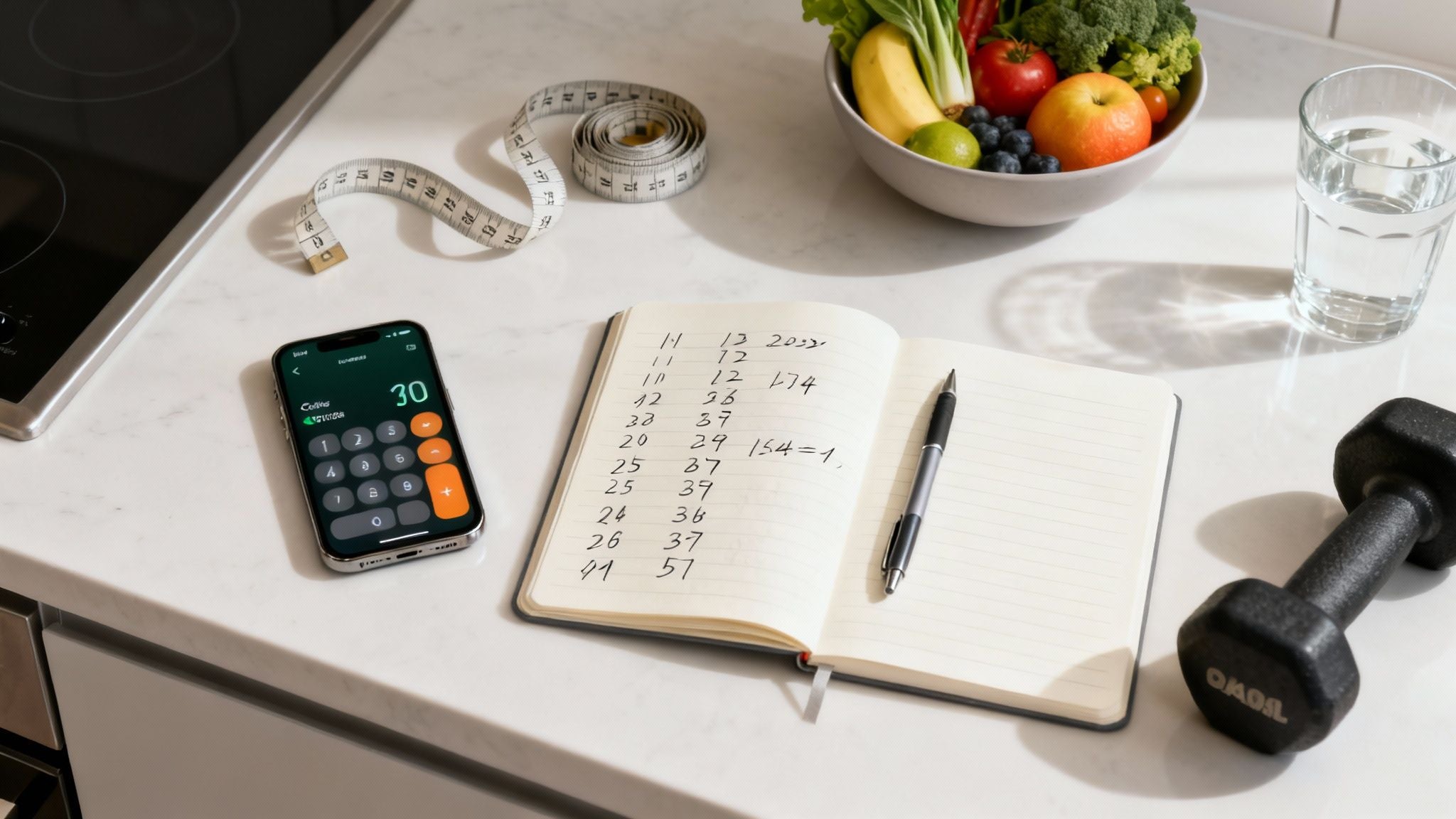
You want to know how many calories you really need per day to lose weight? The quick and honest answer is: A moderate calorie deficit of 300 to 500 calories below your actual total daily energy expenditure is the best and healthiest way.
With this approach, you'll lose about one pound per week in a healthy way, without being constantly plagued by cravings or your metabolism switching to economy mode.
The Basis for Your Success: The Right Calorie Needs

Perhaps you've heard the general advice to simply eat 2,000 calories a day to lose weight. However, this is far too simplistic. Your personal needs are as individual as you are and depend on many things: your age, your height, your current weight, and especially how active you are in your daily life.
Why a blanket figure doesn't work
A craftsman on a construction site naturally burns much more energy than someone who sits at a desk all day. That's why it's so important to establish a personal baseline. That's exactly what a calorie calculator is for – it helps you find a realistic and motivating foundation for your journey to your desired weight.
Interestingly, a study by the German Institute of Human Nutrition showed that 45 percent of adults who aimed to lose weight specifically used a calorie calculator as a central tool. Participants who maintained a moderate deficit lost at least eleven pounds on average within six months.
Don't think of a calorie calculator as a strict rulebook, but rather as your personal compass. It gives you a clear direction so you can reach your goal healthily and, most importantly, sustainably.
This article lays the groundwork for you to understand how your body works and how you can specifically support it. We'll show you step by step how to find your individual needs and cleverly integrate this value into your daily life.
- No more guessing: You'll get a concrete number as a starting point.
- Motivation through clarity: A clear goal in sight helps immensely to stay on track.
- Sustainability instead of crash diet: A sensible deficit protects you from the dreaded yo-yo effect.
To make it easier for you to get started, detailed and clear calorie charts for weight loss are a great addition. They help you quickly develop a better feel for the nutritional values of your favorite foods.
What Your Body Really Burns in Calories: Basal Metabolic Rate and Activity Metabolic Rate
Before we dive into the numbers, let's briefly clarify what we're actually talking about here. Your body constantly consumes energy – not just when you're sweating at the gym. Understanding this is key to successful weight loss.
Imagine your body like a car. Even when it's in the garage and the engine is off, the electronics consume power. That's your basal metabolic rate, also known as BMR. It's the energy your body needs at absolute rest, just to stay alive. Think of breathing, heartbeat, digestion – all the silent processes in the background.
Surprisingly, this "idle mode" accounts for the lion's share of your daily consumption, usually between 60% and 75%.
What exactly is the basal metabolic rate?
The basal metabolic rate is therefore the basic energy your body needs if you were to lie on the couch all day. However, this number is not the same for everyone, but depends on a few fixed factors:
- Age: As we get older, our metabolism tends to slow down a bit more.
- Gender: Men naturally often have more muscle mass, which slightly increases their basal metabolic rate compared to women.
- Weight and height: A larger, heavier body logically needs more energy to supply itself.
- Muscle mass: This is the crucial point! Muscles are metabolically active. They burn calories even when you're doing nothing. More muscles therefore mean a higher basal metabolic rate.
The last point in particular is great news for you. Because the more muscle mass you build, the more calories you burn automatically – even in your sleep.
Your active consumption: The activity metabolic rate
Now the second, dynamic part comes into play: the activity metabolic rate. This is the energy you consume for everything that goes beyond simply lying down. As soon as you start the proverbial car and drive off, you consume fuel – and that's exactly your activity metabolic rate.
Here, every little thing counts, from conscious training to unconscious everyday movements:
- The walk to the mailbox
- Taking the stairs to your apartment
- Housework on the weekend
- And, of course, your sweaty workout
Your personal lifestyle has a huge impact on how high your activity metabolic rate is. A construction worker has a completely different consumption than someone who sits at a desk all day.
Adding the basal metabolic rate and the activity metabolic rate gives you your total energy requirement. This is the exact amount of calories your body burns on an average day. And this is exactly the number we need as a starting point to determine your personal calorie deficit for weight loss.
If you want to delve deeper into this, check out our article where we explain how you can calculate your basal metabolic rate and use it for weight loss. Knowing these two values is the first and most important step for any sustainable weight loss strategy.
How to find out how many calories you really need
Now it's getting concrete. Let's calculate your personal calorie needs together – without complicated formulas. I'll show you the way step by step using two real-life examples so you can understand everything immediately.
Two people, two completely different daily lives
Let's imagine Anna and Markus:
- Anna (35 years old): She has a typical office job and spends most of the day sitting. To stay fit, she goes to yoga three times a week.
- Markus (45 years old): As a craftsman, he is on his feet all day and does physically demanding work. His job is practically his daily workout.
Both want to lose weight in a healthy and sustainable way. But their starting points and thus their daily energy consumption could hardly be more different.
The path to your magic number
Don't worry, the calculation is simpler than it sounds and basically consists of only three parts. This infographic already gives you a good overview of how your total energy requirement is composed.
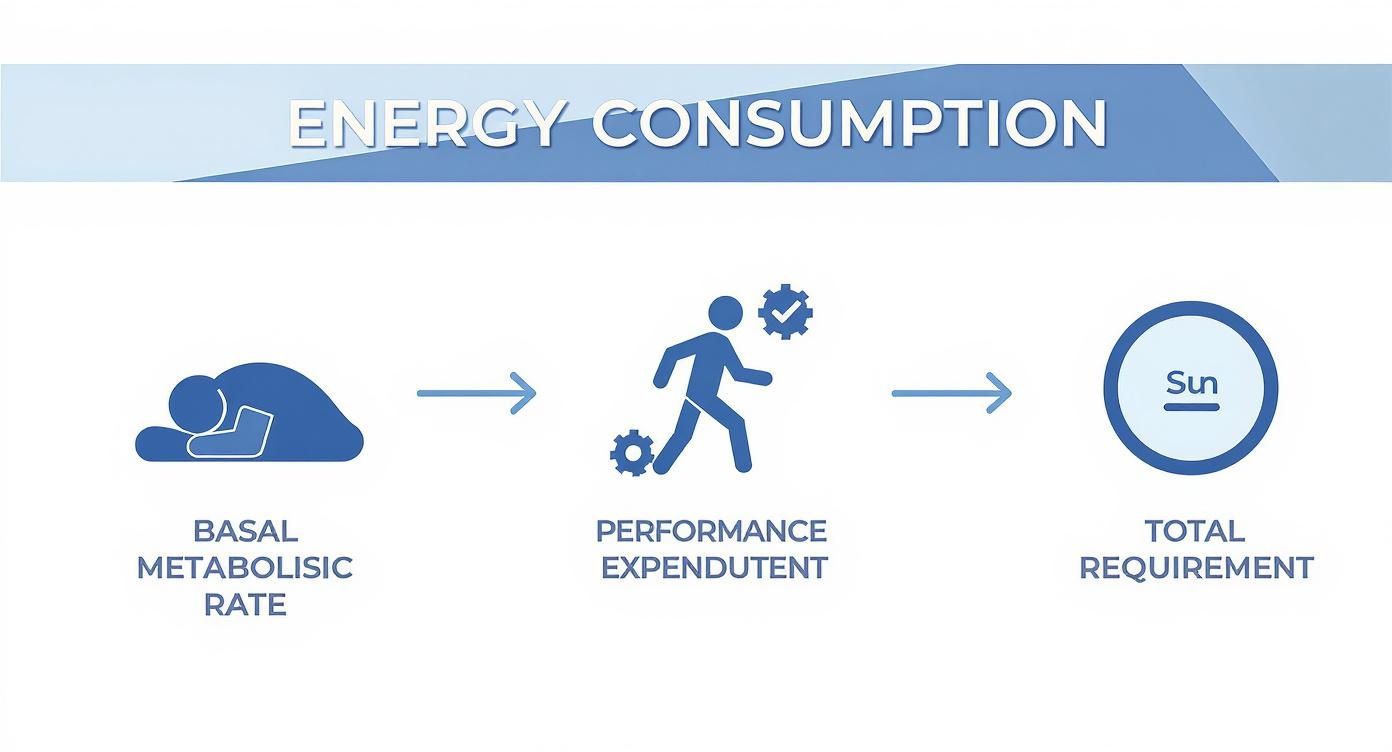
You see: Your total daily energy expenditure is always the sum of the energy your body consumes at absolute rest (basal metabolic rate) and the energy you need for all your activities (activity metabolic rate).
First, we determine your Basal Metabolic Rate (BMR). This is the amount of energy your body consumes when you are simply lying down and doing nothing. We then multiply this value by your personal activity factor (PAL factor). This factor reflects your daily life – from Anna's sedentary activity to Markus's physical exertion.
The result is your total energy requirement, i.e., the amount of calories you need daily to maintain your weight. If you want to delve deeper into the matter, you can find more details in our article on calculating your total energy requirement.
Your lifestyle is the key. Your job, your hobbies, and your daily habits determine how high your calorie consumption really is at the end of the day.
To lose weight specifically, we aim for a healthy calorie deficit of about 500 calories. We simply subtract these from your calculated total daily energy expenditure. This is the best way to sustainably lose about one pound of pure body fat per week, without slowing down your metabolism.
Many people now seek digital support for this. A survey showed that around 28% of adults in Germany have already used a calorie counting app. Such helpers are particularly popular among women between 25 and 44 years old – here the rate is even 37%. The study also confirms what many know from experience: 62% of users became much more aware of their diet through regular tracking. Those who consistently maintained a deficit of around 500 kcal per day lost an average of 3.2 kilograms of body fat in twelve weeks.
Once you understand this simple process, it will be much easier for you to implement. Above all, you will get a much better feeling for how strongly your own lifestyle influences your calorie consumption.
How to achieve a calorie deficit even in a stressful daily life
Calculating a number is one thing. But actually implementing that number in everyday life, without constantly being hungry or having to give up everything – that's the real challenge.
But don't worry, it's simpler than it sounds. It's not about being perfect overnight. It's more about a few clever habits that keep you full and satisfied while the pounds melt away.
Focus on protein and fiber – your best helpers
If there are two nutrients that truly support you in weight loss, they are proteins and fiber. Why? It's simple: they keep you feeling full for an incredibly long time.
Proteins – think lean quark, chicken, lentils, or a good protein shake – not only boost your metabolism because your body needs more energy to digest them. They also ensure that hunger pangs disappear for hours after eating.
Fiber from whole-grain bread, plenty of vegetables, or legumes is just as smart. They fill the stomach, slow down digestion, and thus effectively prevent those dreaded afternoon cravings.
Plan ahead with meal prepping
Who hasn't experienced it? A stressful day, no time to cook, and suddenly the temptation to quickly order something unhealthy is great. This is where meal prepping comes in.
If you plan and prepare your meals a few days in advance, you take away the power of everyday stress over your diet. You always have a healthy, delicious option ready and don't have to think for long.
Even small actions make a huge difference:
- Chopping preparation: On Sunday, chop a colorful mix of vegetables for salads or quick stir-fries. This way, the healthy base is always at hand.
- Cooking side dishes: A portion of quinoa or a few potatoes are quickly cooked and can be perfectly combined with fish or chicken for a full meal.
- Smart snacks: A few hard-boiled eggs in the fridge or a small container of nuts will keep you from reaching for the chocolate bar at the office.
Beware of hidden calorie traps
Often, it's not the main meals that blow the calorie budget. The real culprits are the small, inconspicuous things in between.
Drinks in particular are a common trap. Sugary sodas, fruit juices, or your beloved latte macchiato with syrup can easily contain several hundred calories without really satisfying you. Water, unsweetened tea, or black coffee are clearly the smarter choices.
It's also worth taking a closer look at sauces and dressings. A spoonful of ready-made salad dressing can quickly have more calories than the entire salad underneath. A light vinaigrette made from vinegar and oil or a simple yogurt dressing are often the better alternatives.
Once you understand these basics, implementation will be much easier for you. You can find even more strategies and detailed information in our guide, where we show you how to calculate your calorie deficit for weight loss and effortlessly integrate it into your daily life.
Or simply use the BODY'S PERFECT Calorie Calculator
Don't feel like doing mental arithmetic and formulas? I can totally understand that. If you just need a quick and reliable number to get started, we've developed something specifically for that.
Our BODY'S PERFECT Calorie Calculator takes all the work out of it for you. In just a few seconds, you'll have a precise, personalized recommendation in your hand.
You don't have to be a math whiz. Simply enter your data – age, gender, height, current weight, and how active you are in your daily life. The tool does the rest and calculates your personal calorie needs for weight loss.
In just a few clicks to your personal calorie count
The operation is truly child's play. You fill out the fields and select your activity level from the given options – regardless of whether you sit at a desk all day or do physically demanding work. This way, your individual lifestyle is truly taken into account.
Take a look, the calculator is so clear and simple:
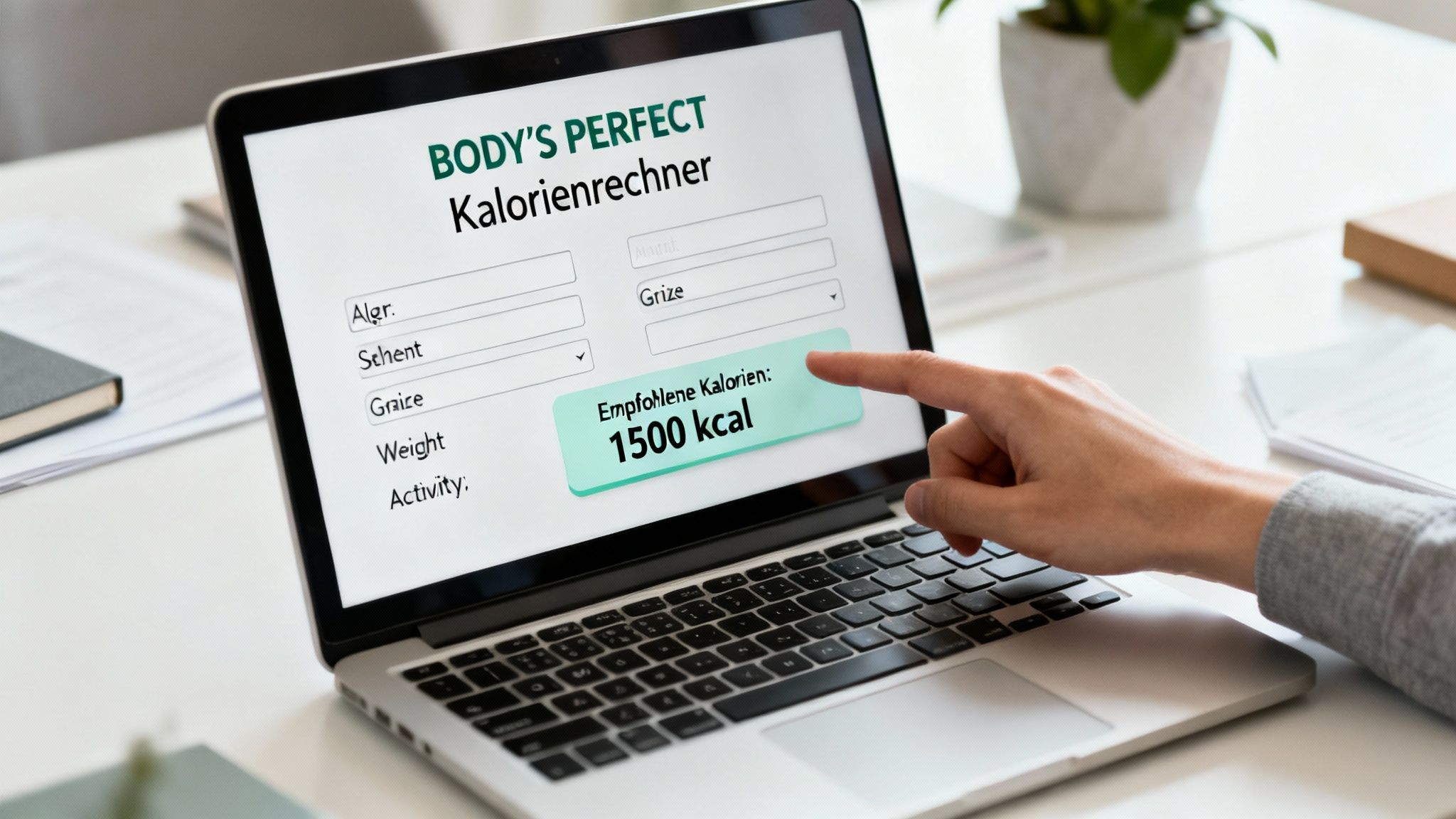
As soon as you have entered everything, you will immediately see how many calories you should aim for for healthy, moderate weight loss. This gives you a clear, actionable number as a perfect starting point.
It's no coincidence that such calculators are becoming increasingly popular. The search for digital helpers for the question "how many calories per day to lose weight" is booming. In Germany alone, sales of nutrition apps amount to around 107.92 million euros. By 2030, this value is even expected to rise to over 126 million euros. This shows how important a more conscious lifestyle has become for many people.
Our tip: Don't just see the calculator as a pure number tool. It's your first step towards a more conscious approach to food. It gives you the clarity you need to start directly and with a good feeling.
Stop guessing and create a solid foundation for your success. With a clear number in mind, it's so much easier to stay motivated and achieve your goals.
Any more questions? Here are the answers
Great, now you have the necessary tools to calculate your calorie needs and set your weight loss goal. But from experience, I know that a few questions often arise in detail. Let's clarify the most common ones directly so you can start with a really good feeling and full of self-confidence.
How accurate are these online calorie calculators actually?
Calorie calculators are a great tool for getting started. They use proven scientific formulas like the Harris-Benedict or Mifflin-St-Jeor equations and thus provide you with a truly solid estimate. So you quickly get a concrete number you can work with.
However, it's also clear: Your body is not a calculating machine. A calculator cannot possibly know individual factors such as your genetic predisposition, your hormone balance, or the exact ratio of muscle to fat mass.
Consider the calculator's result as your personal starting value – a guideline, not a law carved in stone. Start with it, observe what happens in the first two weeks, and listen to your body. If you constantly feel sluggish or nothing is happening on the scale, simply adjust the calories a little up or down.
Do I have to hit my target calories exactly every day?
No, absolutely not! And that's a huge relief, isn't it? It's not about being perfect every single day. Much more important is what comes out at the end of the week. Your body doesn't operate in 24-hour cycles.
Imagine you're invited to dinner today and you end up 150 calories over your goal. No problem! Tomorrow, you just eat a little more consciously and save those 150 calories again. At the end of the week, the balance is right, and you're perfectly on track. This flexibility is exactly what makes the whole thing practical and prevents you from throwing in the towel in frustration at the slightest deviation.
Eat more on training days – yes or no?
A very good and important question! The answer in most cases is: Yes, that absolutely makes sense. On days when you really push yourself in training, your body naturally burns significantly more energy.
There are two common approaches that both work well:
- The flexible method: You consciously eat a little more on training days to at least partially compensate for the additional calories burned. A protein-rich snack after your workout would be perfect for this.
- The constant method: You calculate your total daily energy expenditure from the start with a higher activity level (PAL factor) that already includes your weekly sports sessions. Then you simply eat the same amount of calories every day.
Try out what feels better for you and your body. Many people who exercise regularly prefer the first method. This way, they have more power on strenuous days and at the same time support their recovery.
What happens if I eat too little?
The idea is tempting: the bigger the deficit, the faster the pounds drop. But the opposite is true. A calorie deficit that is too aggressive – i.e., anything more than 700 to 1,000 calories below your total requirement – harms you more than it helps.
Your body immediately notices this and switches to a kind of survival program. The consequences are not only unpleasant but also set you back in your endeavor:
- Muscle loss: Your body doesn't just get the missing energy from fat but also uses your valuable muscles.
- Nutrient deficiency: If you eat too little, it becomes almost impossible to absorb all important vitamins and minerals. Fatigue and concentration problems are often the result.
- Metabolism slows down: To save energy, your body reduces its basal metabolic rate.
- The yo-yo effect says hello: As soon as you eat "normally" again, your slowed-down metabolism clings to every calorie and stores it as fat for the next "famine."
A moderate deficit of 300 to 500 calories is not only healthier but also more sustainable. Patience is your best friend on the way to your feel-good weight.
Would you like to know even more and customize your path? At BODY'S PERFECT, we know that every metabolism works differently. That's why, in addition to our practical calorie calculator, we also offer our BODYSlim DNA tests. With them, you gain deep insights into your genetic predisposition and can perfectly tailor your diet to it.





































Share:
Low-Calorie Fillers: How to Stay Full Longer and Still Lose Weight
The Best Homemade Protein Pudding Recipe