

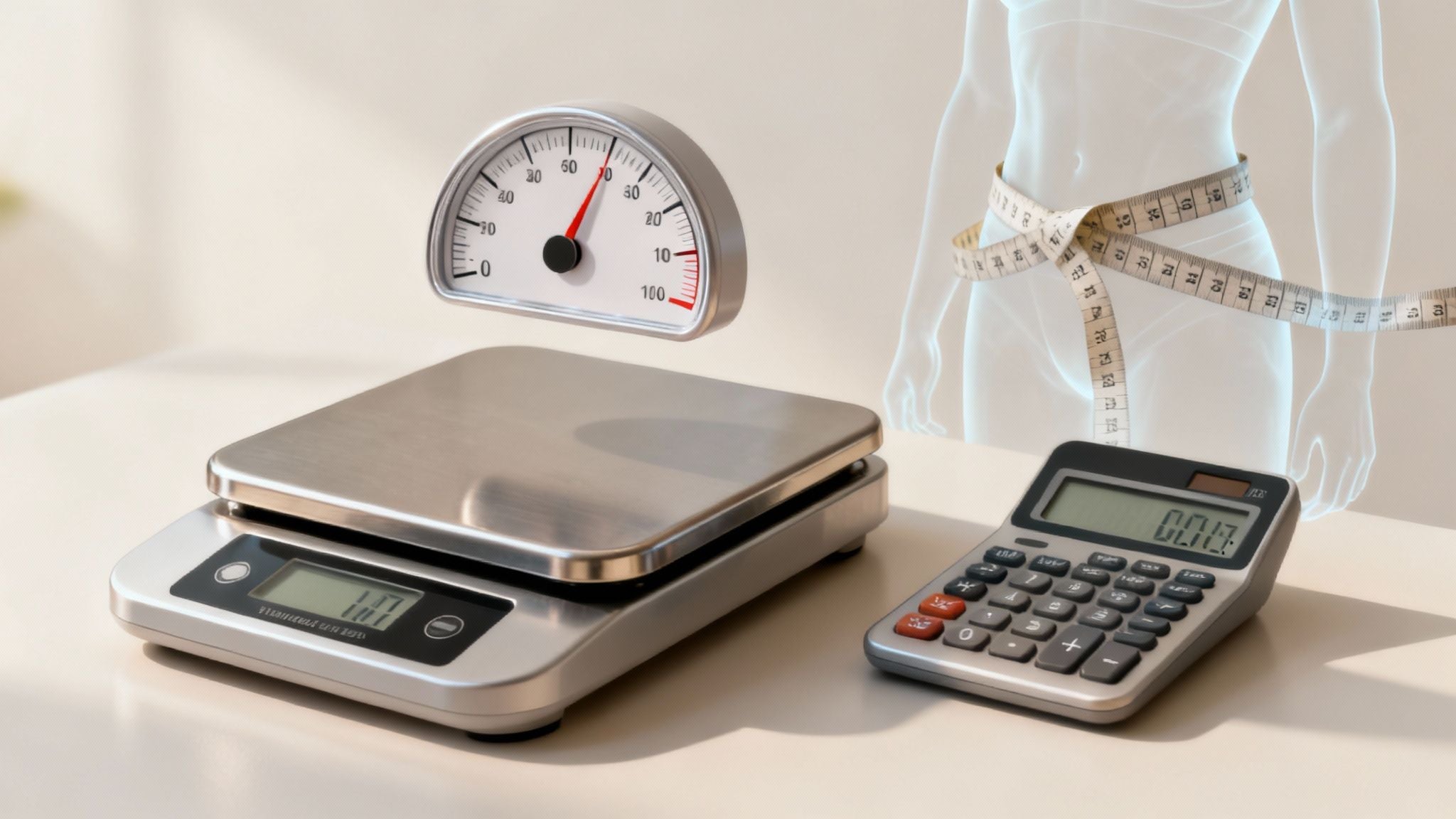
Do you ever wonder how many calories you actually need? A calorie daily requirement calculator can tell you just that. It's the very first and most important step if you finally want to achieve your nutritional goals – especially if you want to lose weight. Think of it like a translator that converts your personal data into a clear number: your daily energy budget.
Finally understand your calorie needs easily
Your daily calorie requirement is essentially like your car's fuel tank. You need just the right amount of fuel to reach your destination – not too much and certainly not too little. It's the same with your body: it needs a very specific amount of energy, i.e., calories, to keep everything running. From breathing to thinking to walking or working out at the gym.
Each of us is different. That's why generic diet tips like "just eat less" usually fail. Your personal energy requirement depends on several key factors that together form a complex but absolutely understandable picture.

What truly determines your energy consumption
The two most important components of your calorie requirement are your basal metabolic rate and your activity metabolic rate. Sounds complicated? It's not.
- Basal Metabolic Rate (BMR): This is the amount of energy your body uses when you're doing absolutely nothing – basically, while you sleep. This energy keeps your organs running and ensures all vital functions.
- Activity Metabolic Rate: This is the extra energy you need for every movement. From climbing stairs to working in the office to a sweaty workout.
Adding both together gives you your Total Daily Energy Expenditure (TDEE). This is the total number of calories you burn in a day. And this number is the starting point for any smart nutritional strategy.
Why your needs don't match the average
These numbers can vary greatly from person to person. For example, Techniker Krankenkasse states that an average man between 25 and 51 years old needs about 2,400 kcal per day. A woman of the same age, on the other hand, gets by with around 1,900 kcal. But be careful: these are purely average values. You can read more about how such average calorie figures come about to better understand the whole thing.
Your age, gender, height, and especially how active you are in everyday life – all of this makes a decisive difference. To accurately determine your personal total energy requirement, we need to consider all these factors.
How a calorie calculator calculates your basal metabolic rate
Have you ever wondered how these online calculators magically spit out that one perfect calorie number for you? Of course, it's not magic, but solid science. Behind it are proven formulas based on years of research that can estimate your personal energy needs quite accurately.
A good calculator always asks you for the same four things: your gender, your age, your height, and your weight. These are the basic building blocks for determining your basal metabolic rate (BMR). Imagine this as the amount of energy your body consumes if you were to lie on the couch all day and do nothing – just for breathing, heart rate, etc.
The most common formulas in detail
Most calculators out there, including ours, use one of two very well-known and reliable formulas: the Harris-Benedict formula or the slightly more modern Mifflin-St. Jeor formula. The latter is now considered the gold standard because it provides even more accurate results for most people.
- The Harris-Benedict Formula: A true classic! It was developed in 1919 and later adapted. For decades, it was the first choice.
- The Mifflin-St. Jeor Formula: Developed in the 1990s, studies show that it often better suits our modern lifestyle.
Both formulas take your personal data and convert it into a concrete number. Fascinating, isn't it? From four simple pieces of information comes one of the most important metrics for your fitness and health.
A practical calculation example
Let's go through this. Let's take our example person Anna: She is 30 years old, 168 cm tall, and weighs 65 kg. We will now apply her values to the Mifflin-St. Jeor formula for women:
Basal Metabolic Rate (kcal/day) = (10 × weight in kg) + (6.25 × height in cm) – (5 × age in years) – 161
For Anna, the calculation looks like this: (10 × 65) + (6.25 × 168) – (5 × 30) – 161 = 650 + 1050 – 150 – 161 = 1389 kcal
Anna's basal metabolic rate is therefore around 1,389 kilocalories per day. This is the absolute basic energy her body needs at rest. If you want to delve deeper into the topic, check out our article explaining how to calculate your basal metabolic rate for weight loss.
This initial calculation is the most important step. It gives us a reliable starting point to continue working with to determine your actual, total daily requirement.
From basal metabolic rate to your actual daily needs
Your basal metabolic rate, which we just calculated, is, so to speak, your body's idle speed. It only covers the energy you consume at absolute rest. But who among us just lies around all day?
From walking the dog to climbing stairs to working out at the gym – every single movement costs additional energy. This is precisely where the next important step comes in: We need to include your daily activity to find your true calorie needs.
To get from your basal metabolic rate to your total daily needs, we need the so-called PAL factor (Physical Activity Level). This is a simple multiplier that reflects your lifestyle and makes all the difference.
Find your personal PAL factor
The following table will help you find your personal activity factor. Be honest with yourself here – it's about your typical daily life, not a wishful scenario.
Overview of PAL Factors (Physical Activity Level) This table helps you determine your personal activity factor based on your typical daily routine.
| Activity Level | Description of Activity | PAL Factor |
|---|---|---|
| Sedentary | Exclusively sedentary activity, hardly any physical activity in leisure time (e.g., office job without sports) | 1.2 |
| Lightly active | Sedentary activity with occasional additional activities such as walks or light sports (1-2 times per week) | 1.4 – 1.5 |
| Moderately active | Activity that involves sitting, walking, or standing part-time; regular sports (2-4 times per week) | 1.6 – 1.7 |
| Very active | Predominantly standing or walking work (e.g., waiter, salesperson) and regular sports (4-5 times per week) | 1.8 – 1.9 |
| Extremely active | Physically demanding work (e.g., construction worker, farmer) or competitive athletes with daily training | 2.0 – 2.4 |
Choose the factor that best applies to you. This honest assessment is the basis for an accurate calculation.
Calculate your total energy expenditure
Now it gets exciting, because we're putting everything together. Your total energy expenditure, often referred to as TDEE (Total Daily Energy Expenditure), is the amount of energy you burn on a normal day.
The formula for this is very simple:
Total Energy Expenditure (TDEE) = Basal Metabolic Rate (BMR) × PAL Factor
Let's recall our example, Anna: Her basal metabolic rate was 1,389 kcal. Since she has an office job but goes to sports three times a week, a PAL factor of 1.6 is best for her.
So, her calculation looks like this: 1,389 kcal × 1.6 = 2,222 kcal
The result of 2,222 kcal is Anna's actual daily requirement to maintain her current weight. This single number is the foundation for all your further plans – whether you want to lose weight, gain weight, or maintain your weight.
In our guide on calorie requirements for weight loss, we show you exactly how to use this number as a starting point for your goals. With this knowledge, you have full control.
Adjusting your calorie needs to your goals
Great, you've now determined your total daily energy expenditure (TDEE)! This is the most important number for your further planning. Think of it as your personal "zero point" – the amount of calories you would need to maintain your current weight. Now it gets really exciting, because we're going to adjust this number to your personal goals.
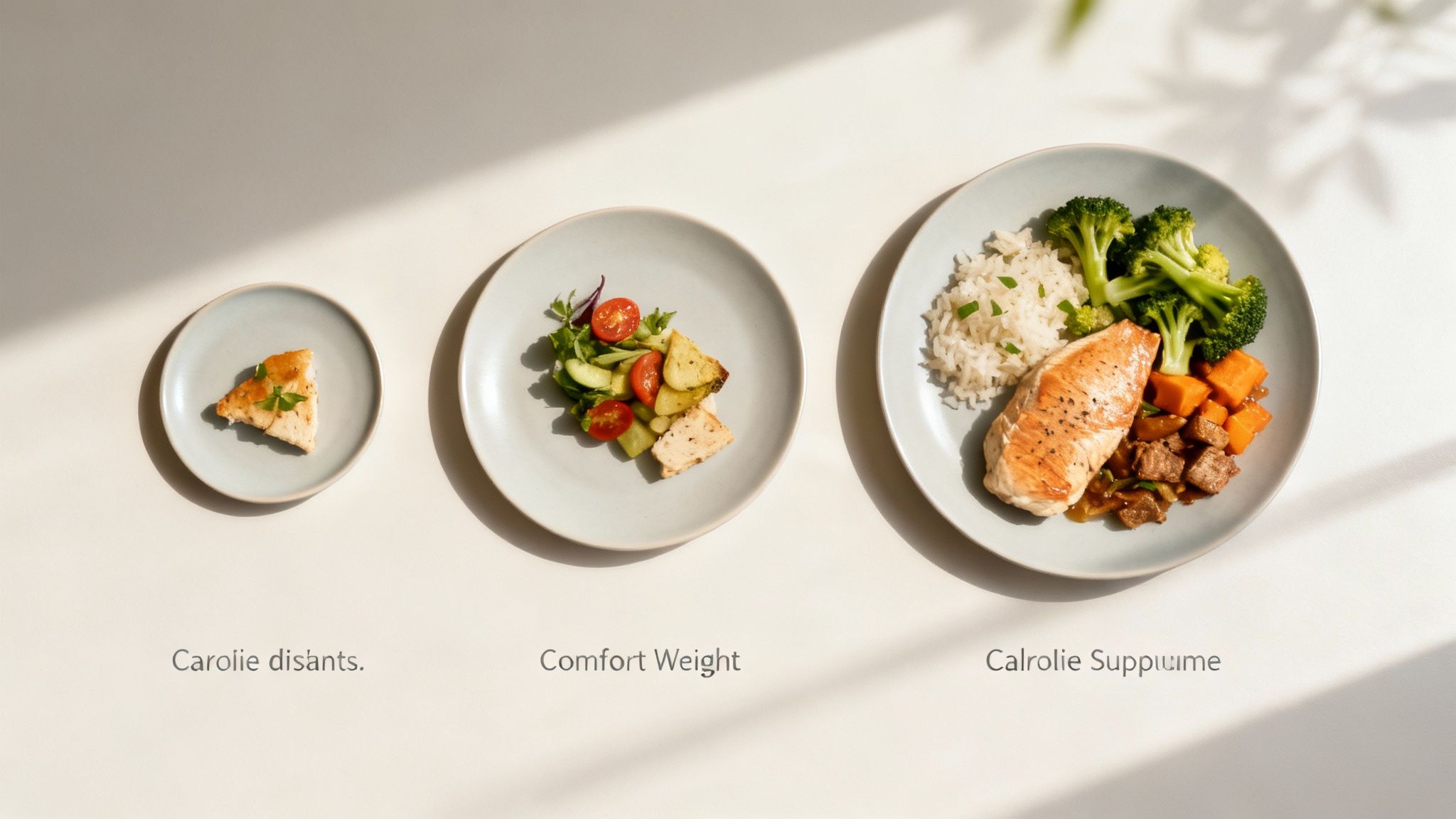
The key to success lies in consciously managing your calorie balance. Think of a simple scale: on one side is the energy you consume (food & drink), and on the other side is the energy you expend (your TDEE). Depending on which side outweighs the other, your body weight will change.
Goal 1: Losing weight with a calorie deficit
To lose weight in a healthy and, above all, sustainable way, you need a moderate calorie deficit. This simply means: you eat a little less than your body consumes throughout the day. This forces your body to draw the missing energy from its own reserves – body fat.
A sensible and sustainable deficit is 300 to 500 calories per day. A larger deficit may sound like faster results, but it often leads to cravings, muscle loss, and a sluggish metabolism.
Example calculation for Anna (TDEE = 2,222 kcal): 2,222 kcal (TDEE) – 400 kcal (deficit) = 1,822 kcal per day for weight loss
With such an approach, you can expect a realistic weight loss of about 0.3 to 0.5 kg per week. This is a healthy pace that you can maintain long-term. In our guide, you'll learn everything you need to know about calculating a calorie deficit for weight loss.
Goal 2: Building muscle through a calorie surplus
If you want to build muscle effectively, your body needs not only hard training but also extra energy. These extra "building blocks" are necessary to repair and grow muscle fibers. For this, a slight calorie surplus is ideal.
A good guideline here is an increase of 200 to 300 calories per day. This gives your body enough energy for new muscle mass without gaining unnecessary body fat.
-
Example calculation for Tom (TDEE = 2,800 kcal):
- 2,800 kcal (TDEE) + 300 kcal (surplus) = 3,100 kcal per day for muscle building
Goal 3: Maintaining weight with maintenance calories
Are you happy with your current weight and just want to maintain it? Perfect! Then your calculated TDEE is your daily roadmap. Your calorie intake should exactly match your expenditure to keep the scale balanced.
Knowing your own needs is invaluable here. Many people tend to overestimate their expenditure and underestimate their intake. Statistics show that the average calorie intake in Germany is around 3,647 calories per person, which is often significantly higher than the actual requirement.
By knowing your personal value and adhering to it, you take full control of your diet and your goals.
Why your metabolism is as unique as you are
You've meticulously calculated your calorie needs with a calculator, you're sticking to the plan rigidly, but the scale or mirror just isn't showing what you expect? That's incredibly frustrating, I know. But it's also absolutely normal and no reason to doubt yourself.
Standard calculators like these are a great starting point. They give you a really good, scientifically sound estimate of your needs. The formulas behind them have been tested for years and provide absolutely reliable guidance for most people.
However, one must be honest: it remains an approximation. Very personal factors such as your genetics, your hormone balance, or even your gut flora cannot be known by such a formula, of course. If you want to move from a good estimate to a precise, tailored analysis, a DNA metabolism test can decode your very personal predisposition.
There's more to it than just a few numbers
Imagine two people: same age, same weight, same height, and even the same amount of exercise. Mathematically, they should have the same calorie requirements. In reality, however, the actual needs can vary greatly.
The reason for this lies deep within our biology – in our DNA.
Your genes have a huge say in how efficiently your body extracts and processes energy from food. Some of us are simply naturally better "food processors." This is also the simple explanation for why your friend can seemingly eat whatever they want without gaining a gram, while you seem to feel every piece of cake immediately on your hips.
Your metabolism does not follow general rules, but your very personal genetic blueprint. General formulas can never fully capture this uniqueness.
This is where general guesswork stops and true precision begins. Instead of clinging to estimates that may simply not be right for you, you can find out how your body really works.
From rough estimation to tailor-made strategy
This is where science comes into play, which can finally give you clear answers. With the BODY'S PERFECT DNA Metabolism Test, you leave the realm of pure assumptions. Instead, you get a direct insight into your body. The test analyzes your genetic markers and shows you in black and white how your organism handles fats, proteins, and carbohydrates.
You'll find out what your metabolic type is and, based on that, receive recommendations that truly suit you. If you want to know more about how to determine your metabolic type, we have further information for you. This way, you make the leap from a rough estimate to a nutrition strategy that is precisely tailored to your genetic predisposition – for results that are not only visible but also sustainable.
Frequently Asked Questions about Calorie Needs
On the journey to a better body feeling, the same questions keep coming up. This is completely normal – so you're in good company! Here, I've gathered the answers to the most common questions for you, concisely and understandably.
See this section simply as a small knowledge base that gives you confidence so you can approach your goals confidently and with the right plan.
How accurate is a calorie calculator really?
A calorie daily requirement calculator is the perfect first step. It gives you a really good, scientifically based estimate of your needs. The formulas behind it have been tested for years and are an absolutely reliable guide for most people.
However, one must be honest: it remains an approximation. Very personal factors such as your genetics, your hormone balance, or even your gut flora cannot, of course, be known by such a formula. If you want to go from a good estimate to a precise, tailor-made analysis, a DNA metabolism test can decipher your very personal predisposition.
Do I need to adjust my calorie needs regularly?
Yes, absolutely! Your body is not a rigid machine, but a dynamic system that constantly adapts to new circumstances. A recalculation is always a good idea when something fundamental changes in your life.
- After a weight change: As soon as you have lost or gained about 5–10 kg, your basal metabolic rate has also changed noticeably.
- With a new activity level: Are you switching from an office job to a construction site or starting to train intensively three times a week? Then your body is practically screaming for more energy.
Simply recheck your needs in such situations. This way, you ensure that your plan still perfectly suits you and your goals.
Are calories more important than macronutrients?
That's a bit like the chicken and egg question. You can't separate one from the other, because both are crucial for your success. Playing them against each other makes no sense, as they fulfill completely different but equally important tasks.
The calorie balance determines whether you lose or gain weight. The macro distribution (proteins, fats, carbohydrates) determines what this change consists of – valuable muscle mass or unwanted body fat.
For the best results, a good feeling of fullness, and your energy level throughout the day, you should always keep both in mind. Those who only stubbornly count calories miss out on an incredible amount of potential.
What are the most common calculation mistakes?
Fortunately, the two biggest stumbling blocks that we repeatedly encounter in practice can be easily avoided once you know them:
- Incorrect assessment of your own activity: Many people tend to overestimate their daily movement. Be brutally honest with yourself here; only then can you create a realistic basis.
- Overlooking "hidden" calories: The splash of milk in your coffee, the oil in the pan, or the juice in between – these small items really add up throughout the day.
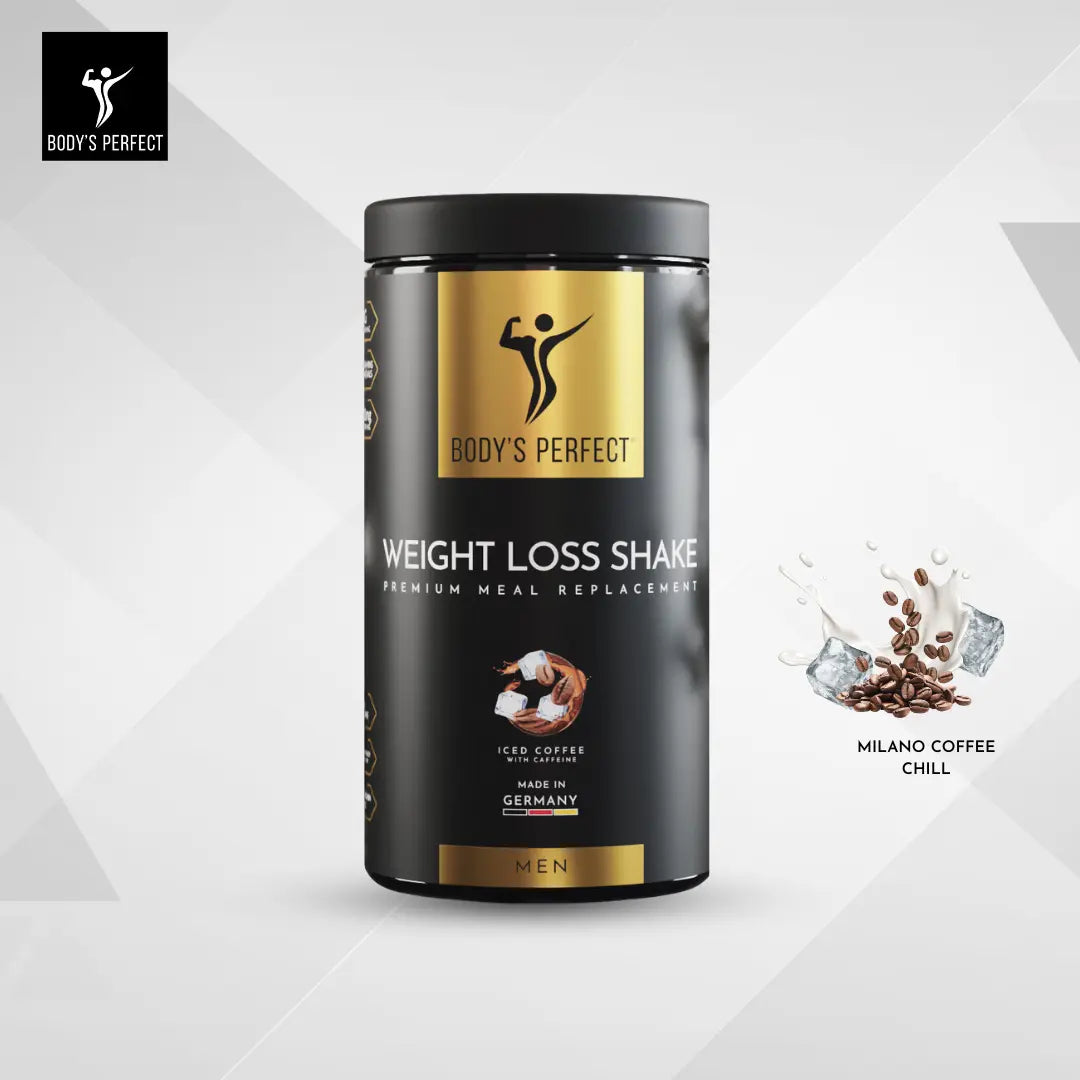
Are you ready to take the step from a good estimate to an exact nutrition strategy tailored to your DNA? The BODY'S PERFECT DNA metabolism test shows you how your body really works and gives you the decisive advantage for sustainable success. Find out now what metabolism type you are and achieve your goals faster and more effectively. Discover the DNA metabolism test at bodysperfect.com.








































Share:
Calculate Basal Metabolic Rate for Weight Loss: Your Simple Path to Your Goal Weight
How much protein per day for muscle growth? Your plan for success