

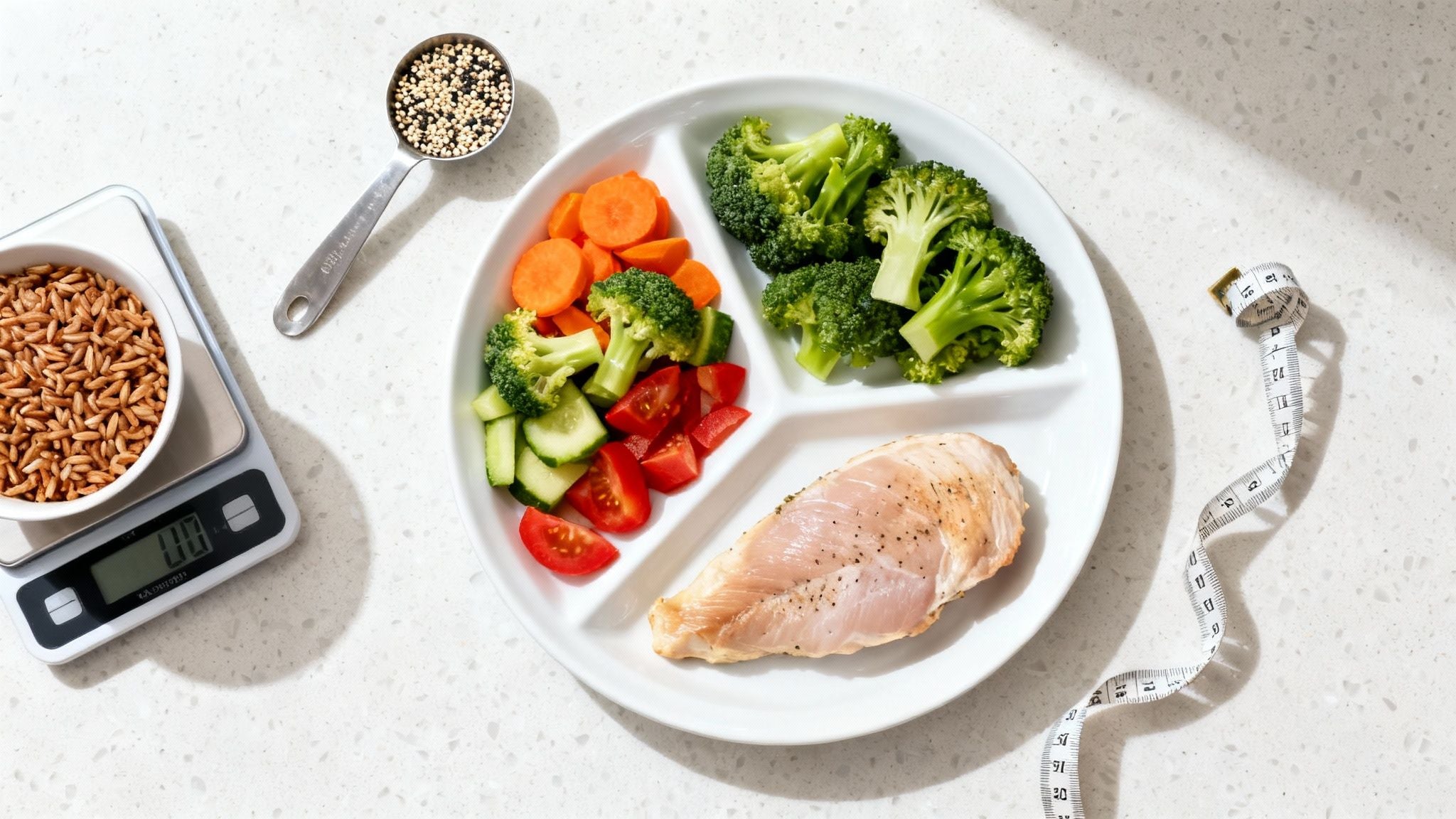
The short answer to how many carbohydrates per day are ideal for weight loss? It depends. A good and, above all, practical guideline that many successfully start with is a maximum of 150 grams per day. This amount is usually sufficient to encourage your body to use fat as an energy source without making you feel weak and tired.
Three Proven Ways to Manage Your Carbohydrate Intake
Are you wondering exactly how many carbohydrates you should be consuming? The honest answer is: there isn't one perfect number for everyone. Your ideal value is a mix of your personal metabolism, your daily routine, and your goals. So, instead of clinging to a rigid rule, you should find a method that truly suits you and your life.
Think of carbohydrates simply as fuel for your car. How much you fill up logically depends on how far and how fast you want to drive. Someone who covers long distances at high speed daily (i.e., exercises a lot) naturally needs more fuel than someone who just drives around the corner to the supermarket. It works the same way with your body.
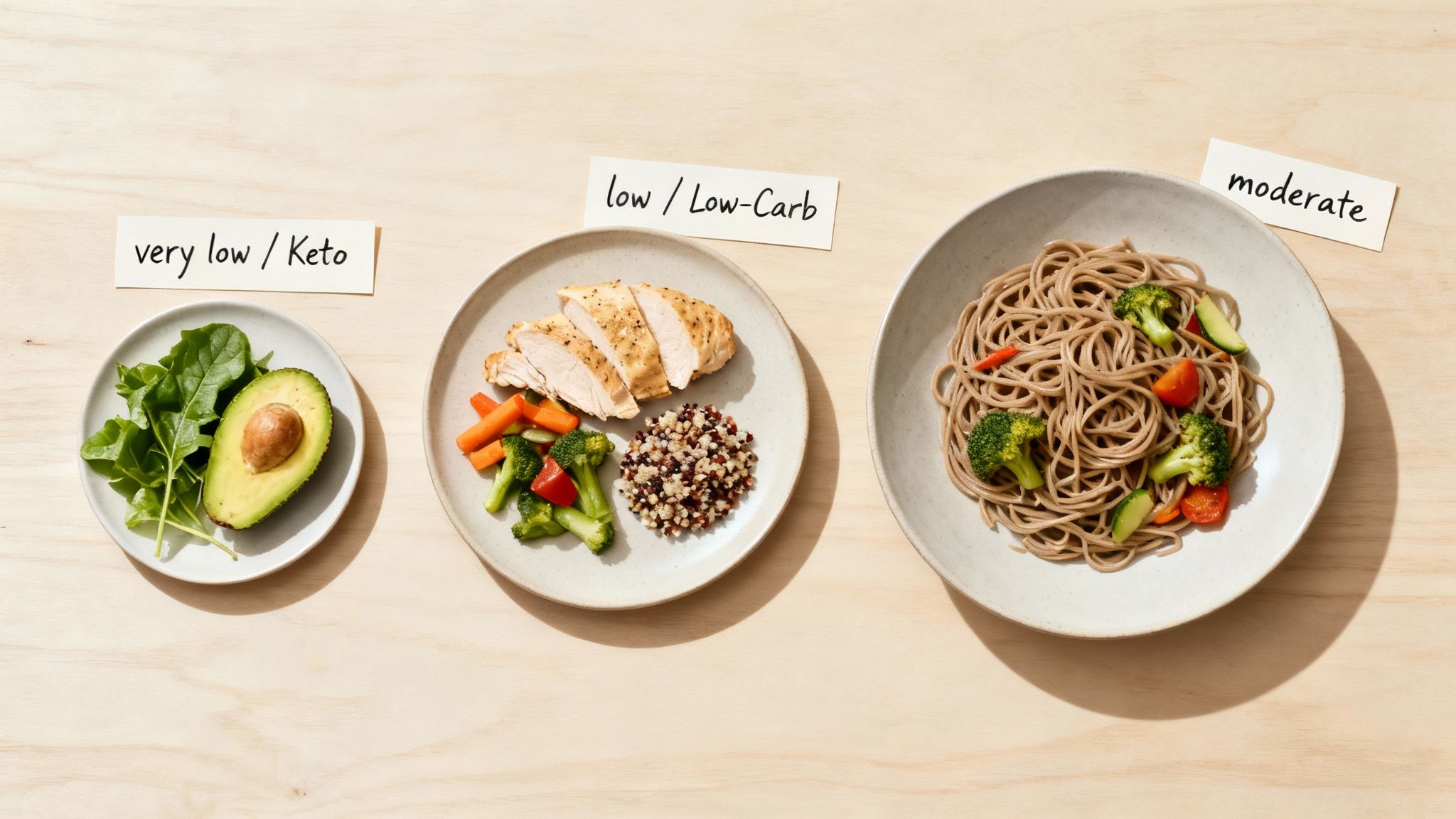
Which approach is right for you?
To give you clear guidance, three different approaches have proven effective in practice. Each pursues a slightly different goal and is suitable for different types of people.
- Very low (under 50 g): This is the so-called ketogenic diet. The goal here is to maximize fat burning. Great for quick initial success, but it also requires a lot of discipline.
- Low (50–100 g): The classic low-carb approach. Perfect if you want to see clear results but need a little more leeway on your plate than with the strict keto version.
- Moderate (100–150 g): A super flexible approach and ideal for beginners or active people who exercise regularly. You'll have enough energy for training and can still lose weight effectively.
Low-carb diets are so popular in Germany because they encourage the body to finally tap into its fat reserves instead of always relying on the quick energy from sugar and starch. As Barmer explains in their article on the low-carb diet, a reduced intake is significantly below general recommendations and can thus shift the metabolism.
Overview of Carbohydrate Ranges for Weight Loss
This table shows the three common approaches to reducing carbohydrates in direct comparison and helps you assess which might be best for you.
| Approach | Daily Carbohydrates | Ideal for |
|---|---|---|
| Ketogenic (very low) | Under 50 grams | People seeking a structured diet for maximum fat burning. |
| Classic Low Carb | 50–100 grams | Anyone who wants faster results and is willing to forgo bread and pasta. |
| Moderate | 100–150 grams | Active beginners who prefer a flexible and sustainable method to start. |
Quality over Quantity
Almost more important than the pure gram count, however, is the quality of your carbohydrates. Your body reacts completely differently to a sweet potato than to a chocolate bar – even if the carbohydrate amount might be similar.
Complex carbohydrates from whole grains, vegetables, and legumes are your friends. They provide you with long-lasting energy and keep you feeling full. In contrast, simple carbohydrates from sugar and white flour send your blood sugar on a rollercoaster ride and often trigger the next craving.
Why the Right Amount of Carbohydrates Makes all the Difference
To understand why the amount of carbohydrates plays such a big role in weight loss, let's take a quick look at how your body works. But don't worry, this won't be a dry biology lesson. It's quite simple: we want to retrain your metabolism from a "sugar burner" to an efficient "fat burner."
Imagine carbohydrates as your body's turbo fuel. As soon as you eat them, they turn into sugar (glucose) and enter your bloodstream. This is completely normal, as your brain and muscles need this quick energy. But this is precisely where the amount and type of carbohydrates determine what happens next.
The Blood Sugar Rollercoaster and its Consequences
Do you know that feeling? After a large plate of pasta or a sweet pastry, you feel great at first, but then suddenly exhausted and hungry again. Welcome to the "sugar rollercoaster"! It's mainly triggered by simple carbohydrates.
Here's how the ride goes:
- The rapid rise: Sugar and white flour products virtually flood your blood with glucose. Your blood sugar level shoots up.
- The insulin response: Your body reacts immediately and releases the hormone insulin. Insulin is like the bouncer that ushers sugar from the blood into the cells, where it is burned for energy.
- The deep drop: With a flood of sugar, your pancreas often releases more insulin than actually needed. The consequence: Blood sugar levels crash just as quickly, often even below the normal level.
- The craving: This rapid drop is an alarm signal for your brain: "Energy crisis! We need an immediate refill!" And boom, there it is – the craving for the next sweet or starchy meal.
This constant cycle of blood sugar peaks and valleys not only makes you tired and hungry, but it also promotes fat storage. Because as long as there is a lot of insulin in the blood, fat burning is practically on pause.
The Switch to Fat Burning
But if you start to reduce your carbohydrate intake and focus on complex carbohydrates, something brilliant happens. Imagine these carbohydrates, like those found in vegetables, legumes, or whole grains, as a slowly glowing log. They release their energy very gradually to your body.
The result is fantastic:
- Your blood sugar level remains nicely stable.
- Your body needs to release very little insulin.
- You feel full, balanced, and energized for longer.
So, if you give your body less of its favorite quick fuel (sugar), it has to look for another source. It switches to its reserve tank: your fat reserves. Your metabolism learns again to use fat as its primary energy source. And that's exactly our goal for weight loss.
The right amount of carbohydrates is therefore the key to getting off the sugar rollercoaster and shifting your metabolism to fat burning. It's not about completely banning carbohydrates, but about using them wisely and consciously for yourself.
If you want to dive even deeper into this topic, check out our guide on good and bad carbohydrates. You'll find even more valuable information there. With this knowledge, you'll make the right decisions that bring you closer to your goal every day.
Calculate Your Personal Carbohydrate Needs
So, now that you know why the right amount of carbohydrates determines your weight loss success, it's time to get specific. Let's set aside the general tips and figure out what your body truly needs. Because your needs are as unique as you are.
Think of it like mixing a good cocktail: every ingredient needs to be in the right proportion for it to taste good in the end. For us, the ingredients are your calorie target, protein, and fat. What's left is your carbohydrate budget. In three simple steps, we'll arrive at your personal gram count.
Step 1: Your Calorie Needs for Weight Loss
It all starts with your personal calorie needs. This is the absolute foundation. You need to know how much energy your body burns to set a meaningful and healthy deficit that will actually help you lose weight.
Your total daily requirement consists of two parts:
- Basal metabolic rate: This is the energy your body needs at complete rest just to stay alive – for breathing, heartbeat, and so on.
- Activity metabolic rate: This includes everything else you do throughout the day. Whether you're sitting at your desk, doing housework, or sweating at the gym, all of this consumes extra energy.
To lose weight, you naturally have to eat less than you consume. A moderate deficit of 300 to 500 calories per day is the golden mean here. This way, you steadily lose fat without compromising your muscles or crashing your metabolism. You can find detailed instructions on how to calculate your calorie needs for weight loss in our comprehensive guide.
Step 2: Define Protein and Fat
Before we dive into carbohydrates, let's address the other two stars on your plate: proteins and fats. They are super important for satiety, protecting your muscles, and keeping your hormones balanced. If you plan these two correctly, losing weight will be much easier.
As good rules of thumb, you can remember:
- Protein: Aim for approximately 1.5 to 2.0 grams of protein per kilogram of body weight. Protein is your best friend in a calorie deficit – it keeps you full and protects your hard-earned muscles.
- Fat: Here, 0.8 to 1.0 grams per kilogram of body weight is a good guideline. Healthy fats are vital, so definitely don't cut them out completely!
Step 3: Fill Remaining Calories with Carbohydrates
Now comes the moment of truth, where we answer the question "How many carbohydrates per day for weight loss?" specifically for you. We simply take your daily calorie target and subtract the calories you've already allocated for protein and fat. What remains is your budget for carbohydrates.
One gram of protein has approximately 4 calories.
One gram of fat has approximately 9 calories.
One gram of carbohydrates has approximately 4 calories.
The following graphic illustrates quite well why we go to this effort. It clarifies how simple carbohydrates send your blood sugar on a rollercoaster ride and often trigger cravings.

It is precisely this vicious circle of sugar highs, energy lows, and the next sweet attack that we want to break with smart carbohydrate planning.
A concrete calculation example
Let's look at Sarah's example. She is 30, weighs 70 kg, and her calorie target for weight loss is 1,800 kcal.
- Protein requirement: 70 kg × 1.8 g = 126 g protein. That is 126 g × 4 kcal/g = 504 kcal.
- Fat requirement: 70 kg × 0.9 g = 63 g fat. That is 63 g × 9 kcal/g = 567 kcal.
- Remaining calories: 1,800 kcal (total goal) − 504 kcal (protein) − 567 kcal (fat) = 729 kcal.
- Carbohydrates in grams: 729 kcal / 4 kcal/g = approx. 182 g carbohydrates per day.
For Sarah, the personal guideline is therefore around 182 grams of carbohydrates daily. This value is, of course, very individual and is intended to serve as a guide. Depending on your activity and metabolism, your personal value may differ. It is important that you stay within your calorie goal.
If you are looking for a shortcut to an even more precise recommendation tailored directly to your genetics, the BODY'S PERFECT DNA test could be just right for you. It analyzes your metabolic type and tells you how your body personally handles fats and carbohydrates. This way, you can tailor your diet even more specifically to yourself.
How a Low-Carb Day Looks in Practice
Theory is all well and good, but what truly matters in the end is everyday life. You now understand why finding the right amount of carbohydrates is so important. Let's bring this knowledge to life and see what a typical low-carb day can look like – without hours of cooking.
The question of how many carbohydrates you should eat per day to lose weight is best answered with concrete examples that you can immediately adapt for yourself. We'll show you two different approaches: a moderate one that gives you more freedom, and a stricter one for those who want to see results faster.

A Moderate Low-Carb Day (approx. 120 g Carbohydrates)
This plan is perfect for you if you exercise regularly or are simply looking for a gentler introduction to the low-carb world. You'll have enough energy for the day, but still comfortably stay within a range that boosts fat burning.
- Breakfast: A bowl of oatmeal (50 g) with low-fat quark (150 g), a handful of berries (50 g), and a few walnuts (15 g). This way, you start with long-lasting energy and a good portion of protein.
- Lunch: A large, colorful salad with chicken breast strips (150 g), plenty of leafy greens, cucumber, and tomatoes. Plus, a light yogurt dressing and a small slice of whole-grain bread.
- Dinner: A salmon fillet (200 g) from the oven with a generous portion of steamed broccoli and cauliflower. A small sweet potato (approx. 150 g) completes the meal as a high-quality carbohydrate source.
A Strict Low-Carb Day (under 50 g Carbohydrates)
If you want to quickly shift your metabolism to fat burning and see clear results, this stricter approach is a great choice. The focus here is clearly on protein, healthy fats, and plenty of low-carb vegetables.
- Breakfast: Scrambled eggs from three eggs with fresh spinach and some feta cheese. This is really filling and keeps your blood sugar stable from the start.
- Lunch: A large zucchini stir-fry with ground beef (150 g) and mushrooms, seasoned with fresh herbs.
- Dinner: A crisp salad with tuna (one can in its own juice), olives, bell peppers, and a simple olive oil dressing.
The Smart Shortcut for Busy Days
Sometimes you just need to be quick, we all know that. Before you resort to unhealthy snacks due to lack of time, there's a clever alternative that can be perfectly integrated into both plans: a high-quality protein shake.
A protein shake from BODY'S PERFECT is the ideal solution for a quick breakfast or as a meal after exercise. It provides you with high-quality protein, keeps you full for a long time, and has very few carbohydrates. This way, you stay on track effortlessly, even when time is tight.
Sample Daily Plans for Your Low-Carb Diet
The following table shows the two approaches in direct comparison. This gives you a feel for how differently you can structure your day to achieve your goals.
| Meal | Moderate Low-Carb Plan (~120g Carbs) | Strict Low-Carb Plan (~50g Carbs) |
|---|---|---|
| Breakfast | Oatmeal with quark, berries & nuts | Scrambled eggs with spinach and feta |
| Lunch | Large salad with chicken & whole-grain bread | Zucchini-minced meat pan |
| Dinner | Salmon fillet with oven vegetables & sweet potato | Tuna salad with olive oil dressing |
| Snack Idea | An apple with a handful of almonds | Some cucumber slices with herb quark |
Both paths lead to the goal – it just depends on which one fits better into your daily life and preferences.
Tips for Successful Implementation
Knowledge alone won't get you to your goal; it's the habits that make the difference. With a few simple tricks, a low-carb diet becomes child's play.
- Meal prep is your best friend: Take an hour on the weekend to chop vegetables, brown chicken, or hard-boil some eggs. When healthy options are already waiting in the fridge, the temptation is much lower.
- Drink enough water: We often confuse thirst with hunger. Two to three liters of water or unsweetened tea a day boost your metabolism and help prevent cravings.
- Know your vegetables: Vegetables are the foundation of your diet. Focus on varieties that are low in starch. You can find out more in our guide on low-carb vegetables.
- Have healthy snacks ready: A small box of nuts, a few slices of cheese, or vegetable sticks in your bag are perfect saviors against cravings when you're on the go.
As you can see, a reduced-carb diet doesn't have to be complicated or boring. Find the path that suits you and integrate it into your daily life step by step.
Common mistakes when reducing carbohydrates
You started with full motivation, cut back on carbs, but somehow things aren't going as smoothly as you'd hoped. Maybe you're constantly tired, your digestion is acting up, or the scale just isn't moving. Don't panic – this is completely normal, and you're definitely not alone. Often, it's just small, unconscious mistakes that slow down your progress.
Consider this section your honest guide to recognizing these pitfalls and elegantly avoiding them. We'll examine the most common stumbling blocks and provide you with a clear, immediately actionable solution for each problem. This way, you'll avoid frustration and stay on track for success.
Mistake 1: The fiber trap
When pasta, bread, and potatoes disappear from the menu, important fiber sources often go with them. Many simply forget to compensate for this loss. The result? Sluggish digestion and an uncomfortable feeling of fullness can really spoil the fun of losing weight.
The solution: Make fiber-rich vegetables the star of your plate. Green leafy salads, broccoli, cauliflower, and avocado are true heroes for your gut. Flaxseed or chia seeds are also great. They not only keep you full for a long time but also get your digestion back on track.
Mistake 2: Hidden sugar in processed foods
One of the biggest sabotages when losing weight is hidden sugar. You avoid sweets, but overlook that many processed foods, salad dressings, BBQ sauces, or even supposedly healthy yogurt contain a lot of sugar.
The solution: Become a label detective. A quick glance at the nutrition facts reveals sugar traps immediately. Look for terms like glucose syrup, fructose, or dextrose. The further up they appear on the ingredient list, the more of it is present.
Mistake 3: Drinking too little water
When your body gets fewer carbohydrates, it also stores less water. This is great at first because the pounds on the scale just melt away. At the same time, however, your need for fluids increases. If you drink too little, headaches and fatigue can be the result.
The solution: Make water your constant companion. Always keep a bottle on your desk or in plain sight. Your goal should be two to three liters per day. Unsweetened tea or water with a splash of lemon are, of course, also perfect.
Mistake 4: Underestimating the "low-carb flu"
Do you feel weak, irritable, and have headaches during the first few days of the transition? This is the so-called "low-carb flu." Don't worry, it's just a sign that your body is switching its metabolism from sugar to fat burning – and that costs energy at first.
The solution: Give your body time and be gentle with yourself. Ensure an adequate intake of electrolytes such as salt, potassium (found in avocados or spinach), and magnesium. A warm broth can work wonders here. Precisely during this phase, targeted support can be beneficial. BODY'S PERFECT Metabolic Capsules were developed to boost your energy metabolism and counteract fatigue. This way, you help your body cope with this demanding transition more easily.
Sometimes, however, the problem lies deeper, and the scale stagnates even though you seem to be doing everything right. If you're wondering why you're not losing weight despite a calorie deficit, you'll find valuable food for thought in our relevant article.
Your Conclusion: Now it's your turn!
So, we've talked a lot about carbohydrates, calories, and weight loss strategies. You now have the tools to get started. The most important realization you should take away is simple: there is no magic number of carbohydrates that works for everyone.
Your path to success lies not in strict deprivation, but in finding a clever balance that integrates well into your life – suitable for your job, your sports routine, and your very personal metabolism.
Your strategy in three simple steps
Let's quickly summarize the most important points again so you know where to start:
- Know your calorie target: Find out how many calories your body truly needs to lose weight healthily.
- Prioritize protein and fat: These two are crucial for prolonged satiety and protecting your muscles.
- Cleverly fill up with carbohydrates: The calories remaining after that are your personal budget for good, nutrient-rich carbs.
Remember: Nobody expects perfection from day one. Listen to your body and don't be too strict with yourself. Every small step in the right direction is a win and brings you closer to your goal.
Your Path, Your Support
You're motivated, but wondering how to fit all of this into your daily life? That's exactly what we're here for. At BODY'S PERFECT, we not only want to provide you with knowledge but also practical helpers to make your journey easier.
Imagine knowing exactly how your metabolism works because it's in your DNA. This shortcut is offered by our BODY'S PERFECT DNA Test. It analyzes your genetic predisposition and provides you with a tailored plan – for results that truly suit you.
For those days when you're short on time, our Protein Shakes are the perfect solution. A delicious, low-carb meal that quickly provides you with everything essential, keeps you full for a long time, and protects your muscles.
And if you feel your metabolism could use a little extra boost, our Metabolic Capsules are a useful supplement. They support your energy metabolism exactly when you need it most.
You have the knowledge now, you bring the motivation – and we stand by you as a partner. Dare to take the first step. You can do this.
Your Questions, Our Answers
After all this information, you surely still have a question or two. That's completely normal! We've collected the most common questions for you here and answered them briefly and concisely so you can get started with confidence.
How quickly will I see the first results?
You often feel positive changes within the first week. Many report less hunger and a flatter stomach, which is often due to the loss of excess water initially.
Visible fat loss on the scale usually appears after two to four weeks if you stay consistent. However, it's important to view the whole thing as a long-term change, not a crash diet. This is the only way to escape the yo-yo effect. Find a carbohydrate amount that works for you in everyday life and with which you feel good.
Do I have to completely cut out fruit on a low-carb diet?
No, absolutely not! Fruit is a great source of vitamins, minerals, and fiber. You just need to choose a little more wisely.
- Berries are an excellent choice: Strawberries, raspberries, or blueberries have little fruit sugar. A handful a day almost always fits.
- Enjoy them in moderation: Sugary varieties like bananas, grapes, or mangoes should be seen as a small extra, especially at the beginning.
Can I even exercise with fewer carbohydrates?
Yes, absolutely! Your body just needs a little time to adjust. In the first one to two weeks, you might feel a bit weaker because your body is learning to use fat instead of carbohydrates as its main energy source.
However, this quickly subsides. For very intense training, it can even be smart to eat a small portion of complex carbohydrates (for example, half a banana) 30-60 minutes beforehand to perform at your best.
Sometimes a high-carb meal cannot be avoided – or you simply want to treat yourself. If you want to know how you can specifically support your body, check out our guide on carb blockers.
How can BODY'S PERFECT products help me?
Our products are intended as smart support for your journey – they help you exactly when you need them.
- The DNA Test is your scientific shortcut. It provides you with the basis for a nutrition plan that truly suits you and your genetics.
- Our Protein Shakes are the perfect solution when you're short on time. They are filling, low in carbohydrates, and ideal for a busy everyday life.
- The Metabolic Capsules can specifically stimulate your energy metabolism so that you stay fit and full of energy during the transition.
At BODY'S PERFECT, you'll find exactly the right helpers to achieve your goals – effectively and without sacrificing enjoyment. Visit the bodysperfect.com shop now and discover the perfect support for your journey.









































Share:
Calorie Chart for Weight Loss: Your Guide to Lasting Success
Calculate Basal Metabolic Rate for Weight Loss: Your Simple Path to Your Goal Weight