


How much weight loss per week is healthy? Experts agree: A weight loss of 0.5 to 1 kilogram per week is a realistic and healthy goal. This moderate pace protects your metabolism, ensures long-term success, and helps you avoid the dreaded yo-yo effect.
What a healthy weight loss pace really means
The question of how much weight you should lose per week goes far beyond the mere number on the scale. Imagine your weight loss journey as a marathon, not a sprint. A fast pace might sound great at first, but it often leads to frustration, nutrient deficiencies, and the undesirable loss of muscle mass instead of fat.
A slow but steady approach is the key to success here. It gives your body the time it needs to adapt to the new circumstances without switching to an "emergency mode." This mode slows down the metabolism and ensures that fat deposits are promoted as soon as you eat normally again. The result? The classic yo-yo effect.
The safe corridor for your health
To lose one kilogram of pure body fat, you need to save approximately 7,000 kilocalories. So, if you aim for a daily calorie deficit of 500 kilocalories, this leads to a weekly weight loss of about 0.5 kilograms. This is a feasible and absolutely harmless goal that you can achieve without extreme diets.
A healthy and sustainable weight loss pace is not only more effective but also much kinder to your body and psyche. It lays the groundwork for a lasting lifestyle change, rather than just being a short-term diet.
The following infographic clearly illustrates which weekly weight loss rates are recommended and when it can become critical.
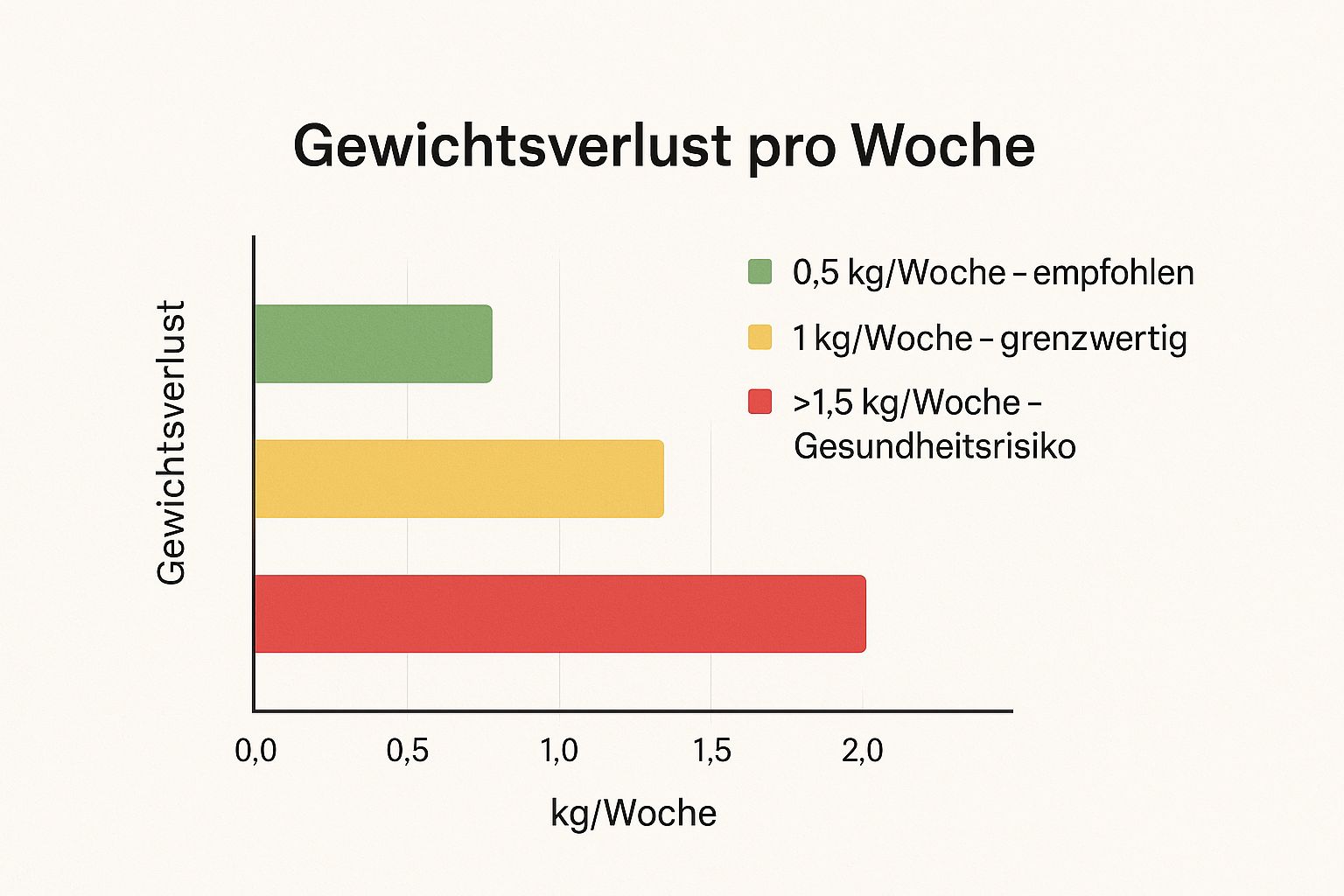
As the graphic illustrates, a weight loss of more than 1.5 kg per week is already considered a health risk, while 0.5 kg is considered an ideal benchmark.
The following table summarizes the recommended values for sustainable weight loss clearly.
Guidelines for healthy weight loss
| Parameter | Recommended Value |
|---|---|
| Weekly Weight Loss | 0.5 to 1 kg |
| Monthly Weight Loss | 2 to 4 kg |
| Daily Calorie Deficit | approx. 500 kcal |
| Long-term Goal | 5 to 10 % of body weight |
These values serve as a safe framework for healthy and lasting weight loss without overtaxing the body.
Realistic goals for long-term success
Experts in Germany recommend a weight reduction of one to two kilograms per month, which corresponds to approximately 0.25 to 0.5 kilograms weekly. Even a reduction in body weight of 5 to 10 percent can bring enormous health benefits, such as a noticeable relief of joints and a lower risk of cardiovascular diseases.
To put these goals into practice, of course, the right strategies for everyday life are needed. In our guide, you will find many useful weight loss tips that will help you sustainably change your eating and exercise habits.
Why Your Body Sabotages Crash Diets

Imagine your body as a clever but very cautious manager. If you suddenly drastically cut its budget—that is, daily calories—all alarm bells immediately go off. It switches into crisis mode. This survival instinct is deeply rooted in our biology and is the main reason why most crash diets are doomed to fail.
Instead of directly attacking the unwelcome fat, the body tries to protect itself from perceived starvation. One of its first defense mechanisms? It slows down metabolism. Your body essentially becomes more economical and burns fewer calories to conserve the little energy it has.
Muscle breakdown as a protective reaction
If the extreme calorie deficit continues, the body taps into an easily accessible energy source: your muscles. Muscles are metabolically active, meaning they burn energy even at rest. However, in a state of perceived starvation, they are a luxury item that the body can do without.
The breakdown of muscle mass has two fatal consequences for your goals:
- Your basal metabolic rate decreases: Fewer muscles mean your body automatically burns fewer calories in everyday life.
- You lose strength and shape: Instead of looking slimmer and more defined, you often appear flabby and weak.
This explains why the number on the scale quickly drops during a crash diet, but the result is rarely what was hoped for. You mainly lose water and valuable muscle mass, but hardly any fat.
In an emergency, the body prefers to sacrifice energy-hungry muscles rather than its vital fat reserves. From an evolutionary perspective, this is a brilliant move, but it directly sabotages your weight loss plans.
The yo-yo effect as a logical consequence
As soon as the crash diet is over, the dreaded yo-yo effect strikes. Your metabolism is still in energy-saving mode, and your body has learned to get by on very little energy. If you now start eating normally again—even if it's less than before the diet—every small surplus is immediately stored as fat again.
Your body practically arms itself for the next famine and becomes a master at storing. The result: you not only regain the lost weight, but often even a few more pounds.
This vicious cycle of rapid weight loss and even faster weight gain is not only incredibly frustrating but also unhealthy. Once you understand this mechanism, you realize why patience and a moderate approach are the only true keys to success. A well-thought-out approach that teaches you how to lose weight sustainably protects your metabolism and leads to lasting results without tricking your body.
What Factors Influence Your Weight Loss Pace

Have you ever wondered why your friend seemingly effortlessly loses weight, while nothing happens on your scale? The answer is quite simple, yet crucial: Your weight loss journey is absolutely unique. There is no universally applicable formula, because your body reacts in its very own way. How much weight you can healthily lose per week therefore depends on a whole range of very personal factors.
Comparing yourself to others is therefore not only unfair but above all demotivating. It is much more important to understand your own variables that determine your personal pace. Knowing these factors allows you to set realistic goals and remain patient, instead of throwing in the towel in frustration.
Your starting point is crucial
A very important factor is your starting weight. Someone with a higher body weight simply burns more calories at rest and with every movement than a lighter person. This is logical, as more mass has to be moved.
Imagine it as carrying backpacks. Someone carrying a 30 kg backpack uses significantly more energy than someone with a light 5 kg backpack. That's why it's completely normal for pounds to drop faster at the beginning of a diet—especially with higher overweight. This initial, rapid success often also consists of excess water that the body releases first.
Further personal influencing factors
Besides weight, there are many other very personal characteristics that play a big role. They are the reason why every person loses weight differently and a general answer to the question "How much weight loss per week is healthy?" must always be considered individually.
- Age: Our metabolism tends to slow down with age. The body naturally loses muscle mass, which in turn lowers the basal metabolic rate—i.e., the calories we burn at complete rest.
- Gender: Men naturally tend to have a higher muscle-to-fat ratio than women. Because muscles consume more energy than fat, their calorie requirements are often higher, which can accelerate weight loss initially.
- Genetics: Your DNA has a say, and not a small one. It can influence how your body stores fat, how efficiently your metabolism works, and how your appetite is regulated. Modern DNA tests can provide really exciting insights here.
- Lifestyle: Things like sleep deprivation or chronic stress can significantly disrupt the hormone balance. Especially the stress hormone cortisol is known to promote cravings and fat storage, particularly in the abdomen.
Your body is not a clockwork, but a complex biological system. Your individual weight loss pace is the result of an interplay of genes, hormones, age, and lifestyle habits.
This very knowledge is your key to success. Instead of competing with others, focus on your own progress. To best support your body, it is helpful to naturally boost your metabolism and thus achieve your goals more effectively. Accept your uniqueness and work with your body—not against it.
The Success Formula of Diet and Exercise

When we look at the question "How much weight loss per week is healthy?" in a practical way, there's no getting around a clear strategy. You achieve real, lasting success when two things work together perfectly: a conscious diet and the right exercise. Don't see these as separate tasks, but as a strong team that will safely get you to your goal.
The absolute foundation for any weight loss is a calorie deficit. Sounds complicated, but it just means one thing: you use more energy than you consume through food. But don't worry, this has nothing to do with starving. It's about making smart choices and focusing on foods that truly make you full and satisfied.
Studies from Germany confirm this: A daily calorie deficit of 400 to 600 kilocalories, combined with regular exercise, can lead to a healthy weight loss of 0.5 to 2 kilograms per week. Especially important for long-term success are a low-fat diet with plenty of fruits and vegetables, as well as honest self-monitoring – for example, through a food diary.
Cleverly designing the calorie deficit
You don't achieve a healthy calorie deficit through radical deprivation, but through clever food choices. The trick is to focus on foods with a high nutrient density but low calorie density. This way, you'll be completely full, but still give your body everything it needs.
- Lots of vegetables and salad: Fills the stomach, provides vitamins, and has hardly any calories. Make it the basis of every meal.
- Sufficient protein: Protein is your best friend when losing weight. It keeps you full for an extremely long time, protects your muscles from breakdown, and even boosts your metabolism.
- Complex carbohydrates: Opt for whole grain products, legumes, and oatmeal. These give you energy for hours and keep your blood sugar stable, which curbs nasty cravings.
Especially a protein-rich diet for weight loss is incredibly effective in managing hunger and protecting muscles. In our article, you'll find five simple tips on how to implement this in everyday life.
The key is not to eat less, but to eat better. A nutrient-rich diet optimally nourishes your body and prevents that tormenting feeling of deprivation that causes so many diets to fail.
Exercise that's fun and effective
Exercise is the second half of your success formula. It not only directly increases calorie consumption but also shapes your body and provides a fantastic sense of well-being. A good mix of endurance and strength training is important here.
Endurance training like jogging, cycling, or swimming is perfect for boosting fat burning and strengthening your cardiovascular system. It helps you achieve your calorie deficit more easily and see faster progress.
Strength training, on the other hand, is your secret weapon against the yo-yo effect. Muscles are like small powerhouses in the body – they burn energy even at rest. If you maintain or even slightly build up your musculature through training, your basal metabolic rate remains high.
But the most important thing is: Find an activity that you truly enjoy. Only then will you stick with it long-term, and exercise will become a permanent and beloved part of your daily routine, rather than a tiresome "must."
A Look at Practice: How Healthy Weight Loss Succeeds
Theory and guidelines are a good basis. But what does healthy weight loss look like in real life? Numbers on paper can quickly be discouraging when everyday life interferes. Let's therefore take a look at a tangible success story that shows how patience and the right strategy really pay off.
Imagine a person starting their journey at over 115 kilograms. The goal was clear from the beginning: no record chase, but a path that feels good long-term. Over a period of seven months, this person lost 13 kilograms. That's an average of just under two kilos per month—a pace that fully complies with medical recommendations and gives the body the necessary time to adapt.
Successes that matter more than the scale
The greatest gain here was not the number on the display. Much more important were the changes that noticeably improved the quality of life:
- Reduced waist circumference: The waist circumference significantly decreased. This not only looks better but is primarily a huge health benefit. Less belly fat means a lower risk for many metabolic diseases.
- More muscle mass: Despite a calorie deficit, muscles were built through targeted training. This is extremely important to keep the metabolism active and avoid the dreaded yo-yo effect.
- A whole new body feeling: More energy in everyday life, less joint pain, and increased self-confidence—these were the actual rewards.
This practical example clearly shows one thing: The question "How much weight loss per week is healthy?" is best answered by shifting the focus from pure kilograms to holistic well-being.
A central building block for this success was the clever combination of adapted nutrition and consistent exercise. Instead of radical deprivation, the focus was on nutrient-rich meals that satisfy and taste good. Sometimes, high-quality meal replacement products can also be a practical help in managing everyday life. If you're wondering which weight loss shake is the best, you'll find valuable tips for making the right choice in our article.
Of course, not everything always went smoothly. Especially regular exercise and conscious eating on stressful days required discipline. But precisely this honest confrontation with the hurdles of everyday life makes the success all the more valuable. It proves that sustainable change is achievable if one learns to set realistic goals and also deal with setbacks. In this exciting report from Germany, you can learn more about such experiences and the scientific background.
Do you still have questions? Here are the answers.
Now that we've looked at the basics, personal influences, and best strategies, there are often still some very specific questions left. That's completely normal. That's why we've collected the most common uncertainties that can arise on the path to a feel-good weight and provide clear and direct answers.
Can I lose more than 1 kg per week if I am severely overweight?
Yes, this is definitely possible, and especially at the beginning of a major change with a very high starting weight, it's not uncommon. In the first few weeks, the body often loses a considerable amount of water, which then quickly shows on the scale. This can be a great motivational boost, but it's important to remain realistic.
After this initial phase, however, weight loss should then stabilize at the recommended 0.5 to 1 kg per week. Those who lose weight faster on a sustained basis risk losing valuable muscle mass and slowing down their metabolism. In cases of severe overweight, it is therefore always a good idea to discuss the entire process closely with a doctor. This ensures that your health is always the priority.
A fast start can be exhilarating, but true success lies in consistency. A moderate pace after the first few weeks protects your body and ensures that the results truly last.
What do I do if my weight suddenly plateaus?
A weight plateau is a normal part of the journey and absolutely no cause for concern. On the contrary: it shows that your body is smart! It has adapted to the lower calorie intake and the new physical strain and is now simply working more efficiently.
Instead of throwing in the towel in frustration, see it as a signal to introduce a new stimulus. Here are a few ideas to get you back on track:
- Vary your training: Try new exercises or switch sports. This challenges your muscles in a new way.
- Increase everyday movement: Often, it's the little things that make a difference. Take the stairs instead of the elevator or walk one stop.
- Check your diet: Sometimes, a small adjustment in calories or the distribution of protein, fat, and carbohydrates is enough to kick-start your metabolism again.
- Be patient: Sometimes the body simply needs a short break to recover before weight loss continues.
Do I really have to count calories to lose weight?
No, calorie counting is not a must, but it can be a really useful tool, especially at the beginning. It sharpens your awareness of portion sizes and the energy content of foods. Often, it uncovers unconscious habits that stand in the way of success.
A great alternative is mindful eating. This involves focusing entirely on nutrient-rich and satisfying foods like vegetables, protein-rich foods, and healthy fats. It's about relearning to listen to your body's natural hunger and satiety signals. Simply find the method that best fits your daily routine and feels good to you. Because you'll only stick with what feels good in the long term.
Do you want to take control of your weight loss journey instead of leaving it to chance, and know exactly what your body truly needs? With BODY'S PERFECT DNA metabolism analyses, you gain fascinating insight into your personal genetic predispositions. Discover now at https://bodysperfect.com how you can perfectly tailor your diet and training to your metabolic type and achieve your goals much more effectively.

































Share:
What L-Carnitine Really Does for Your Workouts and Weight Loss
Best Sugar-Free Protein Shakes: 7 Recipes & Products 2025