


Determine Your Metabolic Type: Find the Perfect Plan for Your Body
Have you ever wondered why some diets work wonders for your friend but do nothing for you? Or why your training partner seems to build muscle effortlessly while you struggle? The answer often lies in your unique metabolism. Determining your metabolic type is the first crucial step to finally working in harmony with your body, instead of constantly fighting against it.
Once you know your metabolic type, you'll understand which "fuel" your body prefers: carbohydrates, fats, or a mix of both. This knowledge is pure gold! It allows you to adapt your diet and training in a way that helps you achieve your goals – whether it's losing weight, building muscle, or simply having more energy in everyday life – much more easily. Are you ready to solve the puzzle and unleash your full potential?
Why You Should Know Your Metabolic Type

Does this sound familiar? You try a new diet and see little success, while others lose weight easily with it. Or you give your all at the gym, but muscle building is slow to happen. This is often not due to a lack of discipline, but simply your individual biology.
Your metabolic type is essentially your body's personal blueprint. It determines how efficiently you process and utilize the three main nutrients – fats, carbohydrates, and proteins. Science is quite clear on this: Up to 70% of weight differences between humans can be attributed to our genes.
No More Frustration and Trial and Error
Instead of struggling through countless, often contradictory, dietary trends, knowing your type gives you a clear, personal guideline. Imagine this: You stop trying to refuel a diesel engine with petrol and wondering why it's sputtering. You finally give your body exactly the fuel it runs best on.
When you understand how your body works, you make choices that truly suit you. This brings you many advantages:
- More effective weight loss: You put together your meals in a way that keeps you truly full for a long time and prevents cravings from even arising.
- Targeted muscle building: You supply your muscles with exactly the energy they need for growth and regeneration.
- More energy in everyday life: Your blood sugar level remains more stable, which prevents the typical afternoon slump and gives you consistent power for the day.
Your metabolism is as unique as your fingerprint. Once you learn to interpret its signals, you lay the foundation for sustainable success – without constant prohibitions and the feeling of having to give up everything.
At the end of the day, it's about finding a strategy that feels good and that you can permanently integrate into your life. Before we look at how you can find out your type, it's important to understand the basics. If you want to delve deeper and learn how you can additionally support your metabolism, check out our guide. There we show you how you can naturally stimulate your metabolism.
The Three Metabolic Types in Detail
To find out which metabolic type you are, let's first look at the three basic categories. In practice, a classification that serves as an excellent starting point has proven successful: the ectomorphic, the mesomorphic, and the endomorphic type. Each of them has its own unique characteristics and thus different needs.
Do you know this? Some people can seemingly eat whatever they want without gaining an ounce. Others, however, only have to look at a piece of cake and feel like it lands directly on their hips. This is not imagination – it is often due to the genetic predisposition of your metabolism.
The Ectomorphic Type – Also Known as the Carbohydrate Type
Do you belong to the people who are naturally rather slender, have long arms and legs and narrow joints? Do you find it difficult to build muscle and gain weight slowly, even though you eat a lot? Then you could be an ectomorphic type. Your metabolism runs at full speed and burns calories, especially carbohydrates, lightning fast.
For you, regular, carbohydrate-rich meals are absolutely crucial to maintain your energy level and enable muscle building in the first place. A low-carb diet would be counterproductive for you and would probably make you tired and listless.
My practical tip: Focus on complex carbohydrates like oatmeal, whole grain products, or sweet potatoes. They provide you with long-lasting energy and don't unnecessarily spike your blood sugar.
The Mesomorphic Type – The Athletic All-Rounder
Mesomorphic types often hit the genetic jackpot. They naturally have an athletic physique with broad shoulders and a narrow waist. Muscle building comes relatively easy to them, and if necessary, they also lose excess fat quickly.
Their metabolism is a true marvel of efficiency and can utilize carbohydrates, fats, and proteins very well. This means: A balanced mixed diet with a good ratio of all three macronutrients is just right for this type.
The following graphic gives you an idea of how the different metabolic speeds are distributed in the population.
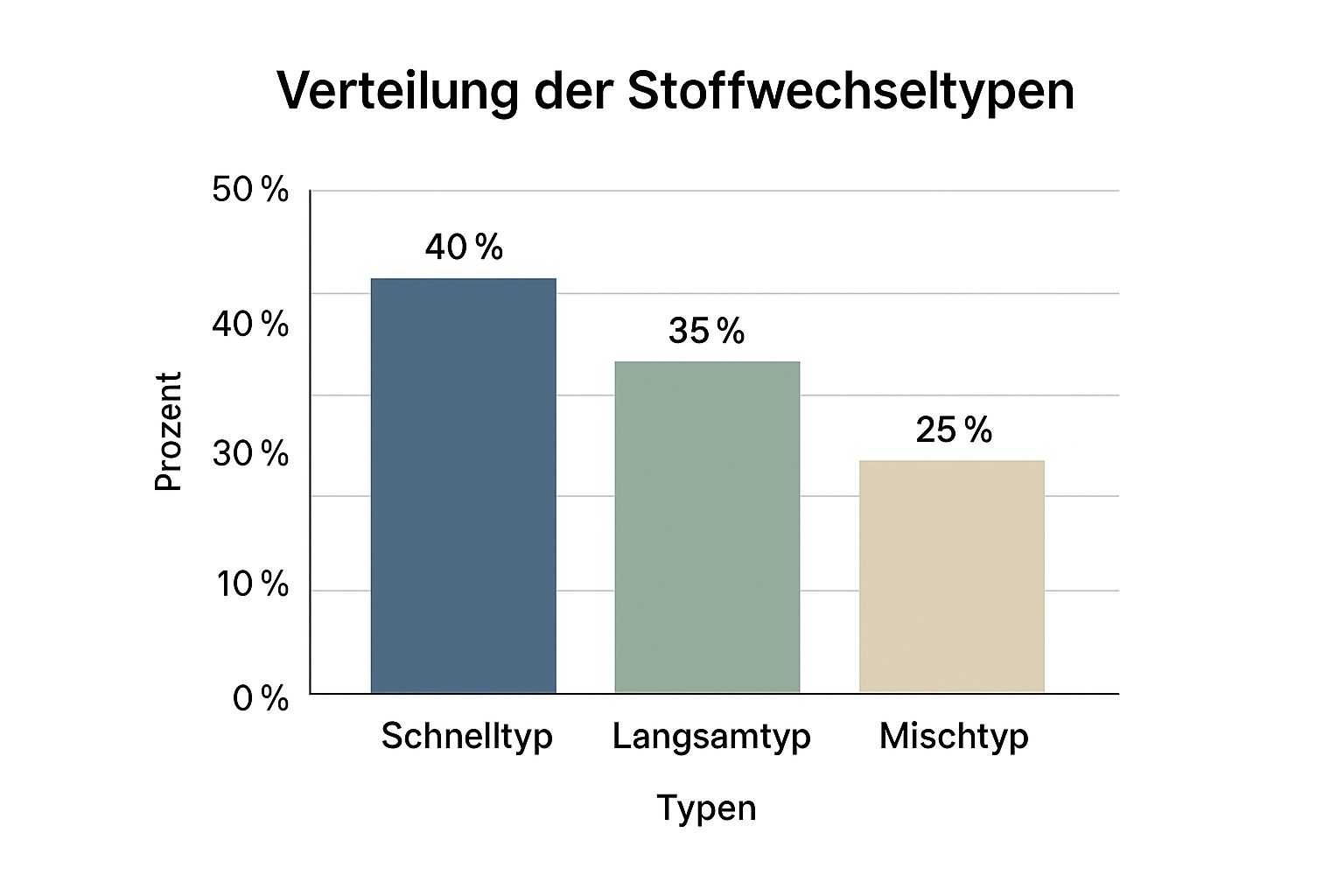
It can be clearly seen here that a fast metabolism is most common, followed by the slow type. The balanced mixed type, on the other hand, is somewhat rarer.
The Endomorphic Type – The Protein-Fat Type
Are you more inclined to a stronger, rounder build and unfortunately store fat quite easily, especially on your stomach, hips, and thighs? Then you might be an endomorphic type. Your metabolism works rather leisurely, which often makes weight loss a particular challenge. Your body stores excess energy – especially from simple carbohydrates – very efficiently as fat reserves.
For you, a diet rich in proteins and healthy fats is often the key to success. Eating fewer simple carbohydrates helps you keep your blood sugar stable and slow down fat storage.
A protein-rich diet can work wonders, especially when losing weight, as it keeps you full for a long time and protects your muscles. If you want to delve deeper into the topic, you will find valuable tips for a protein-rich diet for weight loss in our guide.
How to Find Out Your Metabolic Type with a Self-Test
Are you ready to become a detective of your own body? Excellent! This practical section is your personal guide to collecting initial important clues about your metabolic type. This is not about making a final diagnosis. Rather, I want to show you how to develop a better feeling for your body's signals and sharpen your awareness.
For a moment, forget rigid rules and focus entirely on honest self-observation. Just grab a pen and paper or open a note app. The following questions will help you recognize important patterns in yourself.
Your Body Type and Its Tendencies
Take a close look at yourself in the mirror and feel your joints. Your body type often reveals an astonishing amount about how your metabolism works.
- Your joints: Are your wrists and ankles rather narrow and delicate? Or are they strong and broadly built? Delicate joints often point towards an ectomorphic type, while broader joints rather indicate an endomorphic type.
- Your stature: Would you describe yourself as someone with long, slender limbs or do you have a more compact, sturdier build?
- Muscles and fat: Is it easy for you to build muscle, or do you have to fight extremely hard for it? And where do you most easily gain fat – is it evenly distributed, does it accumulate on your stomach, or rather on your hips and thighs?
These external characteristics are a good start. But it only gets really exciting when we take a closer look at your eating habits and your body's reactions to different foods.
Your Eating Habits and How You React to Meals
Now we're going into detail. Observe yourself consciously after eating in the coming days. How do you feel after certain meals?
Imagine this scenario: You eat a large plate of pasta with tomato sauce for lunch. Are you energetic and fit for the afternoon afterwards? Or does that heavy tiredness come over you an hour later, where you'd rather take a nap right away?
Or another example: You eat a grilled chicken fillet with a large vegetable salad. Does that give you power for hours, or do you feel like you need to eat something again after a short time because you lack energy?
Observe very carefully: Your body sends you clear signals. If you quickly feel hungry and unfocused after a carbohydrate-rich meal, your metabolism might process proteins and fats better. If, however, you stay full and energetic for a long time after a protein-rich meal, that is a strong indication of the protein-fat type.
The influence of nutrition goes even further. A German study has shown that the composition of food has a direct influence on metabolism and even mental health. A typical Western diet with a lot of sugar and saturated fats can negatively affect metabolic function and cognitive performance.
This self-observation is an incredibly valuable tool. It helps you understand why certain diets or eating habits may never have worked for you. It is the basis for any further adjustment.
However, if you want to know even more precisely and see your genetic predispositions in black and white, a DNA test for weight loss could be the next logical step for you.
If You Want to Know Precisely: Professional Methods for Metabolic Analysis
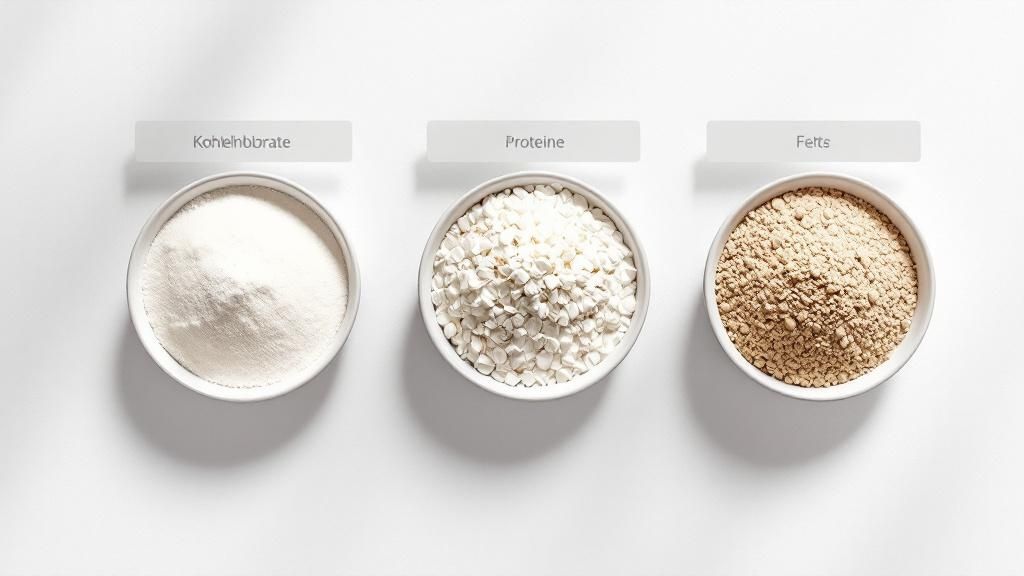
A self-test is great for getting an initial feel for your body. But if you want to stop guessing and really be sure, there's nothing better than a professional analysis.
Here you get hard facts and objective data. This is the basis for finally putting your diet and training on a solid foundation. Such analyses are no longer only reserved for professional athletes but are becoming increasingly accessible. The investment is worthwhile if you finally want clarity and no longer want to waste time with inefficient methods.
Your Breath Reveals Everything: Spiroergometry
One of the most precise methods we have today is respiratory gas analysis, also known as spiroergometry. It sounds complicated, but it's basically quite simple: You breathe through a mask – first at rest and then under exertion, usually on a bicycle ergometer. This measures how much oxygen you inhale and how much carbon dioxide you exhale.
The result is pure gold. This ratio shows exactly which energy source your body taps into when. You see in black and white at which point your body switches from fat to carbohydrate burning. This one piece of information is crucial for perfectly timing your training for fat reduction.
What this means for you: You get your very personal heart rate zones. This allows you to train precisely in the optimal range for fat burning or for more performance. No more trial and error.
Under the Microscope: Body Composition and Blood Values
Another piece of the puzzle is the exact composition of your body. For this, experts often use Bioelectrical Impedance Analysis (BIA). A tiny, imperceptible current is sent through your body. Because muscles, fat, and water conduct electricity differently, the device can calculate your exact composition from this.
In addition, targeted blood tests can eliminate any remaining ambiguities. The following values are mainly examined:
- Blood sugar & insulin: Show how your body really reacts to carbohydrates.
- Hormones: Thyroid values, for example, are the engine of your metabolism.
- Blood lipids: Provide important information about how well your body processes fats.
The combination of these measurements is becoming increasingly important in Germany, especially for the prevention of metabolic diseases. An interesting study from 2018 showed how effective this is: Participants whose metabolism was analyzed by BIA and laboratory values were able to significantly lower their BMI after their diet was adjusted accordingly. The details of this study on metabolic status can be found here.
A Look into the Genes: What DNA Analysis Can Do
If you want to dig even deeper, the path leads to DNA analysis. It looks directly into your genetic blueprint. Certain gene variants (e.g., FTO or APOA5) can indeed influence how sensitive you are to fats or carbohydrates, how strong your feeling of hunger is, or what type of athlete you are by nature. So it's about your genetic predisposition.
But very important: Your genes are not your destiny! They only show a tendency. What you eat, how you train, and how you live determines which genes are actually "switched on." A DNA test can, however, provide valuable puzzle pieces and explain why some strategies work great for you and others don't. Perhaps then you will finally understand why a low-fat diet is personally more beneficial for you than low-carb. The knowledge of how your body works can then also be specifically supplemented with nutrients, whereby, for example, the effect of L-carnitine to support fat metabolism can play a role.
From Knowledge to Action: Your Metabolic Roadmap for Everyday Life
Okay, you've embarked on the journey and learned about your metabolic type – be it through your own observation or even a professional analysis. That's a huge step! But knowledge alone won't get you to your goal. Now comes the exciting part: implementing it in real life.
However, please forget rigid rules and complicated diet plans right away. Nobody can maintain something like that permanently. Your goal should be to gradually establish habits that feel good and fit seamlessly into your daily routine.
See your metabolic type simply as a kind of personal map. The recommendations are your guides, not insurmountable walls. It's about making more conscious decisions that are good for you – without feeling like you have to give up everything.
How to Eat According to Your Type Without Starving
Every body has a preferred "fuel." Your task now is to give your body exactly what it runs best on and feels most comfortable with.
For the ectomorphic type (carbohydrate type): Your metabolism is running at full speed and constantly needs replenishment. To avoid energy dips and support muscle building, you should plan a good portion of complex carbohydrates with every main meal. Think of oatmeal for breakfast, quinoa in your salad for lunch, or sweet potatoes as a side dish in the evening.
For the mesomorphic type (mixed type): You are a born all-rounder, and your body loves balance. A simple rule of thumb for your plate: one-third high-quality protein (like chicken, fish, or legumes), one-third complex carbohydrates, and one-third healthy fats from avocados, nuts, or good olive oil. This will keep you well supplied.
For the endomorphic type (protein-fat type): Your key to success is to clearly focus on proteins and healthy fats. This combination not only keeps you full for a long time but also ensures a stable blood sugar level. Try to reduce simple carbohydrates like white bread, sugar, or classic pasta. Instead, load your plate with plenty of vegetables.
My most important practical tip: Listen to yourself! These recommendations are a great starting point. If you feel energetic, full, and simply good after eating, then you are on the right track.
Exercise That Really Works
The same applies to exercise: work with your body, not against it. A training plan that takes your genetic strengths into account is not only more effective but also more fun.
- Ectomorphic types should focus on targeted strength training. Heavy weights and fewer repetitions will best help you build the desired muscle mass. Endless cardio sessions are rather counterproductive for you.
- Mesomorphic types respond fantastically to a colorful mix. Combine strength training with moderate endurance sports and feel free to introduce variety to always set new stimuli and stay motivated.
- Endomorphic types benefit immensely from the combination of two things: regular strength training to increase basal metabolism through more muscle mass, and high-intensity interval training (HIIT) to really boost fat burning.
In addition to food and exercise, micronutrients also play a crucial role. Did you know that according to a Forsa survey in Germany, more than half of the population regularly uses dietary supplements? Your metabolic type can give you initial indications of whether you might have an increased need for certain vitamins or minerals. If you want to delve deeper into this, qualified advice makes perfect sense. You can find valuable information on how to detect nutrient deficiencies, for example, in this guide from the Verbraucherzentrale.
Typical questions about determining your metabolic type
Great, you already know a lot about how to find out your metabolic type and what this knowledge brings you. Nevertheless, there are usually still a few open questions before you really get started. Don't worry, that's completely normal. Let's clear up the most common uncertainties so you can start with a good feeling.
Can my metabolic type change throughout my life?
A really good question that many people ask. The answer is a clear yes and no. Your genetic predisposition, i.e., your basic type, is fixed in your DNA and remains the same throughout your life.
But your metabolism is not a rigid construct! Your body is clever and adapts. Your age, hormonal phases like pregnancy or menopause, but also chronic stress or a new, intensive training program can influence your metabolism. So it's a really good idea to re-evaluate your strategy every few years and adjust it if necessary.
Is an online test sufficient for determination?
Online questionnaires and honest self-observation are a fantastic start. You learn an incredible amount about yourself and develop a feel for which direction you're heading in. That alone is worth its weight in gold, because you start to understand your body's signals better.
However, if you want to know exactly and delve really deep, then a professional analysis – be it via breath or blood – is simply more precise. For very specific nutrient recommendations, a scientific test provides the most reliable data.
Do I have to adhere 100% to the guidelines?
Absolutely not! Please see the recommendations as your personal compass, not as a strict set of rules. It's about finding a way of eating that you can really live with – and without constant stress. Sustainability always beats perfection.
A great approach that has proven successful in practice is the 80/20 rule.
This means: You try to stick to the foods and meals that are optimal for you for about 80% of the time. The remaining 20% is for everything else – for the piece of cake at Grandma's, pizza with friends, or simply for pure enjoyment without overthinking. This way, you create a balance that feels good and that you can maintain in the long term.
If you still have other things on your mind, check out our FAQ page, where you'll find more answers to questions from our community.
Are you ready to finally take your diet and training to a new level? Discover what's really in you with BODY'S PERFECT DNA tests and weight loss products. Visit our shop now at https://bodysperfect.com and start your personal success story.






























Share:
Boost Metabolism Naturally: Top 8 Tips 2025
Why a metabolism test can help you lose weight