


A metabolic analysis for weight loss is your personal key to success if you finally want to understand why conventional diets simply don't work for you. Instead of blindly counting calories, it helps you discover how your body truly works and processes nutrients like fats and carbohydrates. This lays the foundation for a journey to a feel-good weight that truly suits you.
Why standard diets often fail and what truly helps

Do you know the feeling? You give your all, stick to strict plans, but the number on the scale just won't budge. This frustration is widespread, and you're not alone. Many people torture themselves with diets, reduce calories, and exercise – yet the hoped-for success eludes them.
The catch is often that these "one-size-fits-all" approaches overlook something crucial: your very personal, unique biology.
Each of us is different and processes food in our own unique way. What works wonderfully for your friend might be completely ineffective for you. This is precisely where a metabolic analysis for weight loss comes in. It's not hocus pocus, but a scientifically sound look under the hood of your body's "engine."
Imagine it this way: The analysis provides you with a personalized user manual for your body. You learn which fuel (i.e., fats, carbohydrates, or proteins) it utilizes best. The result is a nutrition plan that is tailor-made for you – without blanket prohibitions and constant deprivation.
Your personal path instead of general rules
Once you know your metabolism, the guesswork stops. Instead, you can act purposefully and answer the right questions:
- What nutrient type am I? Are you someone who processes carbohydrates well, or do fats work better for you?
- What is my actual calorie requirement? Perhaps you are even eating too little and thus slowing down your metabolism.
- Does my genetics play a role? Some people have a stronger predisposition to the notorious yo-yo effect.
With these insights, you can turn things around. You finally learn which foods are good for you and which unknowingly sabotage your weight loss goals. The frustrating feeling of not losing weight despite a calorie deficit will be a thing of the past. You can read more about this phenomenon in our article on reasons why you're not losing weight despite a calorie deficit.
The figures also show how important a personal approach is: A study from the end of 2017 showed that in Germany, approximately 43.1% of women and 62.1% of men were overweight. A diet tailored to individual metabolism can sustainably help to achieve a healthy weight and prevent secondary diseases.
Understanding your metabolism as a unique power plant
It's best to imagine your metabolism as the engine in your car. Every engine is different. One is a zippy petrol engine that loves high revs, the other a solid diesel that quietly and efficiently putters along. Your metabolism is just as individual – your very own personal power plant.
This power plant runs non-stop, 24 hours a day, even when you're sound asleep. It has one main task: to convert the food you eat into energy. You need this energy for absolutely everything – from breathing and thinking to exercising. How quickly and efficiently this process runs, however, varies completely from person to person.
Basal metabolic rate and activity metabolic rate: The two sides of the coin
To understand how your inner engine truly works, we need to look at two important terms:
- Basal metabolic rate: This is the amount of energy your body consumes in a state of absolute rest. Imagine lying relaxed on the sofa – your heart beats, you breathe, your body temperature is regulated. All of this costs energy. This basal metabolic rate accounts for the lion's share of your daily consumption, often between 60% and 75%.
- Activity metabolic rate: This energy is added on top. It is consumed for every single activity that goes beyond pure survival functions. This includes your job in the office, your workout in the gym, but also everyday movements like climbing stairs or walking to the supermarket.
Your total daily calorie requirement is therefore the sum of your basal metabolic rate and your activity metabolic rate. This is precisely where it becomes clear why blanket diet plans so often fail. A "one-size-fits-all" recommendation ignores the fact that these two values are different for each of us. What is just right for one person can be far too much or too little for another.
Your body is not a simple machine where you simply put in less fuel and expect it to continue running the same way. It is an intelligent, complex system that reacts to changes. If you suddenly eat far too little, your metabolism may go into economy mode to conserve energy. The yo-yo effect is inevitable.
Why your metabolism is as unique as you are
Several factors determine the speed at which your personal engine runs. Your genetics essentially set the factory settings – for example, whether you process carbohydrates better or whether fats are your ideal energy source. This genetic blueprint is why a metabolic analysis for weight loss provides such valuable insights. It deciphers what is anchored in your DNA.
But that's not all. Your age, gender, muscle mass, and of course your lifestyle also play a huge role. Understanding these connections is the first step to learning how you can specifically boost your metabolism. Instead of fighting against your body, you begin to work with it and give it exactly what it needs for peak performance.
Which method of metabolic analysis suits you
When you look into metabolic analysis for weight loss, you'll quickly realize that there isn't one perfect way. The different methods can be quite confusing at first. But don't worry, we'll shed some light on the subject and help you find the right approach for your goals.
Think of the different methods as tools. There's a right tool for every job – and the same applies to analyzing your metabolism.
The classic methods: A snapshot
The most common procedures you'll often find in gyms or with nutritionists are resting metabolic rate measurement and bioelectrical impedance analysis, or BIA for short. Both give you a picture of where your body currently stands.
- Breath gas analysis (indirect calorimetry): This measures your precise basal metabolic rate in calories via your breath gases. This method is truly precise for determining your current energy requirements.
- Bioelectrical impedance analysis (BIA): Here, a weak, imperceptible current flows through your body. This allows the composition of fat, muscle, and water content to be determined. However, the accuracy can vary depending on the device and circumstances.
These methods are great for capturing the status quo. They show you where you are now. However, the result can quickly change due to training, a change in diet, or even stress.
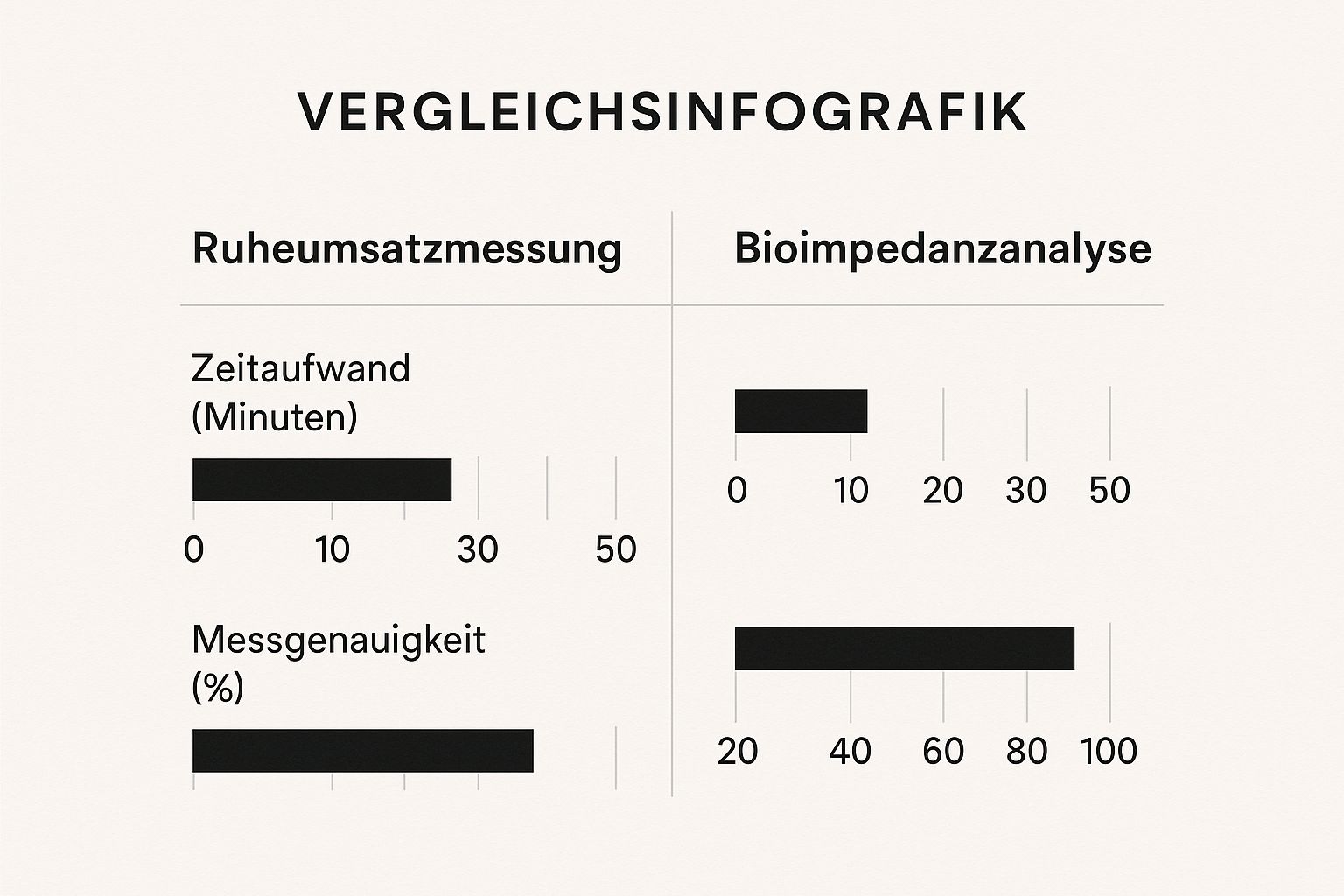
As you can see, resting metabolic rate measurement often provides more accurate data but also takes longer than a quick BIA.
Looking into the future: What a DNA metabolism test reveals
While classic methods provide a snapshot, a DNA metabolism test goes a decisive step further. It doesn't look at your current state, but at your genetic predisposition – essentially your personal "factory settings," which don't change throughout your life. With such a test, like those offered by bodysperfect.com, you gain a sustainable basis for your health.
A DNA test is like looking at your body's blueprint. It tells you whether you are genetically more of a carbohydrate, fat, or protein type and how your body reacts to different nutrients. This information is a sustainable foundation for all your future dietary decisions.
The following table compares the most common methods of metabolic analysis to help you decide on the right approach.
Comparison of methods for metabolic analysis
| Method | What is measured? | Advantages | Ideal for |
|---|---|---|---|
| Breath Gas Analysis | Precise basal metabolic rate (calorie consumption at rest) | Very precise snapshot, good for calorie planning | Athletes or people who need to know their current energy requirements exactly. |
| Bioelectrical Impedance Analysis (BIA) | Body composition (fat, muscle, water) | Quick, easy to perform, good for tracking progress | Anyone who wants to quickly and easily track changes in their body composition. |
| DNA Metabolism Test | Genetic predisposition for nutrient utilization | Lifetime valid results, deep understanding of one's own body | Anyone who wants to build a long-term and sustainable nutrition strategy. |
So each method has its place. For sustainable change, however, it is most effective to know not only the current state but also the underlying predisposition.
These in-depth insights are becoming increasingly important, as, according to the Federal Statistical Office, the proportion of obese adults in Germany rose from 14.7% in 2009 to 16.8% in 2021. This shows how urgently we need precise, individual approaches like metabolic analysis to effectively combat obesity.
So, if you are looking for a permanent solution and don't just want to tinker with short-term adjustments, a DNA test is the ideal choice. It gives you the knowledge you need to truly understand your body and shape your path to a feel-good weight on a solid, scientific basis.
In our guide, you'll learn more about how you can test your personal metabolic type. The DNA Metabolism Tests from bodysperfect.com offer you exactly this opportunity – simple, understandable, and directly for home use.
What your genes reveal about your weight loss success

Imagine you had a personal user manual for your body. A "package insert" that clearly tells you which foods are ideal for you to not only reach your feel-good weight but also maintain it permanently. This is exactly what a metabolic analysis for weight loss based on your DNA achieves. It leads us directly into the fascinating world of nutrigenetics.
Nutrigenetics is the branch of science that precisely illuminates how your unique genes control your body's response to specific nutrients. This is why your best friend loses weight wonderfully with low-carb, while you just feel sluggish and low on energy doing the same. Your genes essentially set the rules of the game for your metabolism.
They have a say in whether you convert fats or carbohydrates into energy better. They can even influence your susceptibility to the dreaded yo-yo effect or how quickly you feel full. This genetic blueprint is the key to a truly personalized nutritional approach – one that goes far beyond simple calorie counting.
Your genetic metabolic type as a compass
A DNA test transforms this complex genetic data into understandable and, most importantly, practical recommendations. It finds out your personal metabolic type. For example, you might discover that you are a "carbohydrate type" whose body prefers carbohydrates as the number one energy source.
However, you might also be a "protein type" who benefits from a higher-protein diet to stay full longer and protect muscles. Of course, there are also mixed types for whom a balanced distribution of nutrients works best.
A DNA test doesn't give you rigid rules, but a compass. It shows you the direction that best suits your biology and gives you the freedom to choose the foods you love and that are good for you within that framework.
This knowledge can be an incredible relief. Instead of struggling through countless diet trends that simply don't work for you, you get a clear, scientifically sound basis for your decisions.
The path to your personal result is very simple
Fortunately, performing such a genetic analysis today is child's play and can be done conveniently from home. The DNA Metabolism Tests from bodysperfect.com are precisely designed to make this access as uncomplicated as possible for you.
Here's how it generally works:
- Sample collection at home: You receive a test kit with everything you need. You take a saliva sample from your cheek with a simple cotton swab – this is absolutely painless and done in seconds.
- Analysis in a specialized laboratory: You send the sample back in a pre-franked envelope to a certified laboratory. There, experts analyze the genes that are important for your fat, carbohydrate, and protein metabolism.
- Your personalized report: After the evaluation, you receive a detailed and easy-to-understand report. It states exactly what metabolic type you are and what that means for your diet and training.
These results are your personal starting signal for sustainable change. You not only learn which nutrients your body can utilize optimally, but often also which types of sports, due to your genetics, best support fat loss and muscle building.
With this knowledge, you can finally design a nutrition plan that is based on your biology, not on general advice. If you want to delve deeper into the topic now, read our article on how losing weight with a DNA test can help you truly achieve your goals. See it as a one-time investment in the most valuable knowledge of all: knowledge about yourself.
How to implement your analysis results in everyday life
Imagine that knowing your genetic metabolic type is your personal compass to weight loss success. A great thing, right? But even the best map won't get you to your destination if you don't take the first step. That's exactly what we're going to do together now: we're translating theory into practice.
I'll show you how to integrate the results of your metabolic analysis for weight loss into your daily life immediately and without much effort.
Forget the image of a huge, insurmountable mountain of changes. We'd rather take many small, manageable steps. It's not about strict prohibitions or a radical diet, but about smart adjustments that fit well into your life.
From knowledge to action: your very personal roadmap
The results of your DNA Metabolism Test from bodysperfect.com are like a blueprint for your body. They tell you in black and white which nutrients your body can utilize best. The next logical step? Getting this knowledge onto your plate – and that starts with grocery shopping.
Take your shopping list and adapt it to your profile:
- Are you a carbohydrate type? Great, then fill your basket with whole grain carbohydrates. Think whole-wheat bread, oats, quinoa, and sweet potatoes. These will give you long-lasting energy.
- Are you more of a protein type? Then lean meat, fish, eggs, but also lentils and tofu should be at the top of your list. They make you feel full and are pure gold for your muscles.
- Can your body utilize fats particularly well? Perfect! Then healthy fats are your friends. Avocados, nuts, seeds, and good oils like olive or flaxseed oil belong in your kitchen.
It's important here: it's about setting priorities, not about eliminating entire nutrient groups. Your body needs a little bit of everything. But thanks to the analysis, you now know the best ratio for your body.
Sport and exercise that suit your genetics
Not only your diet, but also your training can now be designed more specifically. Your genes also give you a hint as to which type of exercise is particularly effective at boosting fat burning for you.
- Endurance types: Often benefit immensely from longer, moderate sessions. Jogging, a bike ride, or swimming could be just your thing.
- Strength types: Often see faster progress when they focus on strength training, HIIT (High-Intensity Interval Training), or short, sharp sprints.
Just try a few things and listen to your body. What feels good? What do you enjoy? Because only then will you really stay motivated.
Avoiding common pitfalls and staying motivated
Every beginning is difficult, and every change comes with some hurdles. The biggest stumbling blocks are usually impatience and the urge to do everything perfectly. Don't expect miracles overnight, and don't be too hard on yourself if a day doesn't go according to plan. That's completely normal.
A program tailored to you is always the most effective way. This is also confirmed by a study that showed how intensive, personalized weight loss not only shed the pounds but also restored a disturbed sugar metabolism to normal. You can read more about it here: the positive effects of targeted weight loss.
As a little support, you can specifically incorporate certain helpers into your diet. We have put together a practical guide for you, in which you will find a list of foods that stimulate metabolism – a perfect addition to your new, personal diet.
Still have questions? Here are the answers
You have now read a lot about how a metabolic analysis can help you lose weight and finally find your own personal path. But often, a few questions still remain. Let's clarify the most common ones so that you really get a clear picture.
Is such an analysis really for everyone?
Basically, yes. Everyone can benefit from understanding their body better. But it is especially helpful for you if you have tried countless diets and success simply hasn't lasted.
Do you know that feeling? You eat healthy, you exercise, but the scale simply doesn't budge. Or you wonder why you simply feel sluggish and full after certain meals. This is exactly where the analysis comes in and gives you the missing pieces of the puzzle.
It is practically your guide away from general "one-size-fits-all" diets to a plan that is truly made just for you.
How accurate is such a DNA metabolism test?
The DNA tests, such as those you can find at bodysperfect.com, are the result of state-of-the-art laboratory analyses. Your individual genetic markers are examined. The accuracy with which your gene variants are determined is extremely high and scientifically sound.
The cool thing about it: Your genes don't change. Ever. So the result is not a snapshot, but a lifelong operating manual for your body. A one-time thing for lasting clarity.
It is important to understand: The test shows you your genetic predisposition – so to speak, your body's factory settings. How you live, of course, still plays a huge role. But with this knowledge, you are no longer in the dark, but can finally perfectly align your lifestyle with your genes.
Does the analysis then replace going to the doctor?
Clearly: No. A metabolic analysis is a fantastic tool to optimize your diet, but it is not a medical diagnosis and does not replace medical advice.
If you have health problems or are severely overweight, please always discuss your weight loss plans with your doctor first. However, the results of the analysis are an excellent basis for this conversation. They help you and your doctor or nutritionist to devise a plan that is not only effective but also safe for you.
And what about the costs? Does health insurance cover it?
The costs, of course, depend on the method. Since DNA tests are a kind of preventive measure for self-optimization, statutory health insurance companies generally do not cover the costs.
Some private health insurance companies are sometimes more lenient and reimburse a portion depending on the tariff. It's best to simply ask your insurance company directly.
However, try to see the costs as a one-time, truly worthwhile investment in yourself and your health. Instead of constantly spending money on new diet shakes, books, or programs that ultimately don't work, you invest once in the most important thing of all: knowledge about your own body. And that stays with you forever.
Are you ready to stop guessing and finally know what your body really needs? At BODY'S PERFECT, we have just the right tools for you.
Check out the DNA metabolism tests from bodysperfect.com now and get the personal user manual for your body.











































Share:
What does protein powder really do for you?
Vitamin B12 Tablets: Your Guide to Making the Right Choice