


Do you know that feeling? You meticulously watch your diet, exercise regularly, but the scale just won't budge. This frustrating feeling is not your imagination. A slow metabolism is a biological reality.
Just imagine your body as an extremely fuel-efficient car. It gets by on very little fuel, which in itself is clever and efficient. But if you want to lose weight, this efficiency becomes a real hurdle.
A slow metabolism is no excuse

Sometimes it feels like your body is holding onto every single calorie, right? You are definitely not alone. For many people, the path to their desired weight is rocky because their metabolism naturally runs on low. This simply means that your body burns less energy at rest than others.
This predisposition is not a personal weakness, but a characteristic of your body that you first need to understand. The good news, however, is that you are not helplessly at its mercy. With the right knowledge and a strategy tailored to you, you can specifically stimulate your metabolism and still achieve your goals.
What your genes have to do with it
Science is now certain: Our genes play a huge role in our weight. In fact, 40 to 70 percent of weight differences between people can be directly attributed to DNA. Certain genes, such as the well-known FTO gene, influence how your body processes fats and carbohydrates, how strong your hunger is, and how quickly you feel full.
And this is exactly where the key lies. Instead of following general diet tips that may not work for you, you can find out what is in your personal genetic makeup.
A slow metabolism doesn't mean losing weight is impossible. It just means you need a smarter approach – one that takes your unique biology into account.
Your path to more control and success
The battle against the kilos is a widespread issue. In Germany, more than half of adults are overweight. This is not only due to lifestyle, but often also to an inherently sluggish metabolism that slows down calorie burning and promotes fat storage.
The first and most important step is to no longer see your body as an opponent, but as a partner. Instead of tormenting yourself with blanket advice that only frustrates you, you can learn what your body really needs. We show you how to understand your metabolism and support it specifically. If you are already looking for practical tips, you will find valuable information on natural weight loss in our article.
Recognizing typical signs of a slow metabolism
Do you often feel tired, even though you've had enough sleep? Are you constantly cold, even when others are walking around in t-shirts? You shouldn't just dismiss such signals from your body. They can be important indicators that you belong to the slow metabolism type. It's less about a single ailment and more about understanding the pattern behind it.
Your body is constantly communicating with you. If your metabolism is running on low, it often manifests itself through a whole range of symptoms that may not seem related at first glance. Imagine it this way: your internal power plant throttles its performance to save energy – and you feel this in many different ways.
Your body speaks a clear language
A slowed metabolism is much more than just a number on the scale. It has a direct impact on your overall well-being. Pay attention to whether the following signs sound familiar to you:
- Constant fatigue and lack of drive: If your body produces less energy, you simply feel exhausted and weak more quickly. Everyday tasks can suddenly feel like a marathon.
- Always feeling cold: Your metabolism is also your internal heating system. If it runs slower, it produces less heat. The result: You feel colder more easily, especially in your hands and feet.
- Unexplained weight gain: You're not eating more than usual, but you're still gaining weight or finding it hard to lose it. This is a classic sign that your body prefers to store calories rather than burn them.
- Dry skin and brittle nails: A sluggish metabolism can also slow down cell renewal and the supply of important nutrients to the skin. Dry skin, brittle hair, and cracked nails are often the result.
Incidentally, these symptoms are not uncommon in this country. Estimates suggest that around 20-30% of people in Germany show signs of a slowed metabolism. Lack of exercise and an unbalanced diet can further exacerbate the problem.
Understanding the pattern behind the symptoms
The following table will help you better classify the most common signs of a slow metabolism and understand what is happening in your body.
Symptoms and their possible causes in a slow metabolism This table shows the most common signs of a slow metabolism and explains the underlying physiological correlations.
| Symptom | Possible metabolic cause |
|---|---|
| Weight gain | The body burns fewer calories at rest (low basal metabolic rate) and tends to store excess energy as fat. |
| Persistent fatigue | Cellular energy production (ATP synthesis) is reduced, leading to a general energy deficit throughout the body. |
| Cold sensitivity | Thermogenesis, i.e., the body's heat production, is reduced. The body generates less endogenous heat. |
| Constipation | Intestinal peristalsis (muscle movements of the intestine) is slowed down, which makes digestion sluggish. |
| Dry skin & brittle nails | Nutrient supply and cell renewal are impaired. Important building blocks reach skin, hair, and nails slowly. |
| Concentration problems | The brain does not receive enough energy in the form of glucose, which limits cognitive performance. |
It is important not to view these signals individually, but as part of a larger whole. If you recognize several of these signs in yourself, it is a strong indication that your metabolism could use some support.
A slow metabolism is not fate, but a state. By correctly interpreting your body's signals, you create the foundation to counteract it effectively and regain your energy.
Recognizing the symptoms is the first and most important step. After that, it's about understanding the deeper causes and finding out how you can take action. If you want to delve deeper now, read our comprehensive guide on how to naturally stimulate your metabolism.
What really slows down your metabolism

Okay, now that you know the typical signs of a sluggish metabolism, let's look at what's behind it. Your metabolism isn't a simple on-off switch. It's more of a complex interplay of many small cogs, some of which you can influence yourself. The good news is: You have more levers at your disposal than you might think.
However, there are also factors that are simply inherent in your biology. Getting to the bottom of this and understanding what slows down your internal engine is the decisive step. Only then can you counteract it specifically and finally regain control.
The biggest roadblocks for your metabolism
Sometimes it's precisely the things we do (or don't do) in everyday life that force our metabolism into decline. Paradoxically, the strategies we actually want to use to lose weight often sabotage us.
-
The vicious cycle of crash diets: If you radically deprive your body of calories, its alarm bells ring. It thinks there's a famine and immediately switches to economy mode. Your basal metabolic rate drops to conserve energy. As soon as you then eat normally again, your body stores every calorie as a fat reserve for the next "crisis." This is the classic yo-yo effect, almost predictable.
-
Lack of muscle mass: Muscles are like small power plants that burn calories around the clock – even when you're sitting on the couch. Those who don't exercise enough or only focus on endurance training miss out on this important combustion engine. Every muscle you don't build is a missed opportunity to effortlessly increase your daily calorie consumption.
-
Chronic stress: Constant stress is pure poison for an active metabolism. Your body constantly releases the stress hormone cortisol, and this has two nasty effects: it fuels cravings for sweet and fatty foods and specifically promotes the storage of belly fat.
The genetic factor you shouldn't ignore
In addition to all the things you can control, there's a component that's fixed from birth: your genetic predisposition. Your DNA has a huge say in how your body reacts to certain nutrients and how efficiently your metabolism naturally works.
Your genes are not your destiny, but they are your starting point. Knowing them gives you an unfair advantage because you stop fighting your own biology.
Scientific studies show that our genes determine 40 to 70 percent of our weight. There are certain gene variants – such as FTO or APOA5 – that determine whether you are more sensitive to carbohydrates or fats. This information is invaluable. It explains why the low-carb diet works great for your friend, but may not work at all for you.
Being a slow metabolism type often means nothing more than having a genetic predisposition for very efficient energy storage. If this interests you further, check out our article on how a DNA test can help you lose weight. It reveals exactly these genetic secrets.
How your DNA shows you the way to success
Imagine having a personalized instruction manual for your body. No more guesswork, no more diets that work for others but just don't for you. This is exactly what a DNA metabolism analysis makes possible. It's like a key that helps you understand your metabolism on a much deeper level and finally achieve the desired results.
Instead of following general advice that often only leads to frustration for the slow metabolism type, a test like the one from bodysperfect.com provides you with tangible, scientifically sound facts. You learn in black and white how your body truly reacts to the main macronutrients – fats and carbohydrates.
Your genes are basically your body's blueprint. A DNA analysis reads this plan and translates it into a clear strategy tailored precisely to you. This is the end of trial and error and the starting signal for your very personal path.
What science knows about your metabolism
Our DNA stores an incredible amount of information that directly controls our metabolism. Researchers have now found a whole range of genes that, for example, influence our tendency to be overweight or even our feeling of hunger.
The BODYSlim DNA test from bodysperfect.com specifically examines these crucial gene variants. A simple saliva sample, which you can take comfortably from home, is sufficient for this. A specialized laboratory then evaluates this sample and creates a detailed breakdown of your genetic predisposition.
This way, you get answers to the really important questions to specifically support your slow metabolism type:
- Fat or carbohydrate type? Are you more sensitive to fats or carbohydrates? This one piece of information can change your entire diet, because you finally know which screw to turn for the best results.
- Your personal sports code: Are you naturally more of an endurance type or a strength type? The analysis tells you which type of exercise most strongly boosts your fat burning and most effectively helps you build muscle.
- Hunger and satiety: How strongly is your feeling of hunger genetically predisposed and how quickly do you feel full? This knowledge is invaluable for better understanding and managing cravings.
Your individual roadmap instead of blanket solutions
With this personal information in hand, you can finally leave frustration behind. You not only save a lot of time and energy, but you also invest specifically in what has been proven to work best for your unique body. Instead of fighting against your own biology, you make it your strongest ally.
This approach gives you back control and lays the foundation for lasting success. You no longer have to blindly follow every new diet trend, but can develop a strategy that perfectly suits you and your life. If you want to read more about how the different metabolism types can adjust their diet, you will find valuable tips in our article on diet by metabolism type. This way, you put an end to guesswork and start with a clear, scientifically sound plan towards a more active metabolism and your feel-good weight.
Your personal roadmap to waking up your metabolism
Okay, now it's getting practical. You now know what can slow down your metabolism and that your DNA is the best guide. It's time to put this knowledge into action. Forget all the blanket diets and rigid rules that don't work for most people anyway. Your very personal roadmap should only be based on one thing: what is best for you and your unique body. A DNA analysis provides the perfect foundation for this.
We focus on three crucial areas: nutrition, exercise, and your daily lifestyle. If you adjust these three levers simultaneously, you create the ideal conditions to specifically activate your slow metabolism type. This way, it will turn from a brake into your strongest ally.
Eat what your genes tell you
The very first and most important step is a diet that fits your genetic profile like a tailor-made suit. No more endless guesswork about whether low-carb or low-fat is right for you. A DNA test, such as the BODYSlim DNA test from bodysperfect.com, gives you a crystal-clear answer here.
Comparison of metabolism types based on DNA analysis
The following table shows at a glance how different the recommendations can be, depending on what your genes reveal about you.
| Feature | Type A (e.g., Carbohydrate type) | Type B (e.g., Fat-Protein type) |
|---|---|---|
| Primary energy source | Complex carbohydrates | High-quality fats & proteins |
| Optimal nutrition | Whole grains, legumes, plenty of vegetables | Fish, lean meat, avocado, nuts |
| What to watch out for? | Sufficient protein for satiety | Carbohydrates specifically and in moderation |
| Training focus | Mix of strength & endurance | Focus on muscle building (HIIT) |
As you can see, there is no "one-size-fits-all." What is a turbo for one type can be a handbrake for another.
One tip that almost always works, no matter what type you are: A protein-rich diet is often the key. Your body actually uses more energy to digest proteins than fats or carbohydrates. This is called the thermic effect of food – a small but significant bonus for your metabolism.
Exercise that truly boosts your metabolism
Your sports program should be as individual as your diet. It's absolutely not about tormenting yourself for hours on the treadmill. Much more important is to set the right stimuli that really challenge your body. For a slow metabolism type, a clever mix of muscle building and targeted endurance sessions is almost always the most effective strategy.
Muscles are your best friend in the fight against a sluggish metabolism. Every single pound of muscle mass you build increases your basal metabolic rate. This is the energy your body burns while you're just sitting on the couch.
And don't worry: strength training doesn't make women bulky – that's an old myth. It shapes and tones your body and turns you into a highly efficient calorie-burning machine. A good start is two to three strength training sessions per week, combined with two sessions of moderate cardio such as brisk walking, cycling, or swimming.
The graphic below clearly shows what a big difference an activated metabolism makes. It compares the values of a slow metabolism with those of an average one.
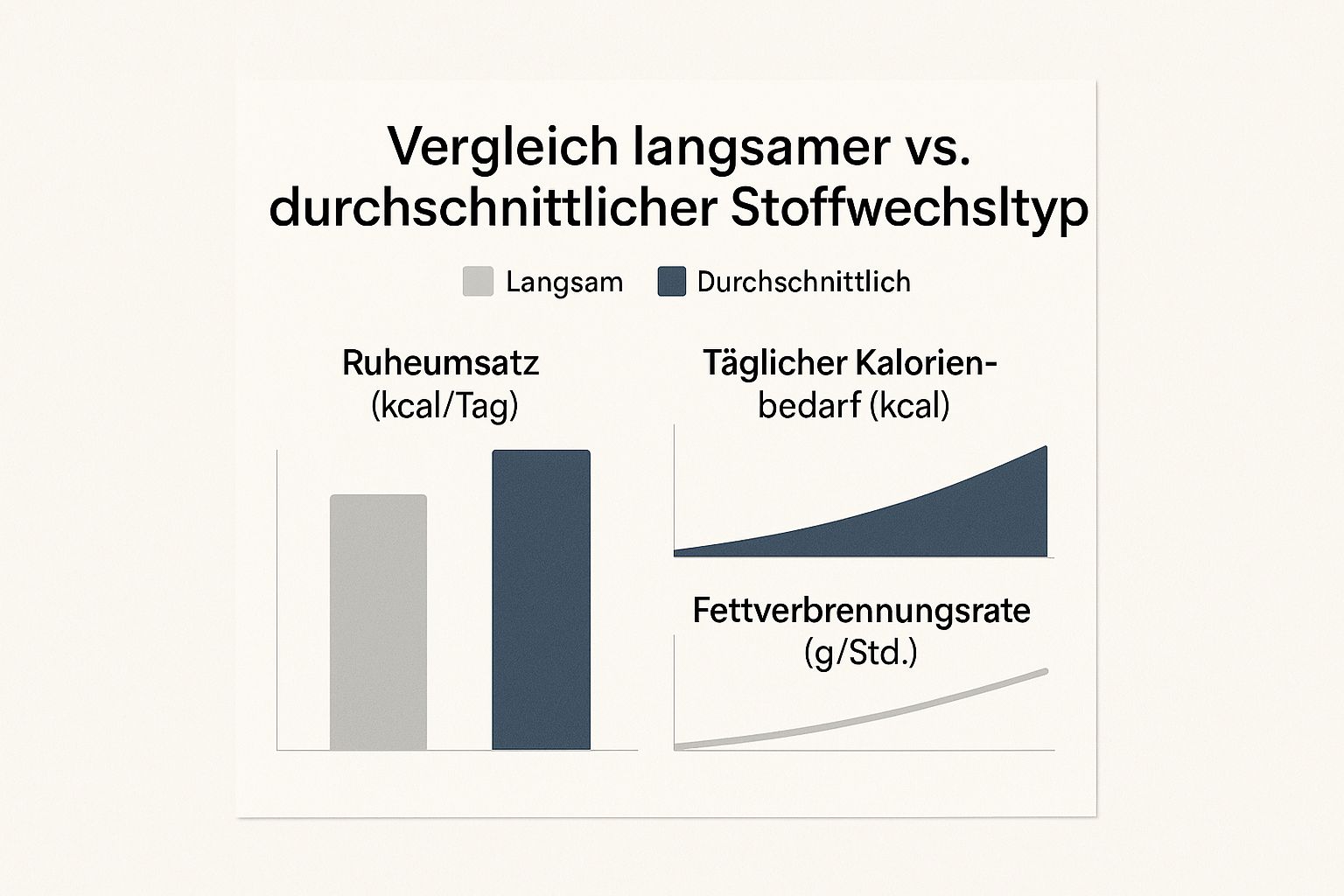
You can see immediately: a slower metabolism directly affects your resting metabolic rate and thus your daily calorie requirement. This is precisely why losing weight often seems so arduous.
Your Lifestyle: The Foundation for Every Success
The best nutrition and the smartest training plan will do little for you in the long run if the foundation isn't right. Often, it's the small daily habits that determine success or failure. They can either subtly support your metabolism or quietly sabotage it.
Here are three simple but extremely effective habits:
- Get enough sleep: Sleep deprivation is poison for your metabolism. It throws off hunger and satiety hormones (ghrelin and leptin) and increases the stress hormone cortisol. Aim for seven to nine hours every night.
- Find your way to reduce stress: As you already know, chronic stress leads to the storage of belly fat. Find a method that works for you – whether it's yoga, meditation, a good book, or simply a walk in the woods.
- Drink enough: Water is the fuel for almost all processes in your body. Keep your metabolism running by drinking about 1.5 to 2 liters of water or unsweetened tea daily.
Frequently Asked Questions About Your Metabolism

When it comes to metabolism, there are often more questions than answers. This is completely normal, as the topic is complex and surrounded by countless myths. We shed light on the matter here and give you honest, clear answers to the most common questions.
Because only when you truly understand the connections can you make the right decisions for your body. Knowledge is the first and most important step on the path to sustainable change.
Can a slow metabolism really be "repaired"?
We hear this question all the time. The honest answer is: No, not in the sense of a repair, as one would do with a broken device. But you can train and optimize your metabolism – and that's even better. Your metabolism is not a rigid state, but a dynamic system that adapts to your lifestyle.
Think of muscles as small power plants in your body. The more you have, the more energy they burn, even at rest. Targeted muscle building therefore increases your basal metabolic rate. If you combine this with a diet tailored to your genetic type, your body learns to use nutrients efficiently instead of storing them as fat.
So it's not about a one-time repair, but about a consistent and personalized adjustment of your daily life. The key is to understand your body and give it exactly what it needs to run at full speed.
When should I see a doctor?
If, despite all efforts, you are not making progress or constantly feel extremely tired and lethargic, you should have it medically checked. Sometimes, concrete medical causes are behind a sluggish metabolism.
High on the list is the thyroid gland. A hypothyroidism (underactive thyroid) is a common reason for a slowed metabolism, unexplained weight gain, and leaden fatigue. A simple blood test at the doctor can quickly clarify this.
Don't see a doctor's visit as a failure, but as a clever strategic move. It helps you rule out medical blockages so you can fully concentrate on optimizing your lifestyle.
Nutrient deficiencies, for example in iron or vitamin D, can also slow down your metabolism. These micronutrients are absolutely essential for countless processes in the body.
What do miracle cures like chili or green tea really do?
Time and again, one reads about foods that are supposed to boost metabolism at the push of a button. Substances like capsaicin in chili or catechins in green tea can indeed slightly increase energy consumption in the short term.
However, this effect is minimal and does not last long. Relying solely on such "boosters" would be like trying to start a campfire with a single match. They can wonderfully complement a healthy diet and an active lifestyle, but they will never replace it. The focus must always be on the big picture: nutrition, exercise, and stress management.
For further answers to your questions, we have an extensive FAQ section where you can find even more useful information.
Are you ready to stop guessing and find your very own path to a more active metabolism? At BODY'S PERFECT, we support you with scientifically sound tools. The DNA Metabolism Test provides you with the exact guidance you need for your success.































Share:
Test your metabolic type: The scientific path to your feel-good weight
Lose Weight with a DNA Test: Your Personalized Path to Success