

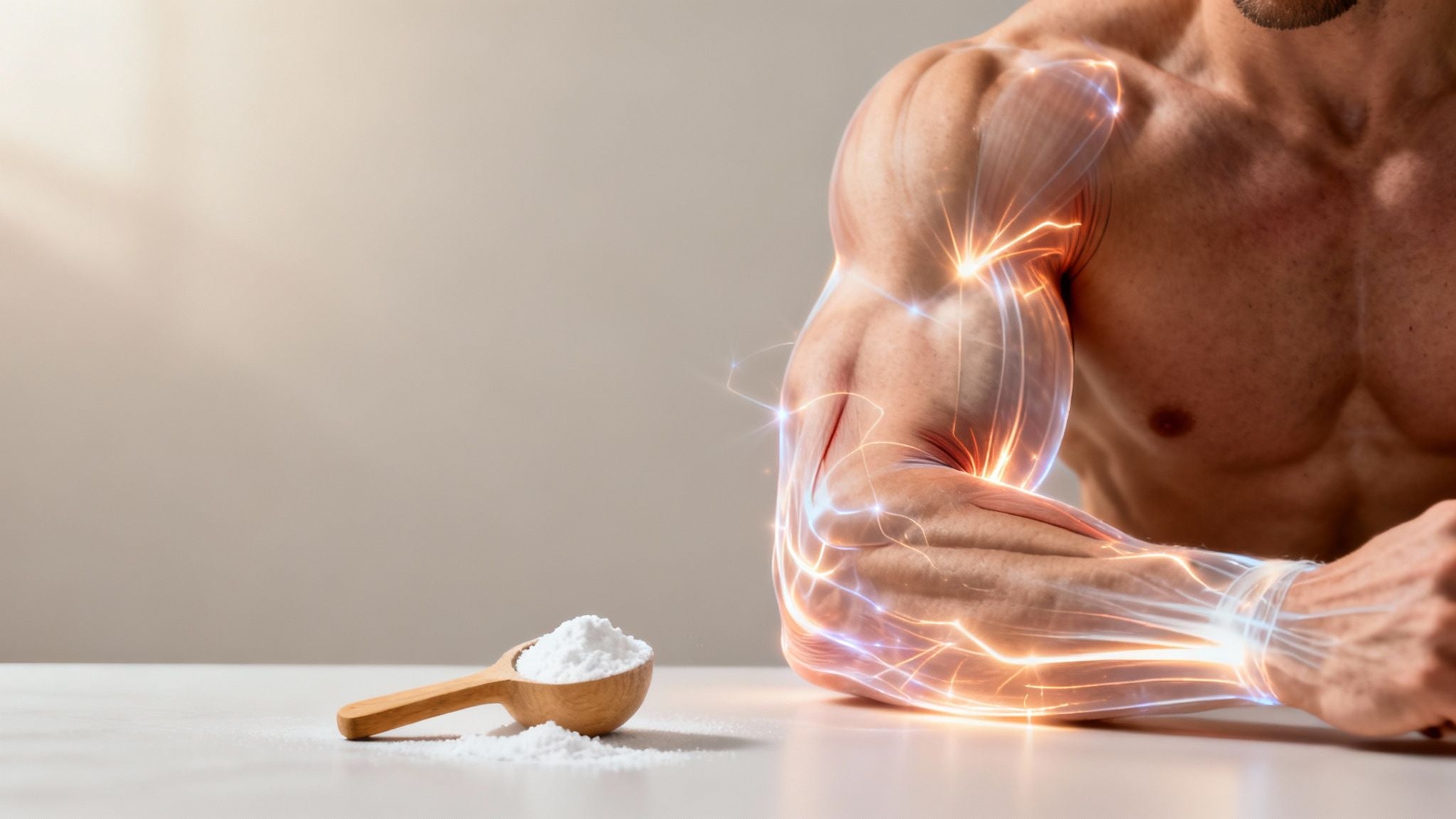
Creatine is much more than just another powder in your shaker for building muscle. You can best imagine it as direct fuel for your muscles – essentially, the turbo boost that kicks in precisely when you want to squeeze out that last, crucial repetition during a heavy exercise. It provides the necessary quick energy and often makes the difference between stagnation and real progress.
What Creatine Truly Means for Your Muscle Growth
If you train hard to get stronger or build muscle, it all comes down to one thing: energy. Every single rep, every sprint, every set – all of it requires strength. Your body's universal energy currency for this is Adenosine Triphosphate (ATP). The problem? ATP stores are tiny during intense exertion and are often depleted after just a few seconds.
This is where creatine in muscle building comes into play. Think of it like a power bank for your muscles. Creatine is converted into creatine phosphate in the body and helps to quickly recharge used ATP. This simple mechanism allows you to train longer at a high level of performance.
What does this mean for you, specifically?
- More strength: You can suddenly manage one or two more repetitions in heavy exercises like squats or bench presses.
- Better performance: Your explosiveness in short, sharp bursts of effort noticeably improves.
- Faster recovery: You recover more quickly between sets and are ready for the next attack sooner.
This infographic illustrates the simple, yet extremely effective cycle of muscle, energy, and performance quite well.
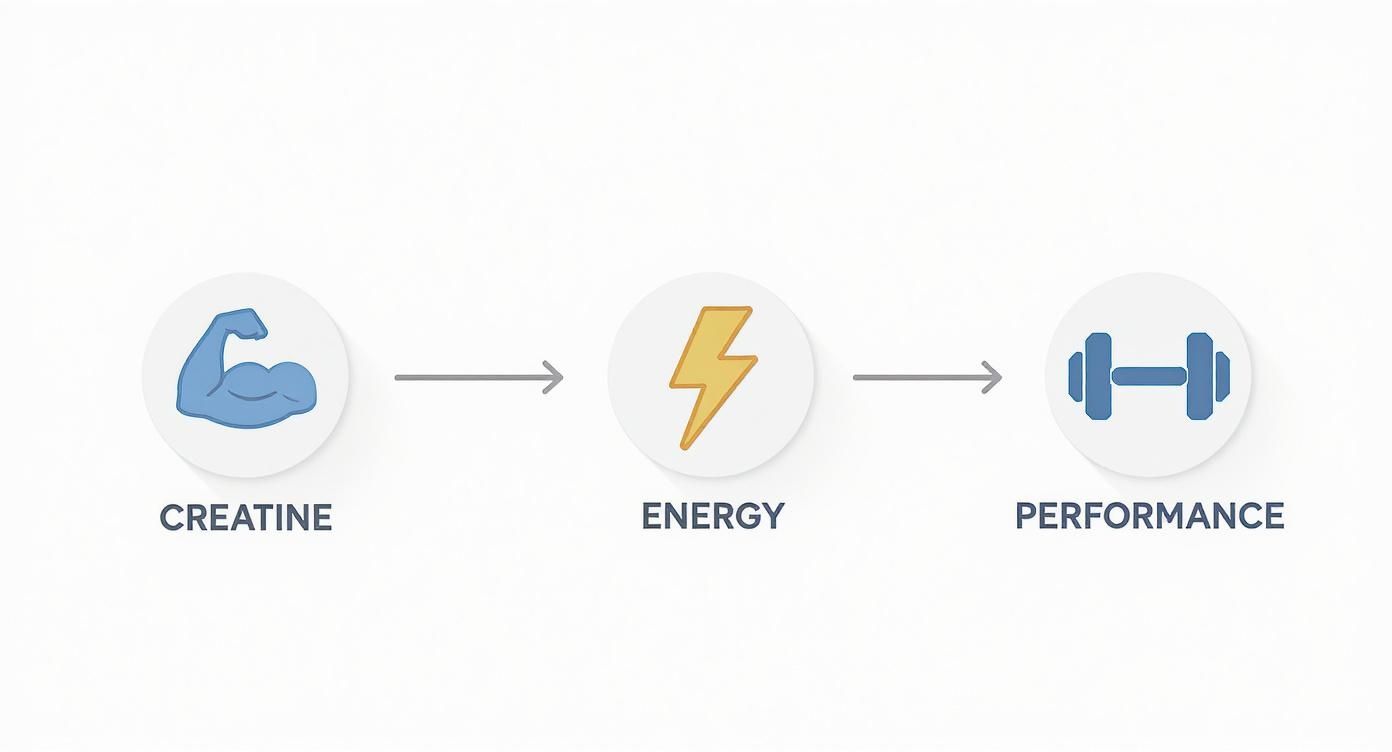
The graphic makes it clear: More creatine in the muscle directly leads to more available energy, which immediately translates into better training performance.
Why Creatine is So Effective
The decisive advantage, therefore, is improved energy supply. If you can train more intensely and harder, you create stronger stimuli that force your muscles to grow. This is no coincidence and not just a matter of feeling; it is extremely well-supported by scientific evidence.
Creatine is one of the most thoroughly researched dietary supplements in the world. Hundreds of studies confirm its effectiveness and safety in increasing strength and muscle mass in healthy adults.
But that's not all. Creatine also ensures that more water is stored within muscle cells. This not only makes your muscles look plumper and fuller but can also stimulate protein synthesis – another important building block for muscle growth. So, it's about much more than just "drawing water"; it's an anabolic signal for your cells.
Creatine in German Sports
In Germany, creatine is particularly popular in sports that require short, intense bursts of strength, such as weightlifting, bodybuilding, or sprinting. Its consumption is completely legal and is not classified as doping by the International Olympic Committee. Studies suggest that creatine can lead to a performance increase of around 10 to 20 percent in strength-focused activities.
Of course, creatine is not a miracle cure. It only unfolds its full potential in combination with consistent training and a clean diet. A well-thought-out nutrition plan remains the foundation for successfully achieving fat loss as well as muscle gain. Creatine is the smart tool that helps you reach your goals a little faster.
The Correct Intake and Dosage of Creatine
Okay, now you know why creatine is such a strong ally in muscle building. But how do you put this into practice? How do you take it so that it truly works and unfolds its full effect? Fortunately, it's quite straightforward. Two proven methods have emerged.
The big question many people ask is: Should I start with a so-called loading phase or opt directly for continuous intake? Both paths lead to the goal. The only difference lies in how quickly your creatine stores are filled. Let's take a closer look at both approaches so you can decide what suits you best.
The Fast Method: The Loading Phase
The loading phase is, so to speak, the turbo start. You take a higher dose for a short period to rapidly fill the stores in your muscles. The goal is to achieve saturation of your muscle cells in just a few days.
A typical loading phase looks like this:
- Duration: Approximately 5 to 7 days.
- Dosage: You take about 20 grams of creatine daily.
- Distribution: It's best to divide this amount into four portions of 5 grams each. This is easier on the stomach and improves absorption.
After this intense initial phase, you continue with a normal maintenance dose of 3 to 5 grams per day. The huge advantage of this method? You feel the positive effects on strength and performance much faster, often after the first week. The slight drawback: The high initial dose can lead to mild gastrointestinal discomfort in sensitive individuals.
The Uncomplicated Alternative: Continuous Intake
If you're not in a hurry and prefer a gentler start, then continuous intake without a loading phase is for you. Here, you skip the high initial dose and start directly with the normal maintenance amount.
A daily intake of 3 to 5 grams of creatine is the most common and thoroughly researched method. It is just as effective as a loading phase – it just takes a little longer for your stores to be completely full.
Expect about three to four weeks here until you feel the maximum effect. This method is particularly stomach-friendly and super easy to integrate into your daily routine – for example, as a fixed part of your morning ritual or as an addition to your post-workout shake. For most people, this is the simplest and most sustainable solution.
If you want to delve deeper into the mechanism of action of creatine, we have a detailed article for you here.
Comparison of Creatine Intake Strategies
This table summarizes the differences between the creatine loading phase and continuous intake at a glance. This way, you can more easily decide which method suits you and your goals better.
| Characteristic | Loading Phase (5-7 Days) | Continuous Intake (without Loading Phase) |
|---|---|---|
| Speed of Effect | Very fast (within 1 week) | Slower (after 3–4 weeks) |
| Dosage | 20 g/day (initial), then 3–5 g/day | Constant 3–5 g/day |
| Effort | Higher effort at the beginning | Very easy and consistent |
| Tolerance | Potential stomach discomfort | Very well tolerated |
| Effectiveness (long-term) | Identical | Identical |
Ultimately, both paths lead to the same result: full creatine stores and increased performance in training. The choice therefore depends entirely on your personal preference, patience, and the sensitivity of your stomach.
The Right Time for Intake
The question of perfect timing is a classic. The good news first: The exact timing is not as critical as many think. Much more important is regularity. Whether morning, noon, or evening – the main thing is that you take it daily.
However, there are indications that taking it around your workout could offer minor advantages. If you take creatine together with carbohydrates and proteins – such as in a typical post-workout shake – the resulting insulin surge can slightly improve absorption into muscle cells.
Here are some practical tips for your daily routine:
- On training days: Simply mix the creatine into your shake after your workout. This kills two birds with one stone and ensures you don't forget it.
- On non-training days: Take it with a meal, for example, with breakfast in the morning. This also supports absorption and helps you establish a routine.
Creatine monohydrate is tasteless and dissolves best in lukewarm liquids like water or tea. However, you can easily mix it into almost any drink. Just find the rhythm that works best for you and stick with it. This way, you'll get the most out of creatine for your muscle building.
What Creatine Really Does for Your Performance

Okay, you now know the theory behind creatine. But what's the tangible benefit for you and your training at the end of the day? Let's set the theory aside and talk about the concrete advantages you'll feel in the mirror and with the weights.
The most well-known and best-researched effect is the increase in your maximum strength. This isn't marketing hype; it's pure biochemistry. Because your stores are packed with creatine phosphate, your body can simply mobilize more immediate energy (ATP) for short, intense bursts of effort.
What does this mean in the gym? You can suddenly manage that one extra rep on the bench press that seemed impossible before. Or you can finally increase the weight on squats without your technique breaking down. This small but crucial push is exactly what provides the essential growth stimulus for your muscles.
More Juice in the Tank for Your Training
This increase in strength isn't just a feeling – it's measurable. Imagine the last, tough rep of a heavy set. Normally, your ATP stores would be depleted, and the muscle would give up. But with full creatine stores, you have that necessary extra kick precisely for those crucial seconds.
This energy boost has several positive effects:
- Higher training volume: Those who achieve more repetitions or sets increase their total volume. This is one of the most important levers for muscle growth.
- More explosiveness: You can also put more power into sprints or jumps.
- Faster recovery: Your body regenerates spent energy faster between sets, so you're ready for the next round sooner.
A comprehensive German meta-analysis impressively confirms this. It summarized the results from 27 studies and concluded that creatine significantly improves maximum strength. On average, the one-repetition maximum in the upper body increased by over 3 kg and in the lower body by even more than 11 kg compared to the placebo group. More details on these study results can be found in this scientific summary from HAW Hamburg.
The Visible "Pump" Effect
Another advantage that many notice after a short time: muscles look plumper and fuller. This so-called "pump" effect comes from creatine drawing water directly into the muscle cells. This is a great sign because it means the creatine is going exactly where you want it to work as an athlete.
This cell hydration, or cell volumization, has two crucial advantages:
- Appearance: Your muscles simply look bigger and more defined. This is a huge motivational boost.
- An anabolic signal: A well-hydrated muscle cell is a happy cell. The increased pressure within the cell can stimulate protein synthesis and simultaneously slow down muscle breakdown.
So, you not only gain more strength but also a visible bonus. Incidentally, this effect has nothing to do with the unpleasant subcutaneous bloating. The water goes directly into the muscle, where it is needed.
Better Recovery, Less Fatigue
Last but not least, creatine also helps you last longer and train harder because it delays fatigue. The more efficient energy supply means that fewer metabolic waste products, like lactate, accumulate. This means you can maintain training intensity for longer before the burn stops you.
If you want to further optimize the pump effect, the amino acid L-arginine might also be interesting for you. You can read more about it in our article on the benefits of L-arginine for your training.
In short: Creatine provides you with a strong overall package. You get more strength, better recovery, less fatigue, and a motivating visual effect. It is the perfect supplement to take your performance to the next level and achieve your goals faster.
What About the Side Effects? Myths and Facts About Creatine
Creatine is one of the most thoroughly researched supplements available. Nevertheless, persistent myths continue to circulate, especially concerning alleged side effects. However, many of these concerns are completely unfounded and stem from old misunderstandings. It's time to clear things up and separate fact from fiction.
The goal is for you to be confident in the end. You should understand why creatine is considered one of the safest and most effective means for healthy individuals to elevate their performance in the gym.
Myth 1: "Creatine damages your kidneys!"
This concern is probably the classic – and at the same time, the myth that has been most thoroughly debunked. The idea behind it is actually logical: when the body processes creatine, the breakdown product creatinine is formed, which must be excreted by the kidneys. An elevated creatinine level in the blood can indeed indicate kidney problems.
But here's the catch: When you supplement with creatine, it is completely normal and even expected that your creatinine levels will slightly increase. However, this doesn't happen because your kidneys are suddenly failing, but simply because there is more creatine in circulation that needs to be processed.
Countless long-term studies have confirmed: In healthy individuals, the intake of creatine at the recommended dosage has absolutely no negative effects on kidney function. It remains one of the safest supplements on the market.
Of course, if you already have a kidney disease, you should talk to your doctor before you start. But for everyone else with healthy kidneys: green light!
Myth 2: "Creatine causes hair loss!"
This claim also regularly surfaces in various internet forums. However, it is based on an extremely flimsy scientific basis – namely, a single, small study from 2009. At that time, an increase in the hormone dihydrotestosterone (DHT), which is linked to hereditary hair loss, was measured in male rugby players after a creatine loading phase.
What you need to know about this:
- Nothing but hot air: The results of this study have not been confirmed in any follow-up study to date.
- No direct proof: The study never investigated whether the participants actually lost hair. Only a hormone value was measured, nothing more.
- Everything within the normal range: Even the elevated DHT levels remained within a completely normal range.
The state of scientific knowledge is therefore clear: There is no single piece of evidence that directly links creatine with hair loss. If you don't have a genetic predisposition for it, creatine will not suddenly trigger it either.
Myth 3: "Creatine just causes bloating!"
Many people are afraid of looking "bloated" or "watery" from creatine. This is a classic misunderstanding. Yes, creatine draws water. But it draws it exactly where you, as an athlete, want it: directly into your muscle cells.
This water retention in the muscle is even an extremely positive effect! It makes your muscles appear plumper and fuller. This increased cell volume can even send signals that additionally stimulate muscle growth. This has absolutely nothing to do with the water that unpleasantly accumulates under the skin and makes you look puffy.
So, if you gain one to two kilos at the beginning of intake, it's not fat, but pure cell water in your muscles. Consider it a good sign – your stores are filling up, and the creatine is starting to work. If you want to delve deeper into the various side effects and myths surrounding creatine, we have a detailed article for you here.
It can therefore be said that the most common "side effects" of creatine are either long-debunked myths or actually positive effects that are simply misunderstood. For healthy athletes, creatine for muscle building is an incredibly safe and effective tool.
How to cleverly integrate creatine into your daily routine
So, now we've battled through all the theory – from the science and benefits to the myths. Now comes the part that really matters: the practice. You now know enough to intelligently use creatine for muscle building. It's not a miracle cure, but a damn good tool that makes your hard work in the gym even more rewarding.
The most important realization is simple: creatine demonstrably gives you more strength, improves your performance during short, intense efforts, and is extremely safe when used correctly. It can be that small but crucial advantage that lifts you over a training plateau and stimulates new growth.
Your Checklist for a Successful Start
Getting started is really not rocket science. With these few steps, you'll make creatine a permanent part of your routine in no time.
-
1. Choose Quality: Buy pure, high-quality creatine monohydrate. This is the most well-researched form and offers you by far the best value for money. Make sure there are no unnecessary additives – you want the pure effect.
-
2. Find Your Strategy: Consider whether you want to start with a quick loading phase or directly with the simple continuous intake of 3 to 5 grams daily. For most people, direct entry without a loading phase is the simplest and most sustainable approach.
-
3. Create a Routine: Integrate the intake firmly into your day. The alpha and omega is regularity. Whether in your coffee in the morning or in your shake after training – choose a fixed time, then you won't forget it.
Creatine is your co-pilot, but you are in control. It only unfolds its full effect when it meets a solid foundation of consistent training and a balanced, protein-rich diet.
Never forget that supplements are only supplements. They optimize what you already build through discipline and sweat. Using creatine for muscle building means training smarter, not less hard.
See it as a conscious decision to give your body exactly what it needs to squeeze out the last, decisive percentage points of your performance. With this simple guide, you are now well equipped to take the next step and achieve your training goals faster than ever before.
The Most Frequent Questions About Creatine – Short and Sweet
Finally, we'll clear up the typical questions that always arise around the topic of creatine. Here you get clear, practical answers to what probably concerns you too.
Do I need to cycle creatine?
No, that's old hat. The idea of "creatine cures" with subsequent breaks is now outdated. Previously, it was feared that the body might reduce its own production if creatine was constantly supplied externally.
However, modern research has shown: continuous intake of 3 to 5 grams daily is completely harmless for healthy people and even more effective. This ensures that your stores are always full and you constantly benefit from the increased performance – without annoying breaks.
Should I take creatine on rest days too?
Yes, absolutely! Think of your creatine stores like a battery: on training days you draw a lot of power, on rest days you recharge it completely. This regularity is key.
Only by taking it daily do you ensure that your stores are always at the highest level. This way you can be sure that you can go full throttle again in your next workout.
Which form of creatine is the best?
Make it easy for yourself: Creatine monohydrate is and remains the gold standard. It is by far the most researched, most effective, and at the same time cheapest variant on the market. Hundreds of studies confirm its effectiveness and safety.
Of course, the market is full of newer, fancier creatine forms that promise better solubility or faster absorption. The only problem is: so far, none of these expensive alternatives have been able to prove in independent studies that they are truly superior to classic monohydrate. So save your money and stick to the proven original.
Choosing classic creatine monohydrate is a smart decision. You get all the benefits for your muscle building without unnecessarily straining your wallet.
Will I lose my muscles if I stop taking creatine?
I can reassure you: No, your hard-earned musculature will remain. What happens is this: When you stop taking creatine, the water stores in your muscle cells slowly empty again. This can lead to you losing one or two kilograms on the scale.
Your muscles may appear a little less full as a result, but the actual muscle mass you have built up through training remains. So you only lose the stored water, not your gains. Your strength will also largely remain, even if the last explosive repetition may be a little harder. By the way, creatine is not only exciting for muscle building, as you can read in our article on the role of creatine in weight loss.
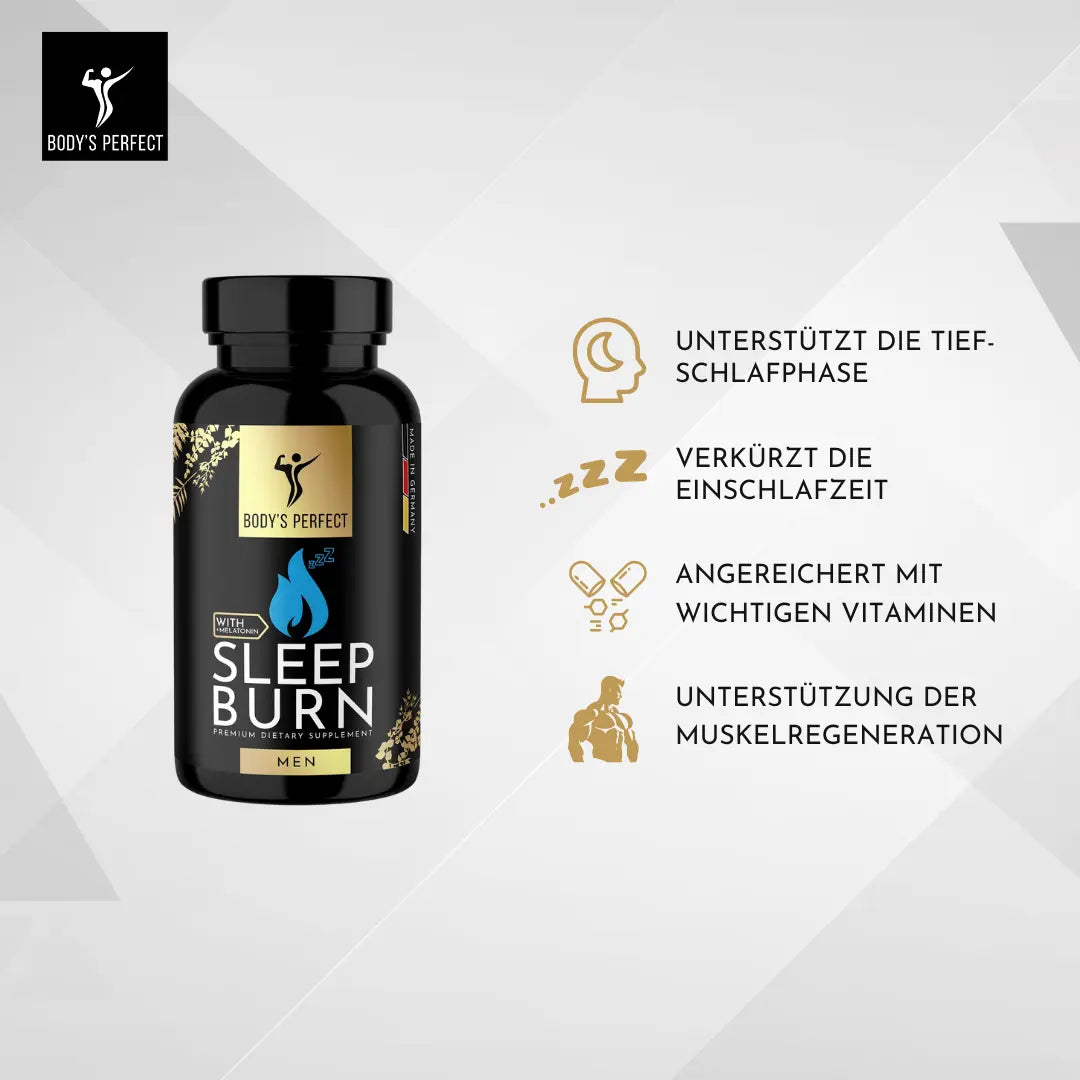
Are you ready to take your training to the next level and experience for yourself what creatine can do? At BODY'S PERFECT you will find high-quality creatine monohydrate that will optimally support you in getting stronger and building muscles. Discover our products now and give your training the decisive boost.









Share:
Sugar addiction: What to do? Your way out of the sugar trap
10 Healthy Weight Loss Recipes for Your Success in 2025