


If you want to lose weight, there's one topic you can't avoid: calories. The basic rule is actually quite simple: you need to consume less energy than your body uses throughout the day. The trick is to find the right balance.
A moderate calorie deficit of about 500 kcal per day has proven to be the golden mean in practice. This way, you lose weight steadily without forcing your body into starvation mode and provoking cravings or the dreaded yo-yo effect.
What your body really needs
Before you start counting or even cutting calories, it's super important to first understand how your body uses energy. Many diets fail precisely at this point because they are too radical and ignore the basics. Your daily energy requirement is not an arbitrary number but is composed of two main pillars:
- Basal metabolic rate: This is the amount of energy your body needs in a complete resting state – that is, if you were just lying on the couch. This energy is required for vital functions such as breathing, heartbeat, and metabolism. Think of it as your body's idle speed.
- Activity metabolic rate: This is where everything else comes into play. Every movement you make burns additional calories. This ranges from typing at your desk to walking the dog to strenuous workouts at the gym.
Together, these two values make up your total energy expenditure – the total sum of calories you burn in a day. And it's precisely from this number that we deduct a small deficit for healthy weight loss.
The building blocks of your energy consumption
Of course, energy requirements vary from person to person, but there are reliable guidelines. Men aged 25 to 51 years require an average of about 2,400 kcal daily, while women in the same age group manage with around 1,900 kcal.
For sustainable weight loss, a daily calorie deficit of 400 to 600 kcal is recommended. You can find more details on these recommendations, for example, at Techniker Krankenkasse.
This infographic clearly shows how everything fits together:
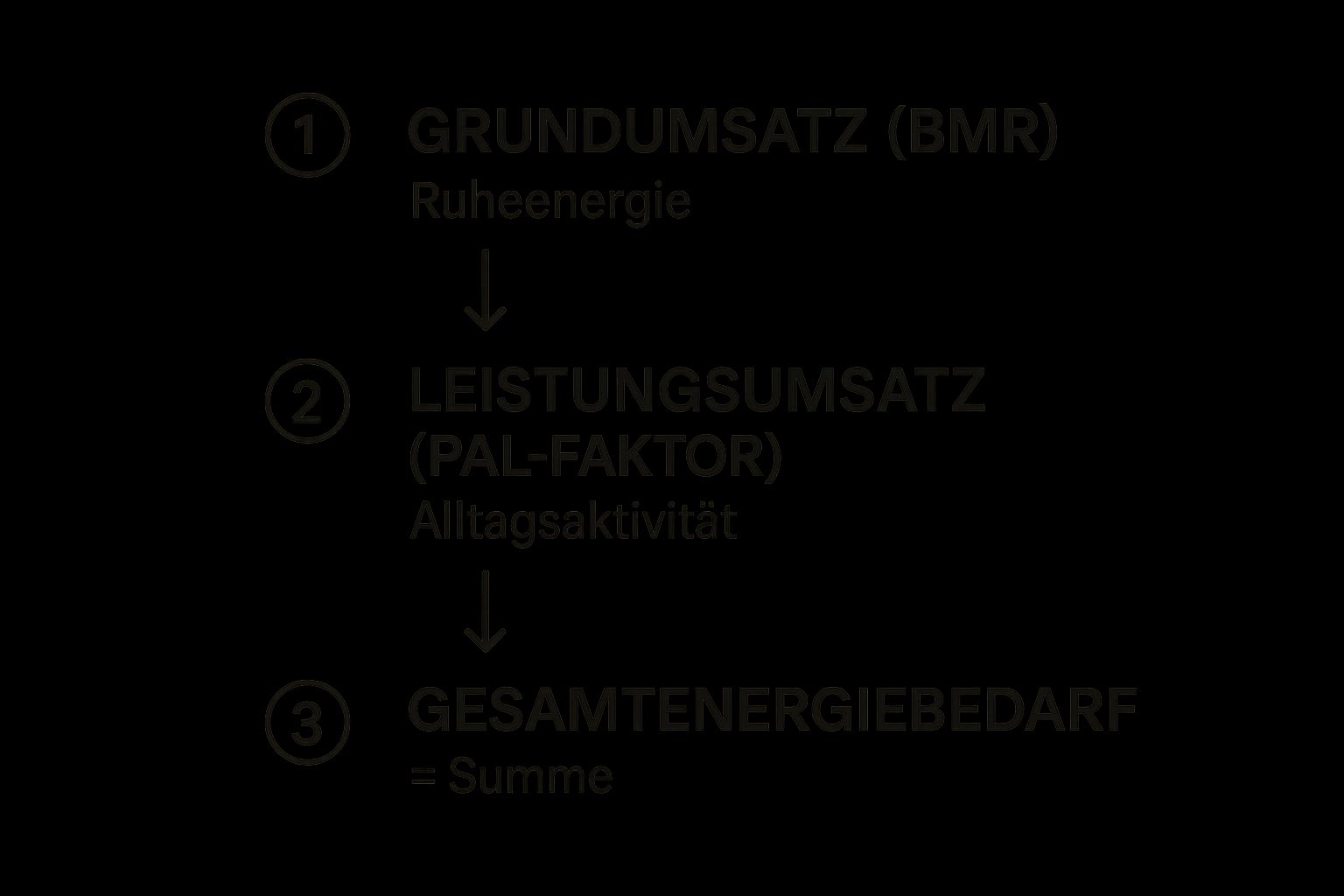
So you see: The total energy expenditure is the crucial number on which your entire weight loss plan is based.
Why a smart deficit always wins
If you set your calorie deficit too high, your body will sound the alarm. It thinks a famine has broken out and immediately slows down its metabolism to conserve energy. Worse still, it begins to break down valuable muscle mass because muscles consume a lot of energy. The result? You feel sluggish, are constantly hungry, and as soon as you start eating "normally" again, the pounds are immediately back – the classic yo-yo effect.
A moderate deficit of about 500 calories per day is the smart way. It signals to your body to tap into fat reserves while protecting your muscles and keeping your metabolism active.
With this approach, you can expect a steady weight loss of about 0.5 kg per week – an absolutely healthy and realistic pace. This way, you reach your feel-good weight without torturing yourself and lay the foundation for long-term healthy habits.
The following table gives you an overview of which deficit can be sensible for whom and what you can achieve with it.
Overview of recommended calorie deficits
| Daily Deficit (kcal) | Weekly Weight Loss (approx.) | Suitable for |
|---|---|---|
| 300 kcal | 0.3 kg | Beginners, people with slight overweight, or for very slow, gentle weight loss. |
| 500 kcal | 0.5 kg | The standard for most – an effective and sustainable way for steady weight loss. |
| 700 kcal | 0.7 kg | More for people with severe overweight and only after consultation with a doctor or nutritionist. |
Choose the deficit that suits your everyday life and your body. Slow and steady always wins the race here.
Determining your personal energy requirements
All right, now for the nitty-gritty. To find out what your personal calorie needs for weight loss are, we need to look at two important values: your basal metabolic rate and your activity metabolic rate. When we add these two together, we get your total energy expenditure – precisely the amount of calories your body burns every day.
This number is your absolute starting point. Only once you know it can you set an appropriate calorie deficit that will allow you to lose weight without constantly feeling hungry or sluggish.
Your foundation: The basal metabolic rate
Imagine you're just lying in bed for 24 hours, doing nothing. Even then, your body consumes energy. This amount is called your basal metabolic rate (or BMR). It's the energy required for vital functions like breathing, heartbeat, or cell renewal.
To calculate this value, there are various approaches. One of the most reliable and commonly used is the Mifflin-St Jeor formula. The great thing about it is that it directly incorporates the most important factors – gender, weight, height, and age.
- Formula for men: BMR = (10 × weight in kg) + (6.25 × height in cm) – (5 × age in years) + 5
- Formula for women: BMR = (10 × weight in kg) + (6.25 × height in cm) – (5 × age in years) – 161
Let's illustrate this with a concrete example. Let's take Anna: She is 35 years old, 170 cm tall, and weighs 75 kg.
For her, the calculation looks like this: (10 × 75) + (6.25 × 170) – (5 × 35) – 161 = 750 + 1062.5 – 175 – 161 = 1,476.5 kcal.
This is the amount of energy Anna's body needs each day in a complete resting state.
Your daily life in numbers: The activity metabolic rate
Of course, you don't lie in bed all day. Every single movement, from getting up to going to the office to a workout, costs additional energy. This is your activity metabolic rate, and it varies greatly from person to person.
To make it tangible, we use the PAL factor (Physical Activity Level). This value basically describes how active your average day is.
Here's how it's classified:

You can immediately see: There's a huge difference whether you have an office job (PAL 1.4–1.5) or you're toiling on a construction site all day (PAL 2.0–2.4).
All together: Your total metabolic rate
Now let's put the pieces of the puzzle together. Your daily total energy expenditure results from a simple formula:
Total metabolic rate = Basal metabolic rate × PAL factor
Back to our example: Anna works in an office, so her daily life is predominantly sedentary. We therefore assign her a PAL factor of 1.4.
Her calculation is: 1,476.5 kcal (basal metabolic rate) × 1.4 (PAL factor) = 2,067 kcal.
These 2,067 kcal are the amount Anna could eat daily to maintain her current weight. And exactly this number is the basis from which we now set the appropriate calorie deficit for her weight loss goals.
By the way: Even regular exercise that burns an additional 2,000 kcal per week can significantly accelerate weight loss.
If you want to delve deeper into this topic, take a look at our comprehensive guide on calculating total energy expenditure. There you'll find even more details and tips.
Finding the right calorie deficit for you
 Okay, you've calculated your personal total calorie expenditure – a super important number. That's half the battle. But now comes the truly crucial part: setting the right calorie deficit. And here, a little sensitivity is required, because when it comes to weight loss, the motto "more is more" is a sure way in the wrong direction.
An overly aggressive deficit may sound tempting at first glance because it promises quick results. But believe me, in practice, you'll do more harm than good. Your body panics, goes into conservation mode, and starts breaking down valuable muscle mass instead of burning fat. What remains is frustration, fatigue, and the dreaded yo-yo effect as soon as you start eating "normally" again.
A moderate deficit is the key to success
The sustainable and smart way to your feel-good weight is through a moderate calorie deficit. We recommend a value between 300 and 500 calories below your daily total expenditure as an ideal starting point.
Why is this so much better? It's simple:
- You protect your muscles: Your body gets enough energy to maintain muscle mass – and muscles themselves burn a lot of calories.
- Your metabolism stays active: You prevent your metabolism from slowing down, thus ensuring constant fat burning.
- You don't have to starve: A moderate deficit can be easily integrated into everyday life without constantly feeling hungry. This makes sticking with it so much easier.
- Cravings don't stand a chance: You avoid the feeling of having to give up everything. This is invaluable for your motivation and mental balance.
Your goal should not be to lose weight as quickly as possible. It's about finding a path that suits you and your life and establishing new, healthy habits.
What the perfect deficit looks like in practice
Let's make it concrete and look at Anna from the previous example again. As a reminder: She is 35, works in an office, and her goal is to lose 8 kg. Her calculated total calorie expenditure is 2,067 kcal per day.
To lose weight healthily, she decides on a deficit of 400 kcal. She simply subtracts this value from her total calorie expenditure. Her new daily calorie target is therefore 1,667 kcal. With this, she can aim for a realistic weight loss of about 0.4 kg per week, without stressing her body or having to decline every dinner invitation.
Remember one thing above all: Your calorie needs for weight loss are not a rigid corset. See it as a flexible framework. It's not about starving, but about making smarter choices that keep you full, satisfied, and energetic while you achieve your goal.
With this well-thought-out approach, you don't just lose weight – you specifically reduce fat and at the same time do something for your health and well-being. If you want to dive deeper and learn how to best implement the deficit in everyday life, you'll find many more practical tips in our guide to calculating calorie deficit.
Avoiding common mistakes and breaking through plateaus
You're highly motivated, sticking to your plan, but suddenly nothing is happening on the scale. Do you know that feeling? Probably everyone who has tried to lose a few pounds has experienced this frustrating feeling. But don't worry: a weight standstill, often called a plateau, is absolutely normal and definitely no reason to throw in the towel. Your body is just signaling that it's time for a few small adjustments.
Often, it's tiny mistakes that secretly creep into daily life. Maybe it's the calories in the salad dressing or in your morning latte macchiato that you unconsciously underestimate. Or perhaps you simply forgot to adjust your calorie target after you've already lost some weight – your body simply needs less energy now than it did at the beginning.
When the scale lies
However, a standstill doesn't automatically mean you're doing something wrong. The number on the scale is only part of the story and can be influenced by so many things that have nothing to do with fat loss.
- Water retention: A salty meal, hormonal fluctuations, or a tough workout can cause your body to temporarily retain more water.
- Muscle building: Especially if you've started strength training, you're building valuable muscle mass. Muscles are denser than fat and weigh more. So your weight might stay the same or even slightly increase, even though you're losing fat and getting leaner.
That's precisely why it's so important not to focus solely on the scale. Instead, grab a tape measure and measure your body circumference, or simply notice how your favorite jeans fit. These are often much more honest indicators of progress.
Strategies to get back on track
If you're stuck on a plateau, there are a few proven tricks to get your body back on track. It's not about throwing everything out the window, but about deliberately setting new stimuli.
First, take an honest look at your eating and drinking habits. Just keep a meticulous food diary for a few days again – you'll be surprised where hidden calories can be found. Another great method: bring variety into your training! If you've only done cardio so far, try incorporating two strength training sessions per week. Or try interval training to really boost your metabolism.
Sometimes the best solution is a conscious break. A planned diet break of one to two weeks, during which you raise your calories to your maintenance level, can work wonders. Your metabolism can recover and you recharge new mental energy for the next round.
If you feel like you're not making any progress despite all your efforts, it's worth taking a closer look. In our article Why am I not losing weight despite a calorie deficit? we delve into other possible causes and provide you with even more solutions.
Frequently asked questions about calorie requirements
Finally, we would like to answer a few questions that we are repeatedly asked in practice when it comes to the ideal calorie requirement for weight loss. Perhaps you still have one or two uncertainties. Here you will get clear and honest answers so that you can start with confidence.
The biggest concern for many: Do I now have to count calories forever? The quick answer is a clear no, absolutely not!
It's best to view calorie counting as a kind of jump start. It's an incredibly useful tool to get a feel for what portion sizes really look like and which foods keep you full for a long time. The real goal is for you to develop intuitive eating habits over time and be able to maintain your deficit even without constant tracking.
What happens if I overdo it sometimes?
Another classic question revolves around so-called "slips". What if you eat significantly more than planned at a birthday party or on vacation? The good news: a single day won't throw you off track.
Your body doesn't think in strict 24-hour cycles. The weekly balance is much more important. The next day, just continue as normal. What you should definitely not do is try to compensate for the "too many" calories by extreme starving the next day. This usually only ends in cravings. Always remember: Consistency beats perfection.
Your journey to your feel-good weight is a marathon, not a sprint. It's about finding a balance that fits into your life. Small slips are human and absolutely okay, as long as the overall direction is right.
Adjust calorie needs if I exercise more?
Many are also unsure whether they need to adjust their calories when they start training. The answer is a clear yes! As soon as you start exercising regularly, your energy expenditure increases, and with it, your total energy requirement.
After a few weeks of consistent exercise, you should definitely recalculate your total needs. It can even be very clever to eat a few more calories on training days. This gives your body the necessary energy for performance and regeneration, while still staying in a healthy deficit.
So that you can save yourself the calculation, simply use our free calorie calculator. It takes all important factors into account for you.
Are you ready to start your journey to a healthier you and get the best possible support? At BODY'S PERFECT you will find everything you need for a successful and delicious start – from high-quality shape shakes to clever dietary supplements.
Discover the right products for your goals now at https://bodysperfect.com.










































Share:
Weight Loss with Protein Powder: How to Succeed and What Matters
Naturally Regulate Female Hormones and Find Balance