


If you want to lose weight successfully, there's one topic you can't avoid: calculating your basal metabolic rate. This is the absolute first and most important step on your journey. It tells you how many calories your body burns when you do absolutely nothing – and thus forms the basis for your very own calorie deficit.
What your basal metabolic rate reveals about your body
Have you ever wondered why some people seem to eat whatever they want without gaining weight, while for you, a slice of cake immediately goes to your hips? The answer often has to do with your basal metabolic rate (BMR) – the invisible energy that keeps your body running.
Imagine your body as a car waiting at a red light. Even when it's stationary, the engine is running and consuming fuel. That's exactly what your basal metabolic rate is: the amount of energy your body needs for the most basic, vital functions. This includes breathing, heartbeat, or regulating your body temperature, even if you just lie on the sofa all day.
This basic calorie amount accounts for the lion's share of your daily energy consumption. That's precisely why it's the key to any sensible weight loss strategy.
Why your basal metabolic rate is so individual
There's no magic number that applies to everyone. Your basal metabolic rate is as unique as your fingerprint and depends on various factors.
- Gender: Men naturally tend to have more muscle mass and a lower body fat percentage. Since muscles burn significantly more energy than fat, their basal metabolic rate is generally higher.
- Age: Our metabolism is not constant. Especially from the age of 30, the body often slowly loses muscle mass, which lowers the basal metabolic rate. That's why it's so important to adjust calorie intake over the years.
- Muscle mass: Muscles are the true powerhouses of your body. The more you have, the more calories you burn – even while sleeping! This makes strength training an incredibly effective tool for weight loss.
This infographic nicely illustrates how the basal metabolic rate can be imagined as an internal engine that constantly needs energy, even when idling.

The image makes it clear: your body is never truly "switched off." The basal metabolic rate is the foundation upon which your entire energy balance is built.
On average, this basal metabolic rate accounts for an incredible 60 to 75 percent of your total daily energy consumption. This underscores its enormous importance. If you want to delve deeper, you can find more details on how the basal metabolic rate works from our partner.
Knowing your own basal metabolic rate is like having a map for your weight loss journey. Without it, you run the risk of getting lost – either by eating too much or, even worse, far too little.
With this one number, you can finally make informed decisions. You create the perfect basis for a healthy calorie deficit that will sustainably lead you to your goal without harming your metabolism.
How to easily calculate your basal metabolic rate yourself
Now it's getting concrete. You now know why the basal metabolic rate is the most important number for your weight loss plans. Let's clarify how to determine this value for yourself. And don't worry, it's easier than it sounds – you don't need a math degree for it.
I'll introduce you to the two most common formulas, and we'll go through them together.
To keep things from getting too dry, let's look at two typical examples:
- Example A – Sarah: 30 years old, 168 cm tall, weighs 70 kg and has an office job.
- Example B – Markus: 45 years old, 185 cm tall, weighs 95 kg and works physically as a craftsman.
Using Sarah and Markus, you'll see wonderfully how different basal metabolic rates can be and how you apply the formulas to yourself.
The classic Harris-Benedict Formula
The Harris-Benedict formula is, so to speak, the oldtimer among calculation methods. It dates back to 1918 and was the gold standard for decades. Although it is now considered somewhat less accurate, it still provides a solid first indication.
The formulas are slightly different for women and men:
- For women: 655.1 + (9.6 x weight in kg) + (1.8 x height in cm) – (4.7 x age in years)
- For men: 66.47 + (13.7 x weight in kg) + (5 x height in cm) – (6.8 x age in years)
Let's calculate this for Sarah (Example A):
655.1 + (9.6 x 70) + (1.8 x 168) – (4.7 x 30) = 1488 kcal
According to this formula, Sarah's body consumes approximately 1,488 kcal per day in absolute rest. This is the energy she needs solely for her vital functions.
The more accurate Mifflin-St Jeor Formula
In the 90s, an update came along: the Mifflin-St Jeor formula. It is now considered the more precise method for determining basal metabolic rate and is favored by most nutritionists. Our practical calorie calculator from BODY'S PERFECT also uses this modern calculation to provide you with a reliable basis for your plans.
Again, there are two variants:
- For women: (10 x weight in kg) + (6.25 x height in cm) – (5 x age in years) – 161
- For men: (10 x weight in kg) + (6.25 x height in cm) – (5 x age in years) + 5
Let's take Markus (Example B):
(10 x 95) + (6.25 x 185) – (5 x 45) + 5 = 1886 kcal
Markus lands at a basal metabolic rate of approximately 1,886 kcal. His higher value compared to Sarah is simply explained by his gender, higher weight, and height.
Precise determination, as possible with the Mifflin-St Jeor formula, is an important pillar for nutritionists in Germany to create scientifically sound weight loss plans. If you want to delve deeper into the scientific background of basal metabolic rate calculation, you can find more information here.
Comparison of Basal Metabolic Rate Formulas
To make the differences even clearer, I have prepared a small comparison for you. This way, you can see at a glance which formula might be the better choice for you.
| Feature | Harris-Benedict Formula | Mifflin-St Jeor Formula |
|---|---|---|
| Year of Development | 1918 (revised 1984) | 1990 |
| Accuracy | Considered solid, but tends to be less accurate for certain groups (e.g., severely overweight). | Considered the current gold standard and is generally more precise for most people. |
| Application | Often still used out of habit or in older calculators. | Recommended and used by most modern tools, apps, and nutritionists. |
| Result | May slightly overestimate basal metabolic rate, which can lead to too small a calorie deficit. | Provides a more realistic basis for further calculation of calorie needs. |
Both formulas use the same basic data – weight, height, age, and gender. The crucial difference lies in how these factors are weighted, which leads to slightly differing results.
My Tip: It's best to use the Mifflin-St Jeor formula. It gives you a more modern and, in most cases, more accurate estimate. A difference of maybe 50-100 calories might not sound like much at first, but over weeks and months, it adds up and can ultimately determine success or stagnation in weight loss.
No matter which formula you choose: You now have a concrete, reliable number in hand. This is your personal starting point. From here, we can now determine your total calorie needs and set an appropriate calorie deficit.
How to determine your actual calorie needs
Your basal metabolic rate is a great starting point, but it's only half the battle. To truly reach your weight loss goal, we need to look at the big picture: your actual, everyday calorie needs. Let's be honest, who among us just lies motionless in bed all day? Every little movement, from walking to the coffee machine to a sweaty workout, costs additional energy.
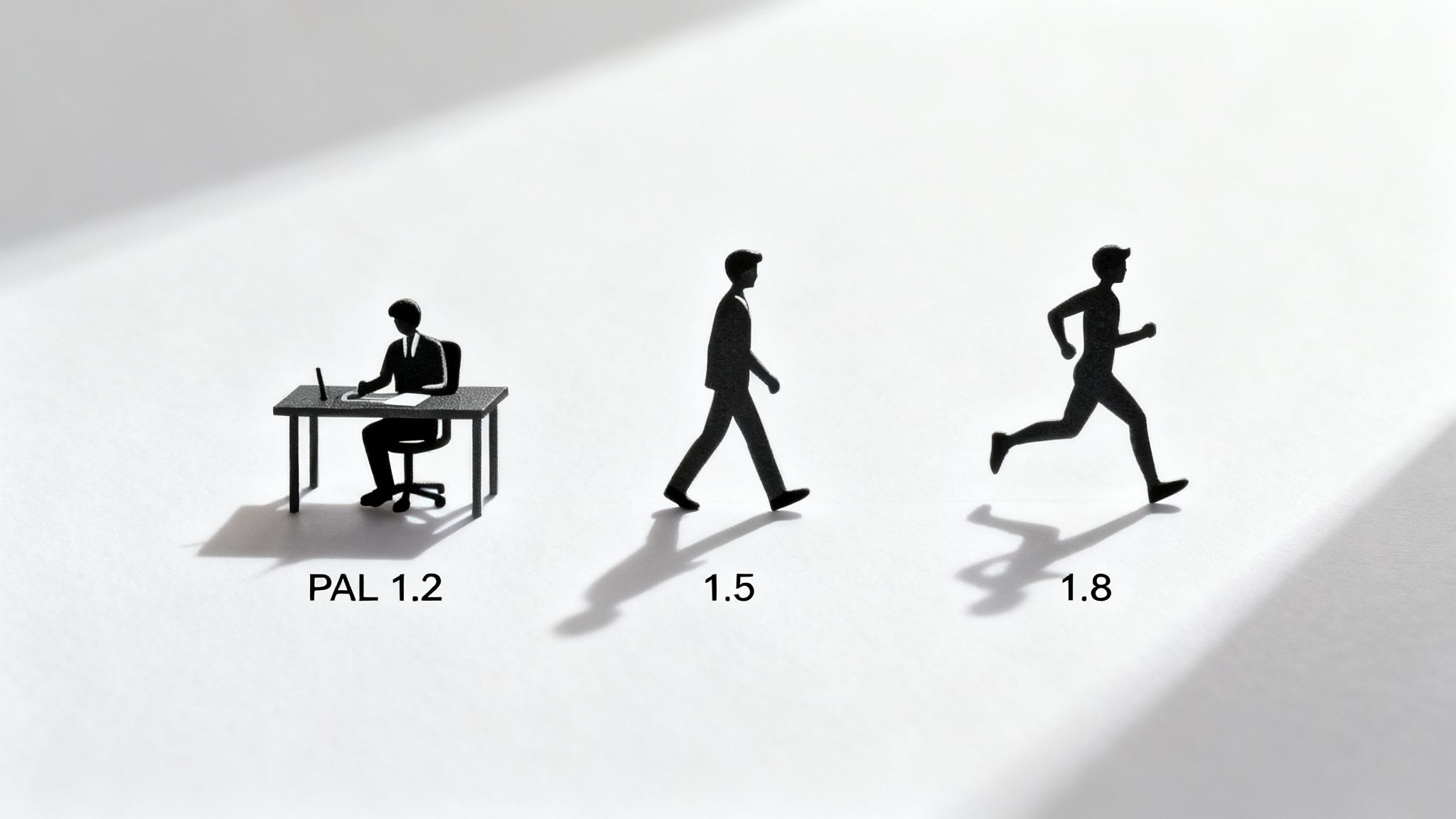
This is where the so-called PAL factor comes into play. PAL stands for "Physical Activity Level" and is basically nothing more than a multiplier that encapsulates your lifestyle into a simple number. With its help, we bridge the gap from your basal metabolic rate to your total energy expenditure – that is, the amount of energy you actually burn on a normal day.
Realistically assess your daily life
The most important point here is to be absolutely honest with yourself. It's not about how active you'd like to be, but how your daily life actually looks. PAL values start at 1.2 for an extremely passive lifestyle and can climb to over 2.0 for physically very demanding jobs or competitive sports.
Take a look at the following categories. Where do you see yourself most?
- PAL 1.2 – 1.3 (Very inactive): You spend almost the entire day sitting or lying down, for example due to illness or a purely office job without any athletic compensation.
- PAL 1.4 – 1.5 (Mostly sedentary): The classic for many of us. You have a desk job and tend to be leisurely in your free time, with little to no exercise.
- PAL 1.6 – 1.7 (Sedentary, but with movement): You sit at work, but you regularly go for walks or manage to do light exercise 2-3 times a week. This is a good average.
- PAL 1.8 – 1.9 (Much on your feet): Your profession keeps you moving, perhaps you work in sales, nursing, or hospitality. You are also active in your free time.
- PAL 2.0 – 2.4 (Physically strenuous): Your job involves heavy physical labor (e.g., construction) or you are a competitive athlete and train intensely daily.
From basal metabolic rate to total metabolic rate – the simple formula
Have you found a suitable PAL factor for yourself? Great, the rest is simple math!
The formula is: Basal Metabolic Rate x PAL Factor = Daily Total Metabolic Rate
Let's calculate this with our examples from before:
Sarah, who works in an office and exercises occasionally, had a basal metabolic rate of approximately 1,488 kcal. Her PAL factor is about 1.6. Her calculation therefore looks like this:
1,488 kcal x 1.6 = 2,381 kcal
Markus, who works physically as a craftsman, had a basal metabolic rate of 1,886 kcal. His demanding daily routine justifies a PAL factor of 1.8.
1,886 kcal x 1.8 = 3,395 kcal
Do you see what a huge difference daily life makes? This number, your total energy expenditure, is the absolute key figure for your further planning. This is your personal maintenance requirement. If you want to delve deeper into the matter, check out our guide on calculating your total energy requirement, where you'll find even more details.
With this value in hand, you now have the most important information: the amount of calories you would need to consume to maintain your weight. And that's exactly where we'll start in the next step to set a healthy and effective calorie deficit for your weight loss.
Find the right calorie deficit for sustainable success
Okay, you've now calculated your daily total energy expenditure. Great! That's the most important number, because now the really exciting part of your weight loss journey begins. It's about cleverly using this number to create a calorie deficit that will safely and, most importantly, permanently get you to your goal.

A calorie deficit is actually quite simple: You supply your body with a little less energy than it actually consumes. This forces it to draw the missing energy from its stored reserves – i.e., from body fat. This is the simple biological basis for any fat loss.
Why moderate always wins
The biggest mistake almost everyone makes at the beginning? Wanting too much, too fast. A radical calorie deficit promises quick results on the scale, but this success is usually short-lived and harms your body more than it helps.
Radical diets put your metabolism in a kind of alarm state. Your body believes there is a famine and immediately initiates drastic countermeasures:
- It lowers your basal metabolic rate to save energy.
- It breaks down valuable muscle mass, because muscles consume a lot of energy.
- Cravings become practically uncontrollable.
The result is the dreaded yo-yo effect. As soon as you eat "normally" again, your body retaliates and stores every single calorie for the next supposed emergency.
The real key to success lies in patience. A moderate, consistent deficit is the only way to keep your metabolism on your side and burn fat instead of muscle.
The golden rule: 300 to 500 kcal
Experience has shown that a daily calorie deficit of 300 to 500 calories is ideal for healthy and sustainable weight loss. This deficit is large enough to achieve visible results, but at the same time small enough to prevent cravings, constant fatigue, and muscle breakdown.
Let's take our example Sarah again. Her total energy expenditure was 2,381 kcal. With a moderate deficit, her daily calorie target could look like this:
2,381 kcal (total energy expenditure) – 400 kcal (deficit) = 1,981 kcal per day
This calorie amount allows her to eat enough to feel full without constantly being hungry. She has enough energy for her daily life and her workouts.
To lose one kilogram of pure body fat, you need to save approximately 7,000 calories. If you want to delve deeper into the matter, you can find more tips on how to calculate your calorie deficit for weight loss in our detailed article.
Example calorie deficits and weight loss
This table shows how different daily calorie deficits can affect weekly and monthly weight loss.
| Daily Deficit (kcal) | Expected Weekly Weight Loss (approx.) | Expected Monthly Weight Loss (approx.) |
|---|---|---|
| 300 | 0.3 kg | 1.2 kg |
| 400 | 0.4 kg | 1.6 kg |
| 500 | 0.5 kg | 2.0 kg |
As you can see, even small but steady adjustments lead to remarkable results without having to torment yourself.
You achieve such a deficit not through radical abstinence, but through clever everyday hacks. Swap sugary soda for water, choose lean protein sources, and simply incorporate more movement into your day. Even a 30-minute walk easily burns 150 calories – that's often half the battle for your daily deficit.
Avoiding common weight loss mistakes
You're giving your all, sticking to your calorie deficit, but the scale just won't budge? Welcome to the club – an incredible number of people know this frustration. Often, it's not that you're doing something fundamentally wrong. Most of the time, it's small but stubborn mistakes that subtly sabotage your success.
Knowing your basal metabolic rate is half the battle. But only the correct application of this knowledge determines whether you reach your goal. Let's honestly look at the most common stumbling blocks so you can elegantly avoid them.
Mistake 1: The Crash Diet Trap
By far the most common and dangerous mistake: drastically lowering calorie intake below your basal metabolic rate. At first glance, this sounds logical: Eat less, lose weight faster. But your body is an extremely clever survival system. It interprets this state as a famine and immediately switches to energy-saving mode.
What exactly happens then?
- Your metabolism noticeably slows down.
- Your body begins to break down valuable muscle mass, because muscles are energy consumers.
- You constantly feel tired, sluggish, and can hardly concentrate.
And as soon as you start eating "normally" again, the yo-yo effect hits with full force. Your body stores every single calorie to be prepared for the next supposed emergency. If you feel like you're stuck in this loop, you'll find many more reasons in our guide why you're not losing weight despite a calorie deficit.
An important reminder: Never consistently eat less than your basal metabolic rate. Your body needs this energy to function optimally and burn fat.
Mistake 2: Protein is sorely neglected
When you're in a calorie deficit, your body looks for readily available energy sources. If it doesn't find enough in your food, it taps into your muscles. To prevent precisely that, a protein-rich diet is essential.
Proteins are the building blocks of your muscles, but they can do much more:
- They are incredibly satiating: A protein-rich meal keeps you feeling full significantly longer than a carbohydrate-heavy one, thus preventing cravings.
- They boost metabolism: The digestion of proteins alone consumes more energy than that of fats or carbohydrates. This is called the thermic effect of food.
A good rule of thumb for strength athletes in a deficit is 2.0 to 2.3 grams of protein per kilogram of body weight.
Mistake 3: You only rely on cardio training
Cardio is great for your cardiovascular system and certainly burns calories, no question. But if you want to lose weight long-term and shape your body, strength training is your very best friend.
Imagine muscles as little fat-burning furnaces that run around the clock. The more muscle mass you have, the higher your basal metabolic rate – meaning you burn more calories, even when you're just lying on the couch. Strength training protects your valuable muscles from breakdown during a calorie deficit and ultimately leads to a toned, defined physique.
The clever solution is to combine both. Use strength training to get your engine (i.e., your metabolism) revving, and use cardio as an additional calorie booster.
Your most frequent questions about basal metabolic rate
Finally, we want to clarify a few questions that we often receive regarding basal metabolic rate and weight loss. This way, you'll be well-prepared and can get started with full motivation.
Can I actually increase my basal metabolic rate?
Yes, absolutely! This is even one of the smartest ways to see long-term success. The key lies in building muscle. Muscles are small powerhouses that, even at rest – meaning when you're lying on the couch – burn significantly more calories than fat tissue.
Regular strength training is your best ally here. Every gram of muscle mass you build permanently boosts your basal metabolic rate. Imagine it this way: You're tuning your body's engine so it consumes more at idle – and that's around the clock.
How often should I recalculate my basal metabolic rate?
Your basal metabolic rate is not a number set in stone. It changes as soon as the most important factors change – namely your weight, your age, or your activity level.
A recalculation always makes sense if you've achieved a significant weight change, let's say around 5 kilograms. Your lighter body simply needs less energy. If you don't adjust your calories then, you'll quickly hit a weight loss plateau.
Even if you notice that you've become significantly more active, or simply a few years have passed, it's worth checking the values again.
Is it bad if I eat less than my basal metabolic rate dictates?
For a single day, that's not the end of the world. But consistently eating below your basal metabolic rate is one of the biggest mistakes you can make when trying to lose weight.
Your body then panics and thinks a famine has broken out. It immediately switches to austerity mode: metabolism slows down, and it starts breaking down valuable muscles to save energy. This is the direct path to the dreaded yo-yo effect. Your body needs this basic energy to even have the strength to burn fat and stay healthy.
We hope these answers shed some light on the matter. If you'd like to know more, feel free to check out our general FAQ section.
Do you want to specifically boost your metabolism and make your weight loss journey even more successful? BODY'S PERFECT products were developed precisely for this purpose: they support you with natural ingredients and scientifically sound formulas. Discover our high-quality shakes and capsules that perfectly match your goals.
Discover the right products for your goal now on bodysperfect.com













































Share:
Mastering Calorie Tables for Weight Loss: Your Path to a Healthy Weight
How to lose weight without exercise: This is how it really works