


Calculating your total energy expenditure is probably the most important step if you want to strategically pursue your fitness goals – whether it's weight loss or muscle gain. Think of it as your personal energy budget: the exact amount of calories your body needs every day to keep everything running, from breathing to an intense workout. This knowledge is the key to a diet that truly works for you.
What your total energy expenditure really means
Before we look at the formulas, let's briefly clarify what this term actually means. It's not a rigid number, but rather your very personal compass for smart nutrition. Your daily calorie budget is made up of two crucial building blocks.

General advice, like the famous 2,000 calories you read everywhere, is simply unsuitable for most people. It ignores what makes you unique! Your body is unique, and factors such as age, gender, weight, and especially your daily activity have a huge impact on how much energy you actually need.
The two pillars of your consumption
Basically, your total energy expenditure is the sum of two different values. To help you keep track, we have broken down the two main components for you here.
The building blocks of your energy needs at a glance
| Component | Description | Typical proportion |
|---|---|---|
| Basal Metabolic Rate (BMR) | The amount of energy your body burns at complete rest. Think of the calories for breathing, heartbeat, etc. | Approx. 60-75% |
| Physical Activity Level (PAL) | All the calories you burn through movement – from a walk to an intense workout at the gym. | Approx. 25-40% |
As you can see, your lifestyle plays a crucial role. Your physical activity level is the part you can most actively influence to achieve your goals.
Once you understand how to calculate your own needs, you take full control. Suddenly, it becomes clear why previous diets may not have worked and how you can now specifically adjust your diet to finally be successful.
The precise calculation of your total energy expenditure is therefore not rocket science, but a logical process. For a quick estimate, you can always use our practical calorie calculator from bodysperfect.com to get a first guideline. In the next sections, we will guide you step by step through the manual calculation.
Your Basal Metabolic Rate: The Basis for Everything Else
Before we dive into the details, let's start with the most important thing: your basal metabolic rate. It's also known as Basal Metabolic Rate, or BMR for short. Imagine lying comfortably on the couch all day – the energy your body uses just to function, that's your basal metabolic rate. It keeps your breathing, your heartbeat, and all those invisible processes going.

It's hard to believe, but this resting consumption is the largest item on your daily energy bill. It often accounts for 60 to 75% of your total calorie consumption. This is where your personal metabolism comes into play. If you're curious about how exactly your body works, a professional metabolism analysis for weight loss can provide exciting insights.
How to calculate your basal metabolic rate with the Mifflin-St. Jeor formula
There are various methods for determining the basal metabolic rate, but the Mifflin-St. Jeor formula has proven to be one of the most accurate and modern. The formula may look a bit technical at first glance, but it is very easy to apply.
- For men: (10 × weight in kg) + (6.25 × height in cm) – (5 × age in years) + 5
- For women: (10 × weight in kg) + (6.25 × height in cm) – (5 × age in years) – 161
A practical example: Let's take a woman, 35 years old, 168 cm tall, and 70 kg heavy. Her calculation looks like this: (10 × 70) + (6.25 × 168) – (5 × 35) – 161 = 700 + 1050 – 175 – 161 = 1,414 kcal.
So, these 1,414 kcal are the basal metabolic rate of our example person. This number is the foundation upon which we will now build to understand the total energy expenditure. Remember it well!
Realistically assessing your activity level
Okay, we have the basal metabolic rate. That's essentially your body's energy requirement in absolute rest mode. But who among us just lies around all day? Now comes the part that really makes a difference: your everyday life.
Every movement, from walking to the fridge to your job to working out, consumes additional energy. This is called the physical activity level. And this is where brutal honesty with yourself is required.
To make this consumption tangible, we work with the PAL factor, which stands for "Physical Activity Level." Imagine it as a multiplier for your everyday life – from a quiet office job to hard physical labor. A wrong estimate at this point can throw the entire calculation of total energy expenditure out of whack and only frustrate you in the end.
Find your personal PAL factor
Take a look at the following table. Think carefully about which description best fits a normal day for you. My tip from experience: If you're torn between two values, it's better to choose the lower one. This way, you start with a solid, realistic basis.
Find your personal PAL factor Assign your typical daily routine to one of the following activity levels to correctly determine your energy expenditure.
| Activity Level | Description and Examples | PAL Factor |
|---|---|---|
| Sleeping | Only while sleeping (already included in basal metabolic rate) | 0.95 |
| Sitting or lying down | Office job with no significant movement, frail individuals | 1.2 |
| Sitting, hardly active | Typical office job with little active leisure activities | 1.4 – 1.5 |
| Walking and standing | Activities where you are mostly on your feet (e.g., in sales, gastronomy) | 1.6 – 1.7 |
| Strenuous | Physically very demanding professions (e.g., construction workers, farmers, competitive athletes) | 1.8 – 2.4 |
It's important to understand that the PAL factor reflects your complete daily average, not just the one hour at the gym. An office job remains an office job, even if you train three times a week. Training doesn't automatically make you a heavy laborer.
If you want to burn more calories specifically through exercise, check out our guide on the best exercises for weight loss – there are plenty of good ideas there.
Your PAL factor should represent the average of your 24 hours. An intense workout is great, but it doesn't change the nature of the other 23 hours. Be honest with yourself here, because that is the key to a result you can truly work with.
Have you found the right factor for you? Great, write it down. Together with your basal metabolic rate, we now have everything we need for the final calculation step.
Putting it all together: Your personal calculation
Now it's getting serious – we're putting everything together to calculate your personal total energy expenditure. You now know your basal metabolic rate and have realistically estimated your PAL factor. You don't actually need anything more!
The formula to combine the two values is incredibly simple:
Basal Metabolic Rate × PAL Factor = Your daily total energy expenditure in kcal
This number is, so to speak, your personal baseline. It tells you exactly how many calories you can eat each day to maintain your weight. From here, every journey begins, whether you want to lose weight, gain weight, or simply get fitter.
A practical example
Let's go through this with a concrete example. Let's take Anna: she is 30 years old, 170 cm tall, weighs 65 kg, and works in an office. To stay fit, she goes to the gym three times a week.
- Her basal metabolic rate: Using the Mifflin-St. Jeor formula, we get approximately 1,428 kcal for her.
- Her PAL factor: Her office job is a sedentary activity, but she balances this well with regular exercise. A PAL factor of 1.55 is a realistic estimate here.
Let's plug that into the formula:
1,428 kcal (basal metabolic rate) × 1.55 (PAL factor) = 2,213 kcal
So, Anna can consume around 2,213 calories daily to maintain her weight. This is her individual total energy expenditure.
This graphic nicely illustrates how simple the process basically is:
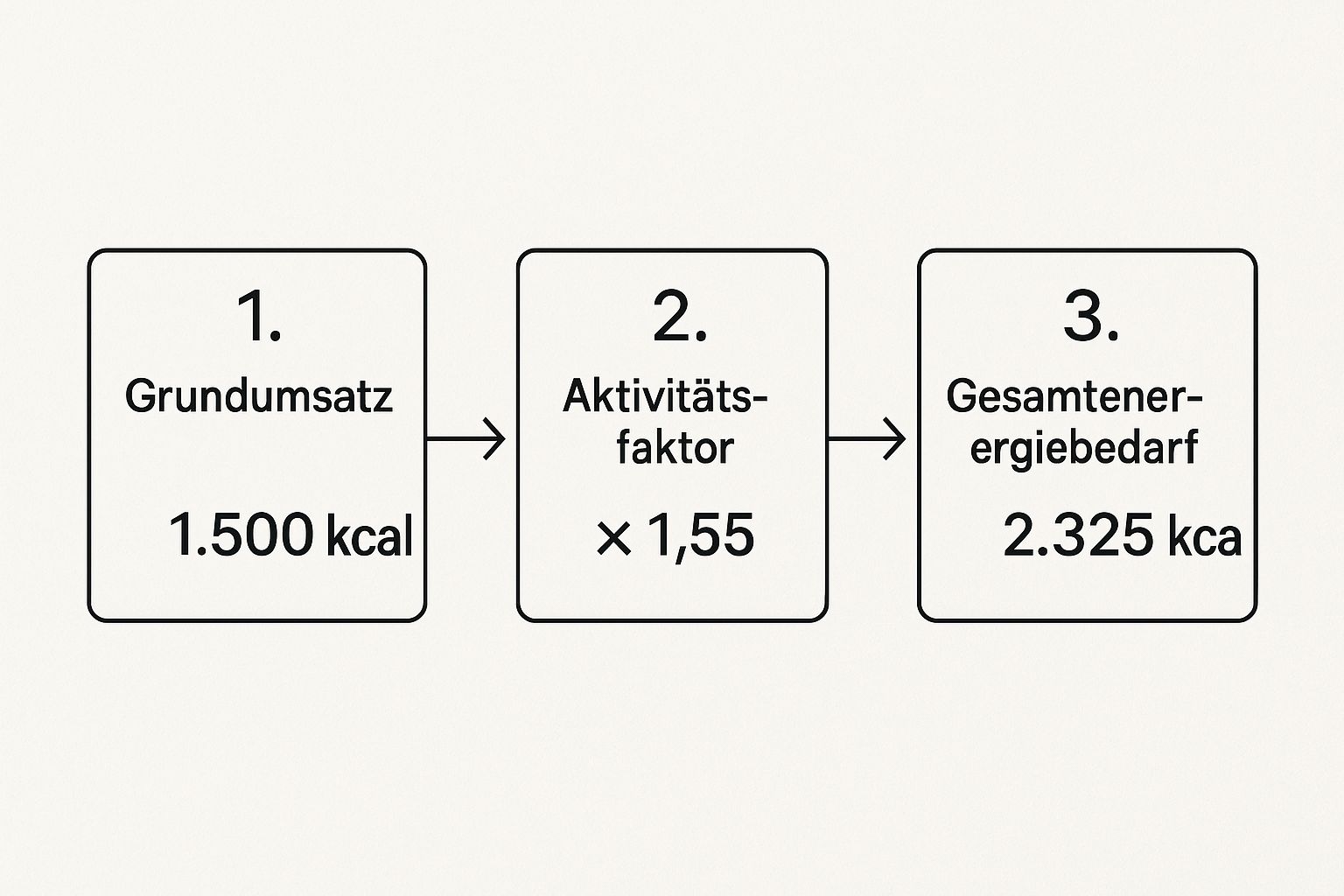
You can immediately see that your end result always consists of two parts: what your body consumes at rest, and what you additionally burn through your lifestyle.
With this result, you now have a solid foundation. If, for example, you want to lose weight, you logically need to stay below this value. We explain exactly how this works in our guide, where you learn how to calculate your calorie deficit for weight loss correctly.
Adjusting your calorie needs to your goals
Okay, so you have a number now – your personal total energy expenditure. That's a great starting point, but now the real work begins. This number isn't a rigid law, but your compass. With it, you navigate your body exactly where you want it to be, whether it's for losing weight or building muscle.
The mere calculation is only half the battle. The real magic happens when you now use this value specifically for yourself.
Losing weight? A smart calorie deficit is your friend
If you want to lose weight, you can't avoid a calorie deficit. This sounds more complicated than it is: You simply eat a little less than your body burns throughout the day.
For healthy and, above all, sustainable success, a deficit of 300 to 500 calories per day has proven effective. It shouldn't be more than that. Radical crash diets may promise quick results, but they usually lead directly to the yo-yo effect and slow down your metabolism.
A gentle deficit signals to your body to tap into fat reserves without panicking. If you want to know exactly how to implement this in practice, check out our article on how much weight loss per week is really healthy.
Very important: Make sure you get enough protein so that your body doesn't start breaking down valuable muscle mass in a deficit. A high-quality protein shake, like those you can find on bodysperfect.com, can help you easily meet your needs and feel full longer.
Your body is clever: with too high a calorie deficit, it switches to "starvation mode" and holds onto energy reserves. A moderate deficit, on the other hand, signals that everything is fine and it can safely burn fat.
Building muscle? Give your body the right building material
If you want to build muscle, you need the opposite: a slight calorie surplus. Again, less is more. A moderate surplus of about 200 to 300 calories above your calculated needs is the perfect sweet spot.
This additional energy is essentially the building material your body needs for intense training and the repair and building of new muscle fibers. Simply eating much more won't get you there faster – too high a surplus usually just ends up as unwanted body fat on your hips.
Interestingly, conscious energy management is not only relevant for us personally. Efficiency also plays a major role at the national level. Learn more about the exciting connections between energy and economy in Germany.
Any more questions? Here are the answers
Now that you know the formulas and have calculated your calorie needs, detailed questions often arise. This is completely normal. Let's clear up the most common ambiguities so you can get started confidently and well-informed.
How accurate are these formulas, anyway?
Honestly? No formula is 100% perfect, but the Mifflin-St. Jeor formula comes pretty darn close to reality. For most people, it's a great starting point. But remember that it naturally cannot know your personal metabolic rate or genetic predisposition.
So, don't consider the result to be set in stone, but rather your personal starting value. Just observe for two to four weeks what happens. Does your weight stagnate or develop differently than planned? Then simply adjust your calories a little up or down.
Do I have to recalculate this every day now?
No, fortunately not! That would be far too much effort. Your calculated value is a solid guideline as long as your lifestyle doesn't fundamentally change.
A little practical tip: Recheck your calculation every few months. But at the latest, when something has really changed – for example, if you have lost 5-10 kg or have switched from an office job to physically demanding work. Then it's time for an update.
What else influences my energy needs?
Your body is not a simple calculating machine. Besides the big levers like weight and activity, there are a few other things that can play a role in calculating your total energy expenditure.
- Your muscle mass: Muscles are real energy furnaces. The more you have, the higher your basal metabolic rate – even if you're just lying on the couch.
- Hormones and stress: A stressful daily routine or hormonal fluctuations can really mess with your metabolism.
- Your sleep: Those who sleep well and sufficiently regulate their energy balance much better.
- Digestion itself: Yes, you read that right. Your body uses energy to process food. This effect is strongest with protein – another good reason to pay attention to a protein-rich diet.
As you can see, it's a combination of many factors. The calculated values are a powerful tool, but in the end, your body feeling remains the best guide.
Do you want to specifically support your body and ensure that you are optimally nourished even in a calorie deficit? BODY'S PERFECT products help you achieve your goals in a healthy and delicious way. Discover the right shakes and supplements for your journey now at https://bodysperfect.com.











































Share:
Why am I not losing weight despite a calorie deficit?
Konjac Root Powder: Your Natural Helper for Satiety and Weight Loss