


Have you tried countless diets, but the yo-yo effect just won't let up? Often, the problem isn't your willpower, but a strategy that simply doesn't suit your body. A metabolic type diet is all about this: your nutrition is adapted to your body's genetic needs. This is how sustainable and healthy weight loss works.
Why most diets fail for you
Does this sound familiar? You feel frustrated because diets that work wonders for others just don't work for you. Your friend raves about low carb and seems to lose weight effortlessly, while it only makes you feel sluggish and low on energy? This is no coincidence and certainly has nothing to do with a lack of discipline. The simple truth is: there is no one perfect diet for everyone.
Every person is unique – and that applies especially to metabolism. The idea behind the metabolic type diet is that your body has a genetically determined preference for how it best processes and uses the main nutrients – carbohydrates, proteins, and fats – for energy.
Imagine your metabolism like the engine of a car. A diesel engine won't get far with petrol; it breaks down. Similarly, your body needs the right "fuel" to run optimally, burn fat, and give you the energy you need for your day.
The three basic metabolic types
Even though the transitions are often fluid, we basically distinguish between three main types. Each of them needs a different balance of nutrients to get going properly:
- The carbohydrate type: Their body is a true master at burning carbohydrates quickly and efficiently. A diet rich in complex carbohydrates, moderate in protein, and rather low in fat usually works best for them.
- The protein type: Their metabolism prefers to draw its energy from proteins and fats. A low-carb, but protein and fat-rich diet often leads to great weight loss results here and ensures a long feeling of satiety.
- The mixed type: As the name suggests, this type is a healthy mix of both. They need a balanced intake of all three macronutrients and can adapt flexibly to different diets.
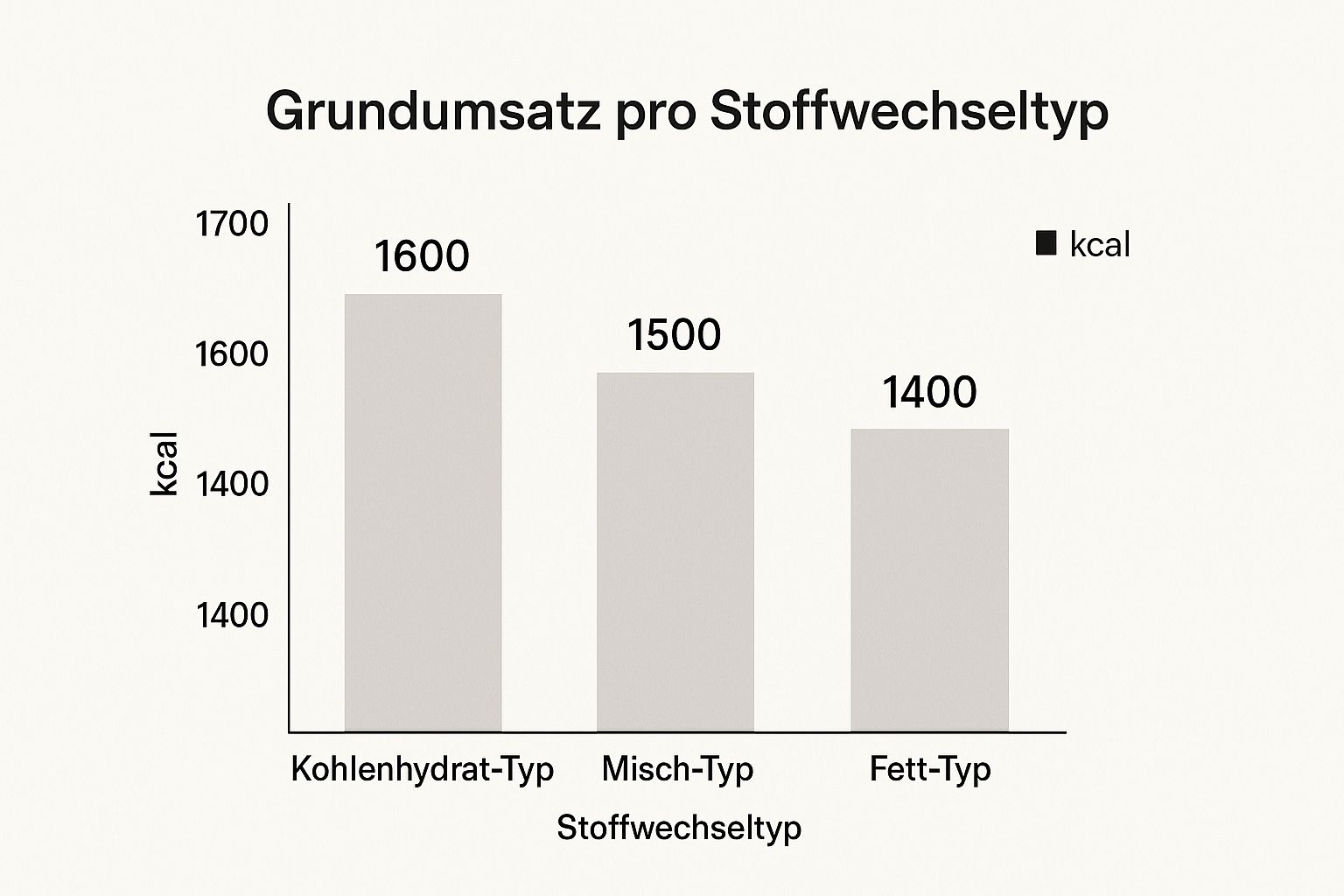
The graphic shows that genetic predisposition alone has a major influence on how many calories your body actually needs. This is the basis for any successful weight loss plan.
The three metabolic types at a glance
To make the differences even clearer, here's a quick comparison of the characteristics often associated with the three main metabolic types.
| Characteristic | Carbohydrate Type | Protein Type | Mixed Type |
|---|---|---|---|
| Body type | Rather slim, slender | Rather strong, plump | Athletic, defined |
| Best energy source | Carbohydrates | Proteins & Fats | Balanced mix |
| Best diet | High Carb, Low Fat | Low Carb, High Protein | Balanced (e.g. 40-30-30) |
| Satiety | Through complex carbs | Through proteins & fats | Through balanced meals |
| Problem areas | Less pronounced | More belly, hips, thighs | Variable, easily builds muscle |
Remember that these are general tendencies. Hardly anyone fits 100% into a single category.
Your body, your rules
A diet that doesn't suit you can lead to constant hunger, lack of energy, or stagnant weight. Once you know your metabolic type, you can stop guessing and finally give your body exactly what it needs. This is the key to finally beating the yo-yo effect and not only reaching your feel-good weight but also maintaining it long-term.
The issue of overweight is unfortunately widespread in Germany. According to a study by the Robert Koch Institute, about half of adults are overweight. 19% are even considered obese. These figures highlight how important personal approaches like the metabolic type diet are to counteract this healthily and effectively.
The first and most important step is therefore to better understand your own body. With this knowledge, you can make targeted and truly effective decisions for your diet. In addition, you will find valuable general weight loss tips in our guide. But first, it's about finding out what type you are to develop the perfect strategy for you.
Discovering your true metabolic type
Okay, now you know why the umpteenth diet often doesn't work and why your personal metabolic type is the key to success. But the big question remains: How do you find out if you are more of a carbohydrate, protein, or mixed type? The answer to this is your personal guide to a diet that finally works for you and not against you.

From rough estimates to hard facts
Sure, the internet is full of quick tests and questionnaires. They ask about your cravings, your body type, or how you feel after a portion of noodles. For a first impulse to think about your own body, such self-tests are quite nice. They can give you a rough direction.
The problem with that? They only scratch the surface and are based on your subjective perception. Your answers might be influenced by old habits or unconscious preferences. In the end, you get a well-meaning guess rather than a scientifically sound fact.
To truly understand how your body "ticks" at a genetic level, you need a method that goes deeper. This is where DNA analysis comes in – it is the most precise and objective way to uncover your true metabolic type.
DNA analysis: Your personal nutrition compass
Imagine you had a map of your metabolism in your hand. One that shows you exactly which paths your body prefers to use to gain energy. A genetic analysis is nothing less: it takes a direct look into your blueprint and provides you with facts instead of assumptions.
Science is also increasingly concerned with aligning nutrition with genes. The metabolic type diet is supported by genetic analyses that are intended to enable truly personalized nutrition. For example, a much-noticed study by Stanford University with 609 overweight participants investigated how genetic characteristics influence the success of diets. In Germany, the use of such tests is strictly regulated by the Genetic Diagnostics Act. Reputable providers like BODY'S PERFECT therefore focus on analyzing very specific gene variants (SNPs) to find out how your body individually deals with fats, carbohydrates, and proteins.
Your path to clarity with BODY'S PERFECT DNA metabolic tests
We at BODY'S PERFECT want to make accessing this knowledge as easy as possible for you. Our BODY'S PERFECT DNA metabolic tests have been developed precisely for this purpose: to give you clear and, above all, actionable insights into your body. The whole process is incredibly straightforward and you can do it conveniently from home:
- Child's play sample: You receive a test kit with everything included. With a cotton swab, you simply take a saliva sample from the inside of your cheek. This is absolutely painless and takes less than a minute.
- Free return shipping: You pack the sample in the enclosed envelope and send it back to our certified partner laboratory in Germany.
- Detailed evaluation: After a few weeks, the time has come: You receive your personal and clearly prepared evaluation. In it, we explain exactly what your genes reveal about your metabolism.
Our analysis specifically looks at the gene markers that are demonstrably related to the utilization of the three main nutrients. You will learn in black and white whether your body is genetically able to use fats or carbohydrates better as an energy source. This knowledge is the crucial building block to put your metabolic type diet on a solid foundation and finally find the nutrition that feels right for you. If you want to learn more about the different methods, read our detailed article on how to determine your metabolic type.
Developing your personal nutrition strategy
Okay, now it gets exciting. You now know what metabolic type you really are – that's the most important information you need for your success. But how do you implement all of this in everyday life without losing your head? That's exactly what this is about. I'll show you how to practically translate the results of your DNA analysis into your daily eating habits and finally start a metabolic type diet that works for you.

Forget rigid rules and general diet plans. From now on, it's about finding a diet that feels good, tastes good, and gets you to your goal. The focus is not on deprivation, but on specifically choosing foods that your body can best utilize. This way, you get your metabolism going and finally feel energetic and well again.
Aligning macronutrients with your type
The result of your BODY'S PERFECT DNA metabolic test gives you a clear recommendation for the ideal ratio of carbohydrates, proteins, and fats. This is essentially the blueprint for your personal nutrition plan.
Imagine your genetic evaluation as your body's personal recipe book. It tells you exactly which ingredients you need and in what ratio to "cook" meals that not only fill you up but also do you good and help you progress.
The following table shows you what a typical nutrient distribution might look like. Remember: this is a great starting point. Your personal values from the analysis may deviate slightly, but this will give you a first feel for it.
Example of nutrient distribution by metabolic type
This table shows typical percentage distributions of macronutrients that can serve as a starting point for your personal diet.
| Metabolic Type | Carbohydrates (%) | Proteins (%) | Fats (%) |
|---|---|---|---|
| Carbohydrate Type | 50–60 % | 20–25 % | 20–25 % |
| Protein Type | 20–30 % | 40–50 % | 30–35 % |
| Mixed Type | 35–45 % | 30–35 % | 25–30 % |
Don't view these numbers as rigid laws, but as helpful guidelines. Use them to plan your meals and feel what does your body good.
Choosing the right foods for your type
Once you know the percentage distribution, it's time for practical implementation. Which foods are best for you?
For the Carbohydrate Type Your body is a master at processing carbohydrates. But that's not a free pass for sugar and white flour! Instead, choose smartly:
- Complex carbohydrates: Whole grain bread, oatmeal, quinoa, and legumes are your friends. They provide you with long-lasting energy and keep your blood sugar stable.
- Plenty of vegetables and fruits: You can load up on these. They provide you with vitamins and important fiber.
- Lean protein: Chicken breast, fish, or tofu perfectly round off your meals and ensure satiety.
For the Protein Type Proteins and fats are your fuel. A carbohydrate-reduced diet helps you stay full and satisfied and avoid cravings.
- High-quality proteins: Meat, fish, eggs, and dairy products should form the basis of your meals.
- Healthy fats: Avocados, nuts, seeds, and good oils like olive or coconut oil are worth their weight in gold. They fill you up and give you energy.
- Low-carb vegetables: Green leafy vegetables, broccoli, cauliflower, or zucchini fill your plate without breaking your carbohydrate budget.
For the Mixed Type You are the flexible all-rounder. For you, a balanced mix of all three macronutrients is ideal.
- Balance is everything: Combine a good protein source (e.g., salmon), healthy fats (e.g., olive oil), and a moderate portion of complex carbohydrates (e.g., a few sweet potatoes) with every meal.
- Listen to your body: Some days you might need a little more carbohydrates for energy, on others, proteins feel better. You have the freedom to adjust your diet to your daily needs.
Your exemplary daily plan
To make it easier for you to start, here's a little inspiration for what your day could look like.
- Breakfast: Greek yogurt with berries and a few nuts (protein/mixed type) or a delicious porridge with fruit (carbohydrate type).
- Lunch: A large salad with chicken breast and avocado dressing (protein/mixed type) or a hearty lentil and vegetable soup with a slice of wholemeal bread (carbohydrate type).
- Dinner: Pan-fried salmon fillet with broccoli and a dollop of herb quark (suitable for all types, simply adjust portion sizes).
These are, of course, just suggestions. Use them as inspiration and adapt everything to your taste. The key to a successful metabolic type diet is to find a routine that you can stick to long-term and with pleasure.
Boosting metabolism with the right exercise
Have you perfectly aligned your diet with your metabolic type diet? Fantastic, that's half the battle and the most important foundation for your success! But to unleash your body's full potential, a crucial factor comes into play: the right kind of exercise.

The same principle applies here as with nutrition: not every sport is equally suitable for every metabolic type. To truly get the best out of yourself, you should also adapt your training to your genetic predisposition.
Training for the protein type
As a protein type, your body is a true specialist in drawing energy from proteins and fats. Your great strength lies in building muscle – and you should definitely use that to your advantage.
Strength training is your absolute key to success. Why? Because muscles are real calorie burners that even burn energy at rest. Every pound of muscle mass you build increases your basal metabolic rate and makes losing weight so much easier.
- Your focus: Classic strength training with weights, bodyweight exercises like push-ups and squats, or even an intensive circuit training.
- Your goal: Stick to moderate repetitions of about 8–12 repetitions per set. This is the ideal stimulus for muscle building (hypertrophy).
- The addition: Short, intense cardio sessions like sprints or HIIT (High-Intensity Interval Training) perfectly complement your training without compromising your hard-earned muscles.
For you, muscle building is more than just a matter of aesthetics. It's the best strategy to permanently get your metabolism working at full speed.
Exercise for the carbohydrate type
Your metabolism is a true master at converting carbohydrates into energy in a flash. This ability makes you a born endurance athlete.
While long, heavy strength training isn't as effective for you, you'll really get your metabolism going with continuous movement.
- Your focus: Endurance sports like jogging, cycling, swimming, or even brisk walking.
- Your goal: Plan longer sessions at a moderate intensity, where your pulse is consistently slightly elevated. At least 30 to 45 minutes per workout are ideal to really kickstart fat burning.
- The advantage: Endurance training not only strengthens your cardiovascular system but also improves your body's ability to process sugar efficiently and keep blood sugar levels stable.
Would you like to learn more about how you can support your metabolism holistically? In our guide, we show you how you can naturally boost your metabolism.
The Perfect Balance for the Mixed Type
Congratulations, as a mixed type, you are the flexible all-rounder among metabolic types! Your body can efficiently derive energy from carbohydrates, fats, and proteins. That's precisely why a colorful mix of strength and endurance training is the best strategy for you.
You simply snatch the benefits from both worlds: You build muscle, which increases your basal metabolic rate, and at the same time improve your fitness and boost fat burning. It doesn't get any better than that!
- Your Focus: A balanced mix of strength and endurance training. For example, you could schedule strength training two days a week and complete an endurance session on two other days.
-
Here's what a week could look like:
- Monday: Upper body strength training
- Tuesday: 45 minutes of running
- Thursday: Leg strength training
- Saturday: 60-minute bike tour
- A good alternative: Circuit training or CrossFit-like workouts that directly combine strength and endurance exercises and provide plenty of variety.
By adapting your training to your metabolic type, you work with your body instead of against it. The result? You achieve your goals not only faster but also more sustainably and with much more joy in movement.
Overcoming typical hurdles and staying motivated
Every dietary change, even the metabolic type diet perfectly tailored to you, has its pitfalls. This is completely normal and human. What's crucial is not if something goes wrong, but how you deal with it. See this section as your personal little coach, helping you to clear away the usual stumbling blocks.
Let's be honest: there will be days when you feel like throwing in the towel. Perhaps nothing is happening on the scale, cravings are knocking at the door, or a dinner invitation is messing up your plans. The most important thing is to be prepared for this and to know: it's part of the process.
The fight against the weight plateau
You are following your plan precisely, but the number on the scale simply won't change for days? Don't panic – you've reached a plateau. This is actually a good sign, as it means your body has gotten used to the new routine. Instead of giving up in frustration, now is the right moment to introduce new stimuli.
Often, a small adjustment is enough. Take an honest look at your portion sizes. Sometimes a little more sneaks onto the plate unnoticed. Another effective method: bring some variety into your sports program. This challenges your metabolism anew.
A weight plateau is not a failure, but a turning point. Your body is showing you that it's ready for the next step. Use it as an opportunity to refine your strategy and better respond to your needs.
Enjoying social events without stress
Invitations to dinner, restaurant visits, or family celebrations often feel like the biggest obstacles. The worry of being a spoilsport or constantly having to say "no" can be quite stressful. But don't worry, there are simple tricks to keep your goals in mind and still have a great time.
- Good preparation is half the battle: Eat a small, type-appropriate meal at home before you go. This way, you won't arrive hungry and will make more conscious decisions.
- Become the host yourself: If you invite friends, you have complete control over the menu. This way, you can cook something delicious for everyone that perfectly suits your metabolic type.
- Be open and honest: Simply explain briefly to your friends or the host that you are currently paying attention to your diet. You will be surprised how much understanding most people show you.
When cravings strike
That sudden, uncontrollable desire for chocolate, pizza, or other things that aren't currently on your plan? This is often your body's cry for certain nutrients or simply an old habit. Instead of blindly giving in, pause for a moment and ask yourself what you really need.
Behind the craving for sweets often lies only the desire for quick energy. A small, type-appropriate snack can work wonders here – a handful of nuts for the protein type or a few berries for the carbohydrate type. Simply give your body time to get used to the new, better fuel. It's not about prohibitions, but about building a healthy relationship with food that is based on knowledge and self-care.
This understanding will also help you in the long run to avoid the dreaded yo-yo effect. You can also read how to permanently break this vicious cycle in our guide on losing weight without the yo-yo effect. Ultimately, it's about creating new, healthy habits that make you motivated and happy.
Frequently Asked Questions about the Metabolic Type Diet
Finally, we want to clarify a few questions that we are asked again and again. It's about the metabolic type diet and DNA analysis, and we want to make sure you start with a good and secure feeling. Here you will hopefully find the answers you were still looking for.
Of course, a dietary change raises questions. Perhaps you're thinking: How quickly will I see results? Or: Do I have to give up everything I love now? These thoughts are totally normal and the first step towards a better body feeling.
How quickly will I see results with a metabolic type diet?
That's probably the most frequently asked question, and the honest answer is: It varies from person to person. However, many people already feel a real energy boost in the first one to two weeks and simply feel better. Your body finally gets the fuel it can best utilize, and you often quickly notice this in more energy in everyday life.
When it comes to losing weight, i.e., visible success on the scale or with a tape measure, it usually takes about two to four weeks. Just give your body a little time to get used to the new nutrient distribution and to properly adjust its metabolism.
Patience truly is your best friend here. It's about sustainable change, not a crash diet that ends in a yo-yo effect. Your body needs this time to adapt.
Do I have to give up everything I like on this diet?
No, absolutely not! That's an old myth that persists. The metabolic type diet is not about prohibitions or strict rules. It's about focusing on the foods that your body can process best.
You learn which foods truly give you strength, keep you full for a long time, and prevent cravings. But that doesn't mean there's no room for a piece of cake or a pizza with friends. It's about a flexible diet that fits into your life – not a short-term battle against yourself.
Is a DNA analysis really necessary for metabolism?
It's not necessary in the classical sense, but it is by far the most accurate and scientific way to unequivocally determine your metabolic type. Questionnaires or body type analyses can give a rough direction, but they are often based on very subjective assessments.
A DNA analysis, such as the one offered by BODY'S PERFECT, saves you the often frustrating guessing and experimenting. You get a clear, genetic basis for your diet. Instead of fumbling in the dark, you have a clear roadmap from the beginning, promising the best chances of success.
What happens after I receive the results of my DNA test?
Once you have your evaluation in hand, you hold the key to your metabolism. You'll then know exactly how your body reacts to carbohydrates, fats, and proteins – not because someone suspects it, but because it's in your DNA.
But we won't leave you alone with the data. Your report translates this information directly into practice. You get concrete recommendations, food lists, and a precise breakdown of your macronutrients, all perfectly tailored to you. This is the basis on which you can specifically optimize your diet and finally achieve your goals. By the way, you can find many more answers to general questions in our comprehensive FAQ section.
A good example of how powerful such an individual diet can be is the ketogenic diet. It is becoming increasingly popular in Germany for losing weight or managing metabolic problems. In this diet, the body is put into a state called ketosis and uses fat instead of carbohydrates as its primary energy source. This is particularly ideal for people whose metabolism simply doesn't cope well with a lot of carbohydrates. If you want to know more about how this special metabolic state works, Wikipedia offers interesting insights into the ketogenic diet. This once again shows: a diet that suits one's own type can move mountains.
Are you ready to stop guessing and start your very personal journey to more well-being and your desired weight? We at BODY'S PERFECT support you with scientifically sound analyses.
Discover the DNA metabolic tests now and find out what's really in you.








































Share:
Glucomannan Capsules: Your Natural Aid on the Way to Your Desired Weight
Test your metabolic type: The scientific path to your feel-good weight