


You've tried countless diets, but the big success either fails to materialize or only lasts a short time? You're definitely not alone. The problem is usually that standard diets work on a one-size-fits-all principle – one plan for everyone. This simply can't work in the long run because it completely ignores your individual biology.
Why typical diets often fail

Imagine your metabolism as a unique fingerprint. It's as individual as you are and reacts to food very differently from your friends' or colleagues' metabolisms. While one person gets along great with carbohydrates and loses weight, another might immediately store them as fat pads.
General diet rules from magazines or online guides cannot capture this biological uniqueness. They rely on pure averages and completely disregard your personal genetic predispositions.
The frustration with general diet tips
The problem with such blanket plans is obvious: they often lead to frustration and the feeling of personal failure. But it's not due to your willpower, but simply the wrong method. This vicious cycle of strict dieting and subsequent relapse is a typical consequence. That's why it's so important to understand the true causes in order to sustainably lose weight without the yo-yo effect.
Figures confirm that the desire for a functioning solution is huge. In Germany, almost every second adult wants to lose weight, and around 49% have already tried a diet. The most common reasons for this are discomfort in one's own body (57%) and health concerns (42%). This clearly shows how much effective, personal strategies are needed.
To clarify the differences, here's a small comparison:
Comparison of standard diet and personalized nutrition
This table shows the key differences between a generic diet approach and nutrition based on a metabolic test.
| Feature | Standard Diet | Personalized Nutrition |
|---|---|---|
| Approach | “One-size-fits-all”, based on averages. | “One-size-fits-me”, based on your DNA. |
| Basis | General rules and trends. | Scientific analysis of your metabolism. |
| Chance of success | Often short-term, high risk of yo-yo effect. | Sustainable, as the body gets what it needs. |
| Motivation | Often frustrating, as results fail to appear. | Motivating due to visible and noticeable successes. |
| Focus | Calorie counting and deprivation. | Optimal nutrient utilization and well-being. |
As you can see, a personalized approach isn't about eating less, but about eating the right thing.
A personal roadmap instead of blind guesswork
A metabolic test for weight loss provides you with exactly this fundamentally different approach. Instead of fumbling in the dark and trying one diet after another, you receive a scientifically based roadmap that is precisely tailored to your body.
A metabolic test is not another diet, but an instruction manual for your body. It shows you how to work with your biological system instead of fighting against it.
It analyzes exactly how your body processes the three main nutrients – fats, proteins, and carbohydrates. With this knowledge, you can adjust your diet to support your goals instead of sabotaging them. This makes the path to your desired weight not only more effective but also feels much easier.
Understanding and utilizing your metabolism correctly
If you want to lose weight, it's crucial to see your metabolism not as an adversary, but as your most important partner. This is where a metabolic test comes in, because it provides you with the facts you need. Imagine it as a very personal user manual for your body – a look behind the scenes that tells you how your internal machinery really ticks.
Instead of fumbling in the fog of general diet tips, you get tangible data. The test shows you how well your body converts the three main nutrients – carbohydrates, fats, and proteins – into energy, or whether it tends to store them as fat pads. This one insight can be the turning point that frees you from the endless cycle of dieting and frustration.
What a metabolic test really measures
A metabolic test for weight loss is not hocus pocus, but based on scientific facts. Depending on the type of test, very different things are analyzed. You can imagine it like a car workshop: sometimes the mechanic looks at the engine itself (your DNA), at other times he measures the current fuel consumption (your breath gases).
Two common methods are particularly widespread:
- DNA analysis: Here, your genetic predisposition is examined. Your genes determine from birth how your body functions. Are you naturally more of a "carbohydrate type" or a "fat type"? Your DNA can provide information about this.
- Breath gas analysis (Spirometry): This test measures your metabolism in the here and now. You breathe into a special device that analyzes how much oxygen your body takes in and how much carbon dioxide it releases. From this, your exact resting metabolic rate can be determined – i.e., the amount of calories you burn when you're just lying on the couch.
A metabolic test translates the unique language of your body into understandable instructions for action. You learn not only what you should eat, but also why.
With this knowledge, you can finally make informed decisions. For example, you'll find out whether a low-carb diet makes biological sense for you at all, or whether you might need more healthy fats to get your engine going. This way, you can specifically naturally boost your metabolism and use it for your goals.
Instead of blindly counting calories, you start to adapt the quality of your diet to your very personal needs. This not only leads to more sustainable weight loss, but also gives you more energy and a better body feeling in everyday life. Finally, you work with your body instead of fighting it with unsuitable diets.
Finding the right metabolic test for you
Anyone looking for the right metabolic test for weight loss often feels overwhelmed. DNA analysis, blood test, breath gas analysis – the offer is large and every test promises unique insights. But which one is right for you? To shed some light on the matter, let's take a closer look at the three most common methods.
Simply imagine the different tests as tools. A hammer is great for driving a nail into the wall, but for a screw you need a screwdriver. In the same way, each test has its own strengths, depending on exactly what you want to find out about your body.
DNA Metabolic Analysis
DNA analysis is essentially the blueprint of your body. It looks at your genes and reveals what predispositions you have. The great thing about it: Your genes don't change, so the results are valid for life.
- How it works: Totally uncomplicated. You take a saliva sample at home with a cotton swab and send it to the lab.
- What you learn: You learn how your body naturally processes fats, carbohydrates, and proteins. These insights help you understand your personal metabolic type.
- The cost: With prices starting at around 100 to 200 euros, this is a one-time investment in your knowledge about yourself.
- The advantages: You get fundamental information about your genetic predispositions that is always accurate.
- The disadvantages: The test does not show how your current lifestyle affects your metabolism.
Important to know: A DNA analysis is the perfect starting point for a long-term nutritional strategy that truly suits your biology. It provides you with the rules of the game, so to speak, according to which your body functions.
Once you know these genetic basics, you might want to know what's currently going on in your body. This is where the other tests come in. If you want to delve deeper into how to practically use this genetic information, we explain how to determine your metabolic type in another article.
The blood test, for example with Metabolic Balance
A blood test, as often used for programs like Metabolic Balance, is a snapshot of your metabolism. It analyzes over 30 blood values and can thus reveal imbalances or deficiencies.
- How it works: You have to go to a doctor or naturopath to have blood drawn.
- What you learn: An individual nutrition plan is created based on your current blood values.
- The costs: Significantly more expensive, often several hundred euros, but usually professional support is also included.
- The advantages: Very detailed and takes your current state of health into account.
- The disadvantages: The result is only a snapshot. Since blood values can change, the test may need to be repeated.
Breath gas analysis or spirometry
Spirometry measures how many calories your body burns at complete rest – this is your basal metabolic rate. To do this, you simply breathe into a special device through a mouthpiece for a few minutes.
- How it works: Often offered in fitness studios, by nutritionists, or doctors.
- What you learn: You get an exact number for your daily calorie requirement at rest.
- The costs: Prices vary greatly, usually between 50 and 150 euros per measurement.
- The advantages: Provides very precise information about your current calorie consumption.
- The disadvantages: Says nothing about nutrient utilization and must be repeated if you change your lifestyle (e.g., exercise more).
This graphic shows you, like a small decision tree, how to get from your basal metabolic rate and activity level to the appropriate calorie goal.
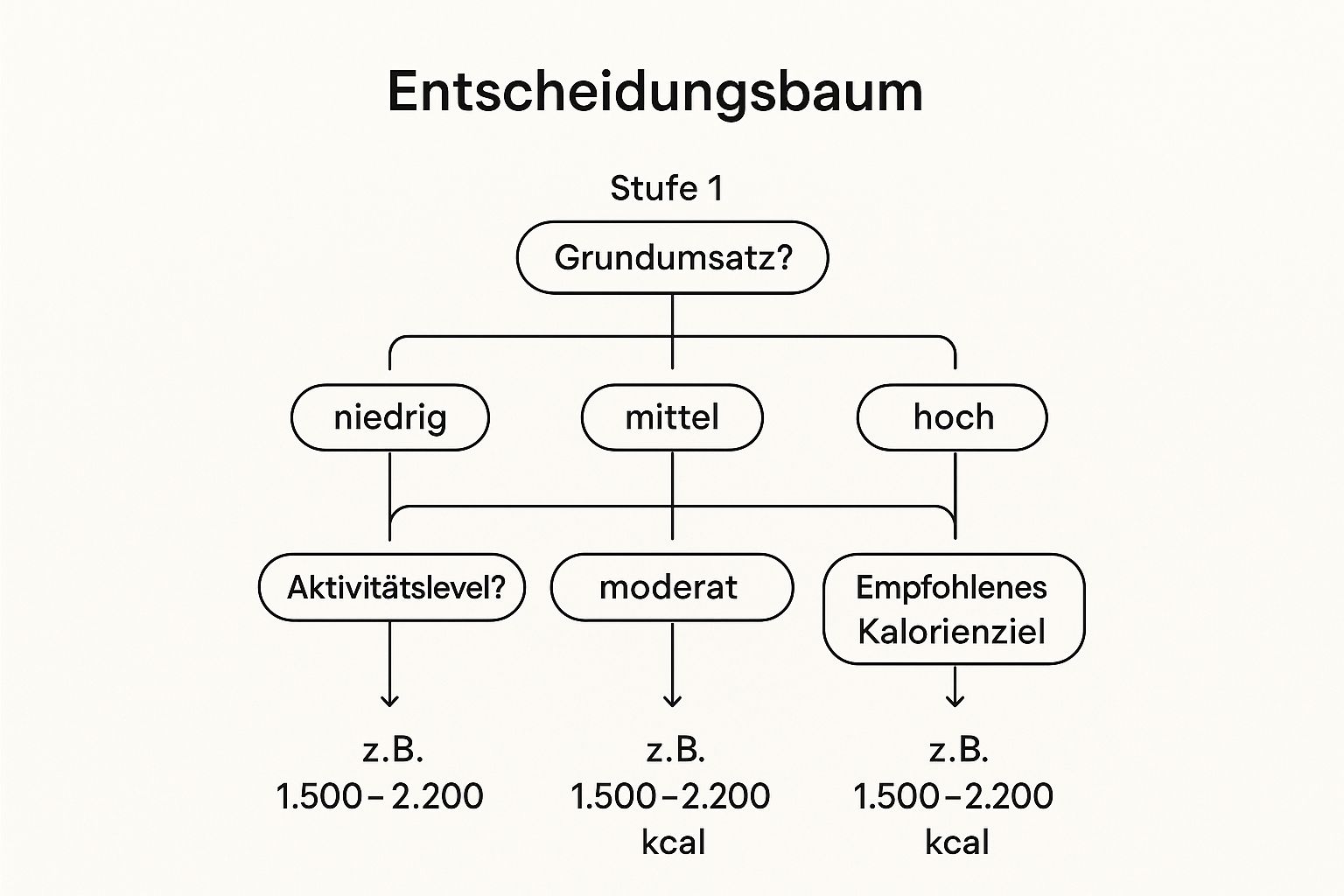
The graphic clearly shows: The recommended calorie target depends heavily on you personally. A general value for everyone rarely leads to success.
From test result to your personal nutrition plan

So there it is, the moment of truth: You hold the result of your metabolic test in your hands. A milestone on the way to your desired weight! But what now? You can imagine this data as a treasure map for your own body. Without good instructions, however, the treasure remains hidden. This is where the real work begins – translating scientific findings into a plan that also works in everyday life.
The key to success is to see the recommendations not as rigid, unchangeable rules, but as your very personal guardrails. It's about finally understanding your body better and giving it exactly what it really needs to burn fat efficiently. A metabolic test for weight loss provides the perfect basis for this.
Now let's get practical. Your result will primarily show you how your body reacts to the three major nutrient groups – carbohydrates, fats, and proteins.
From theory to practice: Here's how
Imagine your test shows that you are a "carbohydrate type." This is, of course, not a license for unlimited amounts of pasta and white bread. Rather, it means that your body can particularly well use complex carbohydrates from whole grains, legumes, or vegetables for energy production.
Your meals could then look like this, for example:
- Breakfast: A bowl of oatmeal with fresh berries and a handful of nuts.
- Lunch: A colorful quinoa salad with lots of vegetables and chickpeas.
- Dinner: A smaller portion of sweet potatoes with lean chicken and broccoli.
It looks quite different for the "protein type." This person benefits more from a diet rich in proteins and healthy fats. This keeps you full for a long time and boosts your metabolism. Carbohydrates should play a smaller role here and mainly come from fiber-rich sources.
Your metabolic profile is not a judgment, but a tool. It gives you the opportunity to design your diet in such a way that you feel energetic and lose weight at the same time – and all without constant hunger.
It's also well-documented that this personal approach works better than general diets. A study on the Metabolic Balance program, which is also based on an individual analysis (of blood values here), showed impressive results: Over 62% of participants reduced their weight by at least 5% and were able to maintain this new weight for at least one year.
Your individual exercise plan
But it's not just about food. Your metabolic profile can also give you clues as to which sports are most effective for you personally. Does your body need short, intensive sessions like HIIT (High-Intensity Interval Training) to get fat burning going? Or is it rather the extended endurance sessions like jogging or cycling that it responds to best?
Exercise recommendations depending on type could be:
- For the endurance type: Long, moderate sessions like running, swimming, or cycling, ideally 3-4 times a week.
- For the strength type: Strength training with weights to build muscle mass and increase basal metabolic rate (2-3 times a week), supplemented by short cardio sessions.
The right combination of food and exercise is your very personal recipe for success. It's about finding a lifestyle that fits your unique biology and that you can sustain long-term with joy and motivation. If you are looking for more inspiration, you can find valuable general tips for losing weight here, which you can perfectly combine with your new knowledge.
How to avoid common mistakes and stay on track long-term
A metabolic test for weight loss is a fantastic tool, but it's not a magic pill. Many make the mistake of believing that knowledge of their own metabolic type alone will shed the pounds. This is a fallacy that quickly leads to frustration and nullifies all success.
The real work begins after the test. The key is to consistently implement the recommendations, be patient with yourself, and honestly examine your own habits. Your test result is the personal map to your goal, but you have to walk the path yourself – step by step, every day.
Patience is your most important ingredient for success
One of the biggest pitfalls is false expectations. You may have lived according to certain patterns for years or even decades. It is simply not realistic for your body to completely change within a few weeks. Give it the necessary time to get used to and react to the new, optimized diet.
Set small, achievable interim goals instead of just staring at the single number on the scale. Celebrate the small victories: more energy in everyday life, better sleep, or your favorite pants suddenly fitting again. These are the true signs that you are on the right track.
Losing weight permanently is a marathon, not a sprint. Your metabolic test gives you the perfect equipment and the fastest route – but you have to bring the stamina yourself.
Precisely this mental attitude is crucial. Studies show that women in particular are often highly motivated when it comes to losing weight. However, this motivation must be channeled correctly so that it does not turn into frustration if success does not materialize overnight. Those interested in the psychological aspects of weight loss can find interesting insights in the ZAVA study 2024.
Typical stumbling blocks you should know about
To ensure that the investment in your metabolic test really pays off, you should definitely avoid these classic mistakes:
- Focusing solely on diet: Successful weight loss is teamwork. The best diet plan in the world can only help to a limited extent if exercise, good sleep, and stress reduction fall by the wayside. See your body as a whole.
- Misunderstanding the results: The evaluation of a test can be overwhelming at first glance. Without professional guidance, there is a risk that you will implement the recommendations too strictly or simply incorrectly. A conversation with a nutritionist or directly with the test provider is often golden here.
If you recognize and deliberately navigate these hurdles, you'll lay the best foundation. This way, you can use the insights from your metabolism test for weight loss not only to lose weight in the short term but also to find a permanently healthier and lighter lifestyle.
Frequently Asked Questions about Metabolism Tests

A metabolism test for weight loss sounds exciting, but naturally, many questions arise. Before investing money and time in your health, you want to know if it's really worth it. That's perfectly understandable.
That's why we've collected and answered the most common questions for you here – short, concise, and without technical jargon. This will give you the clarity you need for your decision.
How reliable is such a metabolism test really?
A very important question! The answer depends on two things: the type of test and the quality of the provider. A DNA test that examines your genes provides an extremely stable result. After all, your genetic predisposition is the same throughout your life.
Other analyses, such as a breath test or a blood analysis, are more like a snapshot. They show how your metabolism is ticking right now. However, this can change due to your diet, lifestyle, or even stress.
The most reliable results are achieved when an expert – for example, a nutritionist – evaluates the results for you. Professional support ensures that you not only understand the data but can also translate it into a plan that truly works for you.
Do I then have to stick to it for the rest of my life?
No, not at all! Don't see the result as a rigid law, but rather as your personal operating manual. It is a valuable guide that helps you make smarter decisions for your diet and lifestyle.
Your body is not a machine that always runs the same way. With age, more or less exercise, stress, or hormonal fluctuations, your metabolism also changes. Adjusting your plan now and then is therefore not only normal but absolutely necessary for your long-term success.
How much does a metabolism test for weight loss cost?
Prices can vary considerably. It all depends on the method and scope you choose.
- Simple at-home DNA tests: These are often the cheapest entry point. Prices start at around 100 to 200 euros. They provide a good overview of your genetic predisposition.
- Comprehensive analyses with support: Programs like Metabolic Balance, which are based on a comprehensive blood count and include personal support from doctors or consultants, can quickly cost several hundred euros.
So, when comparing, always look closely at what's included in the price. Professional evaluation and personal consultation cost more, but they also significantly increase your chances of success. If you have further questions, you might find an answer in our general FAQs about our products and services.
Does health insurance cover the costs?
In Germany, this is unfortunately the exception. Statutory health insurance companies usually view metabolism tests as individual health services (IGeL) or lifestyle products and therefore generally do not cover the costs.
With private health insurance or some supplementary insurances, this can be different. Depending on the tariff, partial or even complete reimbursement is possible. It's best to ask your insurance company directly before taking a test. That way, you'll be on the safe side.
Ready for the first step? Do you want to find out what really makes you tick and what your personal path to your desired weight looks like? At BODY'S PERFECT, we offer a detailed DNA metabolism test that provides you with the scientific basis for your success.
Discover the BODY'S PERFECT DNA test now at bodysperfect.com













































Share:
Metabolic Analysis Costs: Discover transparent & affordable options now
8 Best Natural Fat Burners for 2025: The Ultimate Guide