

DNA Test Nutrition: Optimizing Personal Diet
Imagine your DNA as a personal cookbook, written just for you. A DNA test for nutrition is like looking into that book. It reveals your body's secret recipes and helps us understand how you react to certain foods. This way, we can truly personalize your diet.
What a DNA Nutrition Test Really Reveals

Standard diets are often like one-size-fits-all clothing – they're supposed to fit everyone, but rarely do. Have you ever wondered why your friend loses weight so successfully with a low-carb diet, while you see little to no results? The answer might be hidden deep in your genes.
A DNA test for nutrition takes a closer look. It specifically analyzes the gene variants that control your metabolism of fats, carbohydrates, and proteins. The result is not a strict diet plan, but a scientifically sound insight into how your body works.
Your Personal Blueprint on a Plate
Imagine two people who both want to lose weight. Person A has a genetic predisposition to process fats rather slowly. Person B, on the other hand, struggles more with carbohydrates. A blanket "eat fewer carbohydrates" recommendation would likely be a bullseye for Person B, but probably a flop for Person A.
This is precisely where the DNA test for nutrition comes into play. It uncovers such highly personal predispositions.
A genetic test is not a miracle cure, but rather the blueprint for your success. It shows you which nutrients – fats, carbohydrates, or proteins – your body can utilize best and where it might struggle.
To help you grasp the most important points at a glance, we have summarized the core aspects in a table.
Overview of the DNA Nutrition Test
This table summarizes the core aspects and provides a quick overview of how it works.
| Aspect | What it means for you |
|---|---|
| Genetic Analysis | We examine specific genes that influence your metabolism of fats, carbohydrates, and proteins. |
| Individual Reaction | You learn what macronutrient type you are and how your body reacts to specific foods. |
| Personalized Recommendation | Instead of general diet rules, you receive recommendations tailored to your unique genetic predisposition. |
| No Strict Plan | It's not about prohibitions, but about finding the right foods for your body and optimizing your diet sustainably. |
Such a test therefore provides a solid basis for making informed decisions about one's own diet.
More Than Just Metabolism
Modern tests can often do more than just analyze the basics of metabolism. They provide valuable insights into many other areas of your diet and lifestyle.
These include, for example:
- Propensity for intolerances: Indications of a genetic predisposition for lactose or gluten intolerance.
- Need for vitamins & co.: Insights into a possibly increased need for micronutrients such as vitamin D or B12.
- Caffeine sensitivity: How quickly your body metabolizes caffeine – important information for all coffee lovers.
- Satiety: Insights into genetic tendencies that influence how quickly you feel full.
These insights make it much easier to specifically and, above all, sustainably change one's habits.
There is a great desire for such a personal approach. In fact, 47 percent of Germans believe that genetic tests could help them eat healthier.
At the end of the day, a DNA nutrition test provides a data-based foundation for making one's diet much more conscious and effective. If you are now curious about what is in your DNA, feel free to check out our DNA Metabolism Tests.
Understanding Your Personal Metabolic Type
A DNA test for nutrition does not dictate rigid rules. Instead, see it as a compass that points you in the direction of your optimal diet. Providers often summarize the complex results in so-called "metabolic types" or "metatypes" to make the genetic data more understandable and tangible.
However, do not think of these types as dry, scientific categories. Rather, view them as living profiles that transform abstract genetics into a practical guide for your daily life.
What Your Metabolic Type Really Means
A metabolic type basically describes how well your body can process the three main energy sources – carbohydrates, fats, and proteins. This predisposition is deeply rooted in your genes and can be the reason why some diets work great for you, while others simply do not lead to success.
Let's take Anna as an example. Her DNA nutrition test revealed that her body converts carbohydrates into energy particularly efficiently. For her, wholemeal bread, lentils, and oatmeal are true powerhouses that provide her with energy and keep her full for a long time.
And then we have Max. He is a classic fat-protein type. His body runs at full speed when his diet is rich in healthy fats and high-quality proteins. With nuts, avocado, fish, and lean meat on his menu, he feels energized and fit.
These examples illustrate how individual the path to the right diet can be.
Your genes are not your destiny, but they show you the path of least resistance. If you work with your body instead of against it, you will achieve your goals much more easily.
A Look Beyond Macronutrients
Determining your metabolic type is just the beginning. A good DNA test provides you with many other pieces of the puzzle that are crucial for your health and well-being.
- Vitamin and mineral requirements: Your genes can influence how well your body absorbs and utilizes certain micronutrients such as vitamin D, iron, or B vitamins.
- Sensitivities and intolerances: The test can provide clues about a genetic predisposition to lactose intolerance or increased sensitivity to gluten.
- Caffeine metabolism: Are you a "fast" or "slow" caffeine metabolizer? The result helps you better control your coffee consumption.
- Satiety: Some gene variants influence how quickly you feel full and whether you are more prone to cravings.
All this information combined paints a very detailed picture of your personal needs. This is particularly important as many people struggle with their weight and diet. According to the National Consumption Study II, approximately 66% of men and 51% of women in Germany are overweight, which clearly underscores the need for individual solutions.
With these insights, you can not only adapt the what but also the how of your diet. For example, if you want to specifically support your carbohydrate utilization, our information on the ingredients of our C-Block might be of interest to you. Thus, the DNA nutrition test becomes an effective tool for a sustainable and successful dietary change.
How Does Your DNA Nutrition Test Actually Work?
Perhaps you're considering a DNA nutrition test but are still unsure what exactly to expect. Don't worry, we'll guide you step-by-step through the process. You'll see: the path from ordering to your personal results is amazingly simple and straightforward.
The best part is that you can do everything comfortably from home. A doctor's visit or blood draw is not necessary, which makes the whole thing much more relaxed for most people.
Step 1: Uncomplicated Sample Collection at Home
As soon as your test kit arrives, it's time to get started – and this part is truly child's play. Taking the sample is completely painless and only takes a few minutes. Most of the time, there are two methods for this:
- Saliva sample: For this, you simply spit a little saliva into a small tube.
- Cheek swab: You rub a cotton swab briefly against the inside of your cheek.
Both methods are absolutely safe and provide enough cells to reliably examine your DNA. Each kit contains detailed instructions to ensure that nothing can go wrong.
The following graphic shows you the entire process at a glance – from the sample to the finished nutrition plan.
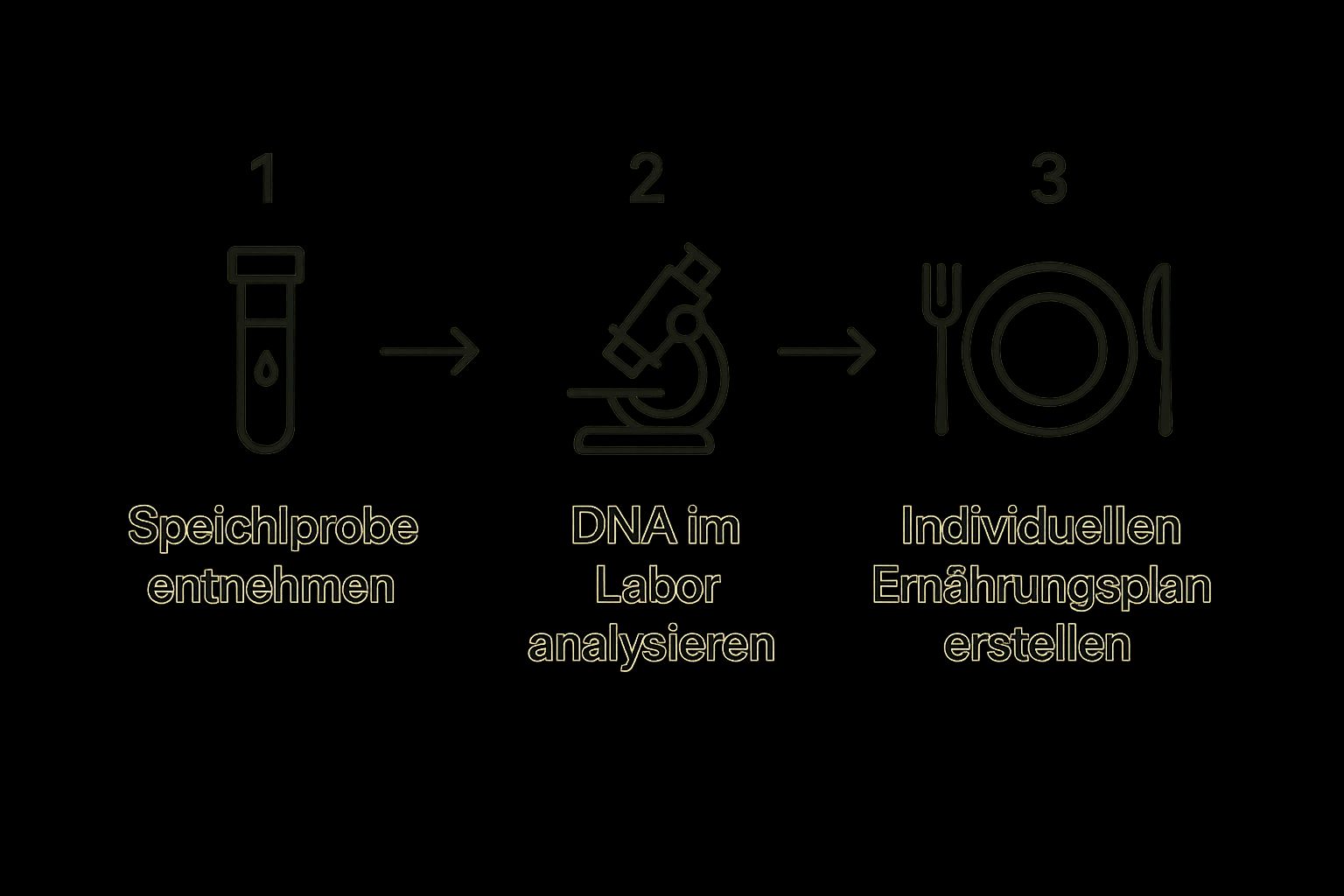
As you can see, the process is clear and logically structured. We want you to know exactly what happens when.
Step 2: Laboratory Analysis and Data Protection
Once your sample arrives at the lab, the actual scientific work begins. Specialized laboratories extract the DNA from your cells and specifically examine the gene variants that are important for your metabolism and diet. This usually takes a few weeks.
A crucial point here, of course, is data protection. After all, your genetic information is extremely personal.
Reputable providers in Germany and the EU are bound by the strict General Data Protection Regulation (GDPR). This means, specifically: your data must be anonymized or pseudonymized and may never be passed on to third parties without your express permission.
When choosing your provider, therefore, always pay attention to an understandable privacy policy, a company headquarters in the EU, and ideally also certified laboratories. This way, you are on the safe side.
After the analysis, your results are prepared and usually made accessible to you via a secure online portal or an app. For an even more detailed insight, you can view our DNA test instructions, which explain each step in detail.
What's Next? How to Implement Your Test Results in Everyday Life
A detailed report with all the data and graphics is a great thing. But honestly: without a clear plan, it remains just a piece of paper. The truly exciting part only begins now, when we translate these genetic insights into concrete, everyday habits. It's about finding the crucial levers for your nutrition from the flood of information.
The first step? Focus on the essentials. Nobody can completely turn their life around overnight. Pick the most important recommendations from your DNA nutrition test. Which food groups are particularly good for you according to your DNA, and which should you perhaps avoid?
The knowledge alone that you are a certain metabolic type does not get you any further. What matters is what you do with it and what ultimately ends up on your plate. See your results report as a kind of treasure map – it shows you the way to your personal feel-good diet.
From Knowledge to a Concrete Meal Plan
The key to success is to make theory tangible. For example, if your test shows that your body can utilize carbohydrates well, that doesn't mean you should only eat pasta. Rather, it's about choosing the right carbohydrate sources, such as whole grain products or legumes.
Let's make it concrete with an example. Imagine your result classifies you as a "fat-protein type." This means your body best derives energy from healthy fats and proteins.
A simple daily plan could then look like this:
- Breakfast: Instead of sugary cornflakes, there's Greek yogurt with a handful of nuts and berries.
- Lunch: A large salad with grilled chicken, avocado, and olive oil dressing replaces the classic white bread sandwich.
- Dinner: Instead of pizza, there's pan-fried salmon with steamed broccoli.
See? It's about clever swaps, not strict deprivation. With small adjustments, you are already eating in harmony with your genetic predisposition.
A DNA test gives you the "why." The "how" only emerges when you actively integrate the results into your meals. Every meal is an opportunity to make a conscious decision for your body.
Why Professional Help Can Make a Difference
Although the reports are very detailed, they sometimes raise questions. Perhaps you wonder how best to reconcile the recommendations with your personal preferences or a stressful everyday life. This is where professional nutritional counseling comes in.
An expert helps you interpret the results correctly and avoid misunderstandings. Together, you develop a plan that is not only based on your DNA but also on your goals, lifestyle, and taste. This combination of science and personal support is the best way to fully exploit the potential of your test.
Working with a professional ensures that you not only know what to do but also have the motivation and the right tools to stick with it. If you're curious and want to learn more about how your results are prepared, you can find more information about your personal DNA results and the next steps here. This way, your genetic roadmap becomes a real success.
Where DNA Nutrition Tests Reach Their Limits
A DNA nutrition test can be a really exciting tool. It gives you a scientifically sound direction for your diet and can provide you with real "aha!" moments. But to get the most out of the results, we also need to be honest about the limitations. It's important to understand that a genetic test is not a panacea and certainly does not diagnose diseases.
Rather, it shows you tendencies and probabilities. Advertising claims like "This test guarantees you'll lose 10 kilos" are not only unserious but simply wrong. See your genetic profile as an important piece of the puzzle – but only one of many that make up your health.
Your Genes Are Only Part of the Big Picture
Imagine your health as a complex mosaic. The DNA test highlights some of the central stones, but many others shape the overall picture just as strongly. Factors that are at least as crucial as your genes include, for example:
- Your lifestyle: How much do you move? How well and how long do you sleep? How do you deal with stress?
- Your current health status: Do you have pre-existing conditions? What does your hormone balance look like? All of this influences how your body processes food.
- Your gut health: The microbiome in your gut is a huge factor in how nutrients are absorbed by you at all.
- Epigenetics: Your environment and behavior can actually influence the activity of your genes without changing the DNA itself.
All these puzzle pieces work together and influence each other. A DNA test cannot capture all of this. That's why it's a fantastic building block, but never the sole solution.
A DNA test is the starting point, not the destination. It provides you with a personal map, but you walk the path to more well-being yourself – with every conscious decision on your plate and in everyday life.
That's precisely why a holistic view is so important. To get an even clearer picture, it can be very useful to also have classic blood tests done in addition to the DNA test for nutrition. These detect specific nutrient deficiencies, such as vitamin D, iron, or B12, which directly affect your well-being. Such analyses, which are often available for around 30 Euros, can wonderfully complement the genetic recommendations and underpin them with hard data. If you would like to know more about how to detect a nutrient deficiency, you can find good information here. This way, you gradually gain a truly comprehensive understanding of what your body currently needs.
Frequently Asked Questions About DNA Nutrition
As soon as the topic of DNA testing for nutrition comes up, many questions often swirl in one's head. That's completely normal. On the one hand, you're curious, on the other hand, perhaps a little skeptical – after all, it concerns very personal health data and an area that is still new to many.
That's why we're addressing the most common questions here. We want to give you honest and practical answers so that you can make a good decision for yourself. We'll look at the costs, what science says about it, and of course, the super-important topic of data protection.
What does a DNA nutrition test actually cost?
Of course, the first question is often about the price. A DNA nutrition test is an investment in your health, and prices can vary considerably depending on the provider and the scope of the analysis.
As a rough estimate, you can expect costs between €150 and €400. However, it is important to look closely at what you are getting for your money.
- Basic Packages: These usually focus on the genes that are crucial for the metabolism of fats, carbohydrates, and proteins. This tells you what your basic metabolic type is.
- More Extensive Analyses: If you want to delve deeper, choose an extended package. These tests often also look at whether you have a genetic predisposition for a higher need for certain vitamins or minerals, how sensitive you are to caffeine, or whether a tendency towards lactose intolerance is in your genes.
- Additional Services: Sometimes the price also includes extras such as personal nutritional counseling or a cookbook with suitable recipes. This can, of course, enormously increase the value of the test.
Ultimately, what is often true in life also applies here: a small comparison of offers helps to find the package that best suits your own goals and budget.
How scientifically sound are these tests anyway?
An absolutely legitimate and important question. The good news first: gene analysis itself, i.e. the pure reading of your DNA in the laboratory, is a long-established and absolutely reliable scientific process. The crucial point where good providers differ from less good ones is the interpretation of these gene data.
Nutrigenetics – the science that researches the interaction of genes and nutrition – is a relatively young field. But for some correlations, there is already very strong scientific evidence.
A prime example is lactose intolerance. The responsible gene variant is very well known, and the test results here are extremely reliable. The situation is similar for caffeine metabolism.
For more complex recommendations, such as the perfect way to lose weight, the study situation is sometimes not yet 100% clear. Reputable providers are open about this. They transparently explain the scientific basis of their recommendations and emphasize that the results are a valuable guide – but not a truth set in stone.
Are my genetic data safe?
Your DNA information is among the most sensitive data about you. Data protection must therefore be the top priority here. Providers who sell their tests in Europe must adhere to the strict General Data Protection Regulation (GDPR).
This means specifically for you:
- Anonymization: Your sample usually receives a number in the laboratory, meaning it is anonymized or pseudonymized. The laboratory therefore does not know whose DNA it is.
- No disclosure: Without your express consent, your data may never be passed on to third parties – especially not to insurance companies or employers.
- Secure storage: Pay attention to where the provider has its servers. Locations within the EU are a good sign, as data protection laws are significantly stricter here than elsewhere.
Take a moment to read the provider's privacy policy before ordering. It should be clear and easy to understand. If you have any further specific questions, take a look at our detailed FAQ section. There you will find further answers to help you.
Would you like to take the first step towards a diet that truly suits you? Discover a new way to achieve your goals with BODY'S PERFECT products, supported by high-quality products and insights from your own DNA. Start your journey to a better body feeling now at https://bodysperfect.com.






































Share:
Why a metabolism test can help you lose weight
Big Weight Loss Shake Test 2025: Which shake truly delivers on its promises?